

Governor Josh Shapiro signed a wide-ranging executive order on August 18 placing some of the nation's strictest requirements on data center development in Pennsylvania, with immediate implications for the Lehigh Valley, where dozens of proposed projects and months of community opposition have made the issue one of the region's most contentious local policy debates.
Key Provisions of the Order
The executive order converts the Governor's Responsible Infrastructure Development (GRID) framework from voluntary guidelines into binding requirements for any data center seeking state environmental permits. Developers must commit to paying for their own power supply, with an increasing share required to come from renewable sources such as solar, advanced nuclear, or battery storage. They must also hire locally, adhere to high water-conservation standards, and be fully transparent with host municipalities about the scope of proposed projects. Nondisclosure agreements for data center projects are now banned in Pennsylvania. Governor Shapiro described the order at signing as establishing the most stringent legal requirements for data centers of any state in the nation.
Fast-Track Permitting Eliminated
The order removes all data center projects from Pennsylvania's fast-track permitting program, which had previously allowed eligible projects to receive expedited state review. Going forward, any data center developer must first obtain local land use approval before the DEP will begin reviewing a permit application. Developers must also submit a notice of intent confirming compliance with all GRID requirements. Shapiro, who had championed streamlined data center permitting in his budget address earlier this year, cited the emergence of more than 100 speculative projects across the state as the reason for the course correction. Many of those proposals had not disclosed who would ultimately occupy the finished facilities.
That single sequencing change may be the order's sharpest edge in this region. For the past year, the fight over data centers in the Lehigh Valley has played out almost entirely in township meeting rooms, where zoning boards and planning commissions have absorbed the full weight of the opposition. Under the new order, those local decisions are no longer just the first hurdle. They are the gate that has to open before Harrisburg will even look at an application.
Reaction in the Lehigh Valley
Local reaction was swift. The South Whitehall Civic Alliance, which has actively opposed data center proposals near residential neighborhoods in its township, called the executive order “political damage control” and said it “serves only to throttle down the massive datacenter rush the Governor's own policies initiated.” The Lehigh Valley has seen a wave of municipal data center ordinances in recent months, with Allentown, Bethlehem, Upper Mount Bethel Township, and Whitehall Township among the communities that have passed or advanced local rules. How the new state requirements will interact with those already-enacted local ordinances remains to be clarified by state and local legal counsel.
What the Order Means for Project Atlas
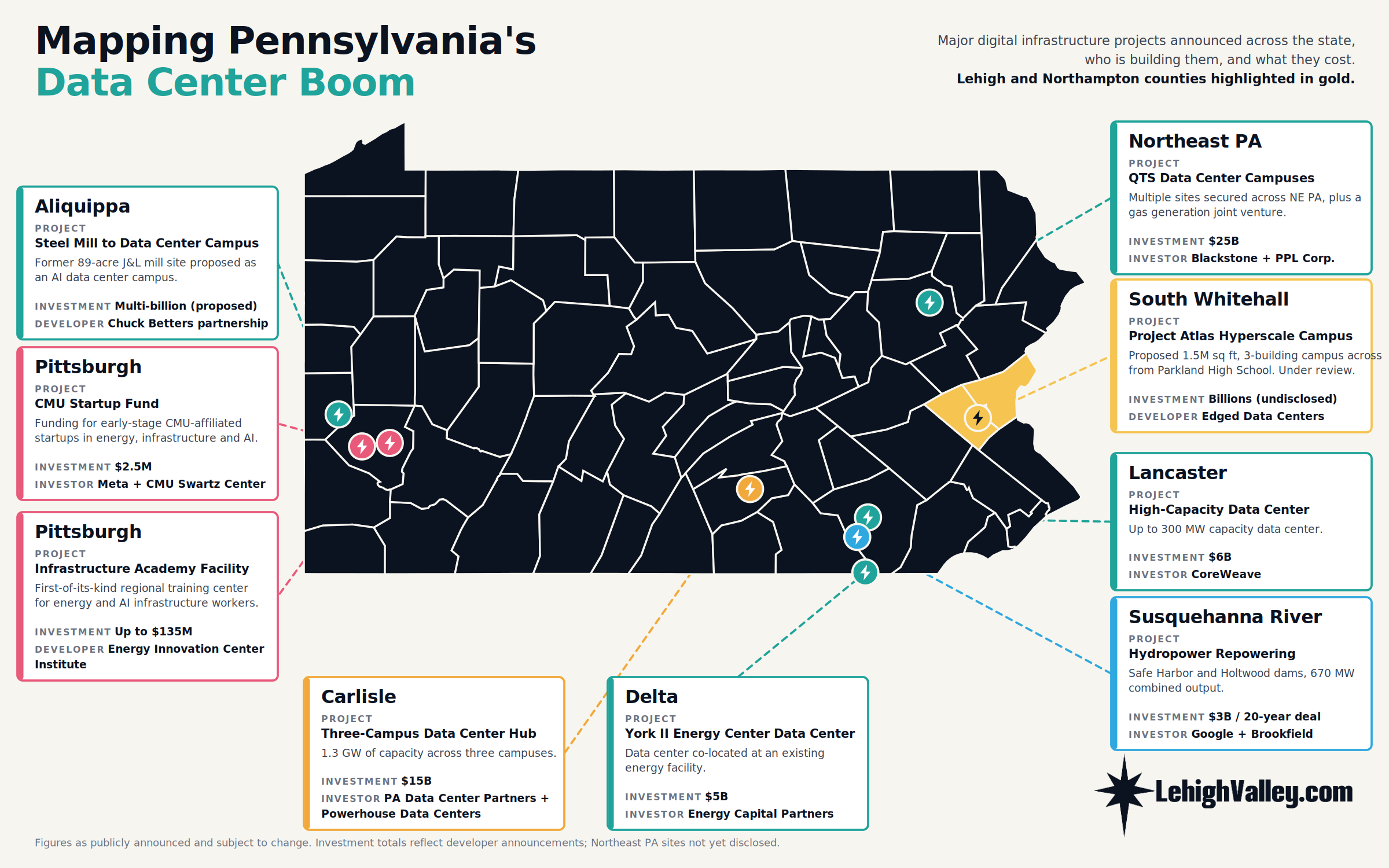
No local proposal tests the new rules more directly than Project Atlas. Developer Edged Energy has pitched a hyperscale campus of three data center buildings, an administration facility, and a warehouse along North Cedar Crest Boulevard in South Whitehall Township, roughly 1.5 million square feet across 410 acres. Edged has told the township the campus represents an $8.9 billion investment that would generate $99.5 million in annual economic activity and $16.5 million per year in local taxes. Township filings put its power draw at roughly 725 megawatts.
The project has drawn sustained opposition, in large part because it sits across from Parkland High School. When Edged brought its case to a packed auditorium at Springhouse Middle School, the planning commission postponed any formal vote rather than act in front of the crowd. Dr. David Caruth, a township resident and 20-year Verizon executive who has become the most visible face of the opposition, has framed his objection narrowly. “I am fundamentally anti-placement,” he said, describing a hyperscale campus as carrying “the equivalent energy scale of half a million homes.”
Several of the order's provisions map almost point for point onto the arguments residents have been making at those meetings: who pays for the power, how much water the cooling systems consume, and whether a municipality is told the full scope of what is being proposed. The order does not decide Project Atlas. It changes the order of operations around it.
Who Pays for the Power
The requirement that developers pay for their own power supply lands in the middle of an argument that has been running in the Lehigh Valley for more than a year. PPL Electric Utilities is the dominant electric utility across the region, and data center developers have expressed interest in more than 60 gigawatts of potential projects within PPL's Pennsylvania territory, with roughly 28 gigawatts already in advanced planning stages.
Households have been absorbing part of the cost of that build-out. On June 4, the Pennsylvania Public Utility Commission voted 5-0 to approve a settlement raising PPL's base distribution rates, adding about $6.48 a month, or roughly 3.23 percent, for a typical home using 1,000 kilowatt-hours. It was the utility's first base distribution increase since 2016. Consumer advocates and lawmakers have spent much of the year fighting over how much of the grid investment driven by AI computing should land on residential bills. By writing developer-funded power into the state's permitting conditions, the order takes a side in that fight.
A Water Standard in a Drought Year
The order's water-conservation requirements arrive in a county that is already short of water. On June 29, the Department of Environmental Protection upgraded Lehigh County from a drought watch to a drought warning, and the Lehigh County Authority asked customers to voluntarily cut water use by 10 to 15 percent. The authority draws roughly 27 million gallons per day from the Little Lehigh Creek, the Lehigh River, two natural springs, and a network of groundwater wells, all of them under simultaneous stress.
Water has been one of the most persistent questions at local hearings, though the answer varies by project. Edged has said its closed-loop cooling system for Project Atlas uses no water, a claim that has done little to settle the broader debate as more campuses are floated across the region.
The End of Nondisclosure Agreements
The ban on nondisclosure agreements addresses a complaint that has surfaced repeatedly in the Lehigh Valley, particularly in Lower Mount Bethel Township, where the relationship between municipal officials and data center developers has drawn intensifying backlash. Shapiro's stated reason for the broader course correction points the same direction: of the more than 100 speculative projects now filed across Pennsylvania, many never disclosed who would actually occupy the buildings. Under the order, a developer can no longer ask a township to keep the scope of a project confidential while that township weighs whether to approve it.
A Region Already Writing Its Own Rules
The order reaches a region that did not wait for it. The Lehigh Valley Planning Commission says at least 16 local governments are now working on data center rules. In Allen Township, supervisors have been advancing a data center overlay district that would confine such facilities to designated zones, even as developer Prologis obtained a state permit for a substation tied to a proposed facility there.
Not every proposal has survived that local scrutiny. On May 27, the Upper Macungie Township Zoning Hearing Board unanimously denied a request tied to a roughly 2.6 million-square-foot campus proposed for the 194-acre former Air Products site on Cetronia Road. State Sen. Jarrett Coleman told the board, “I don't think this is a good fit.” The practical effect of the executive order is to give the 16 municipalities now drafting ordinances something they did not have before: the assurance that a developer cannot route around them to Harrisburg for an expedited permit.
At a Glance
- Gov. Shapiro signed the executive order on August 18, 2026.
- GRID standards are now binding, not voluntary, for developers seeking state permits.
- Data centers are removed from Pennsylvania's fast-track permitting program.
- Local government approval must be obtained before state permitting can begin.
- Developers must fund their own power supply, with a rising share from renewables.
- Nondisclosure agreements for data center projects are banned in Pennsylvania.
- More than 100 speculative data center projects have been filed statewide.
- At least 16 Lehigh Valley municipalities are already drafting data center rules.
- South Whitehall Civic Alliance called the order “political damage control.”
More on Data Centers in the Lehigh Valley
- Data Center Proposals Spark Zoning Fights Across the Lehigh Valley
- South Whitehall Postpones 'Project Atlas' Data-Center Vote to August After Packed Meeting
- 'Anti-Placement, Not Anti-Data Center': Inside Dr. David Caruth's Fight to Stop Project Atlas
- PPL Bets Big on AI Data Centers as Lehigh Valley Electric Bills Climb
- A Drought Warning Meets a Data-Center Boom
- Allen Township Schedules August 11 Public Hearing on Ordinance to Create Data Center Overlay Zone