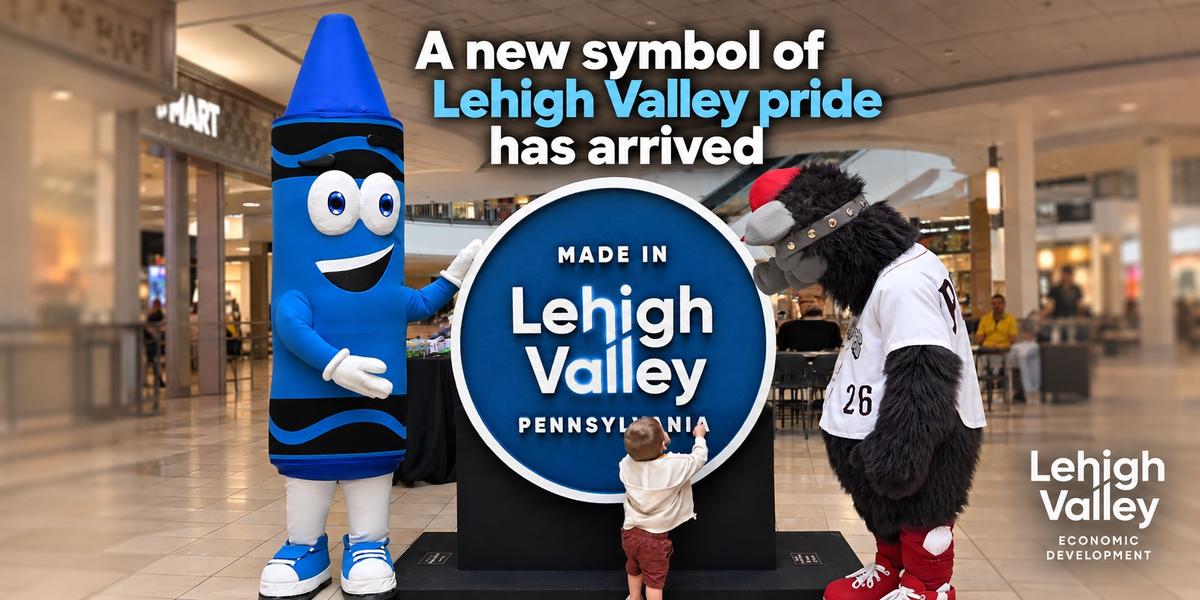
The newest attraction at the center of the Lehigh Valley Mall is six feet tall, seven feet wide, and says exactly where you are.
On Wednesday, the Lehigh Valley Economic Development Corporation unveiled a "Made in Lehigh Valley" logo sculpture in the mall's center court, joined by mall executives, representatives from Crayola, Martin Guitar and Freshpet, and mascots from the Lehigh Valley IronPigs and Crayola. It was fabricated by Inaflash Sign & Design of Emmaus, and the model for it is Philadelphia's LOVE sculpture: a piece of civic hardware built to be stood in front of, photographed and posted.
"The sculpture is a public extension of LVEDC's regional branding campaign that has featured iconic Lehigh Valley manufacturers on billboards and national and international efforts to brand our region as one of America's leading manufacturing centers and a cool place to work, live, and visit," said Don Cunningham, LVEDC's President & CEO.
It is the first one, and it is not meant to be the last.
"It is our hope to extend the 'Made in Lehigh Valley' sculptures to outdoor spaces in iconic spots and downtowns across the Lehigh Valley, much like Cleveland has done with its signature logo," Cunningham said. "We are in discussions now on how to make that happen."
A six-foot logo in a shopping mall is a small object. What it is trying to describe is not small at all, and it is worth laying out in full, because the region the sculpture is advertising has changed more in the last ten years than most of the people living in it have had occasion to notice.
A Campaign That Started on Two Billboards
The sculpture did not arrive out of nowhere. It is the physical version of a campaign that has been running on the side of the highway for about a year.
LVEDC launched the "Made in Lehigh Valley" billboard campaign in November 2025, pairing a world-famous product with the place it is actually made. Crayola went up first. Freshpet, Mack Trucks, Martin Guitar and Just Born followed. In May, Broadcom joined, which is the one most residents would not guess: the semiconductor company runs a wafer fabrication plant in Upper Macungie Township that turns out indium phosphide lasers and detectors for fiber-optic networks and AI hardware.
The boards are digital and sit on two of the region's busiest sightlines, Interstate 78 just west of the Route 412 exit and Route 22 just west of Airport Road, through Adams Outdoor Advertising. The branding is shared: LVEDC and Discover Lehigh Valley, which handles tourism, adopted a common regional identity a few years ago rather than marketing the Valley twice with two different logos.
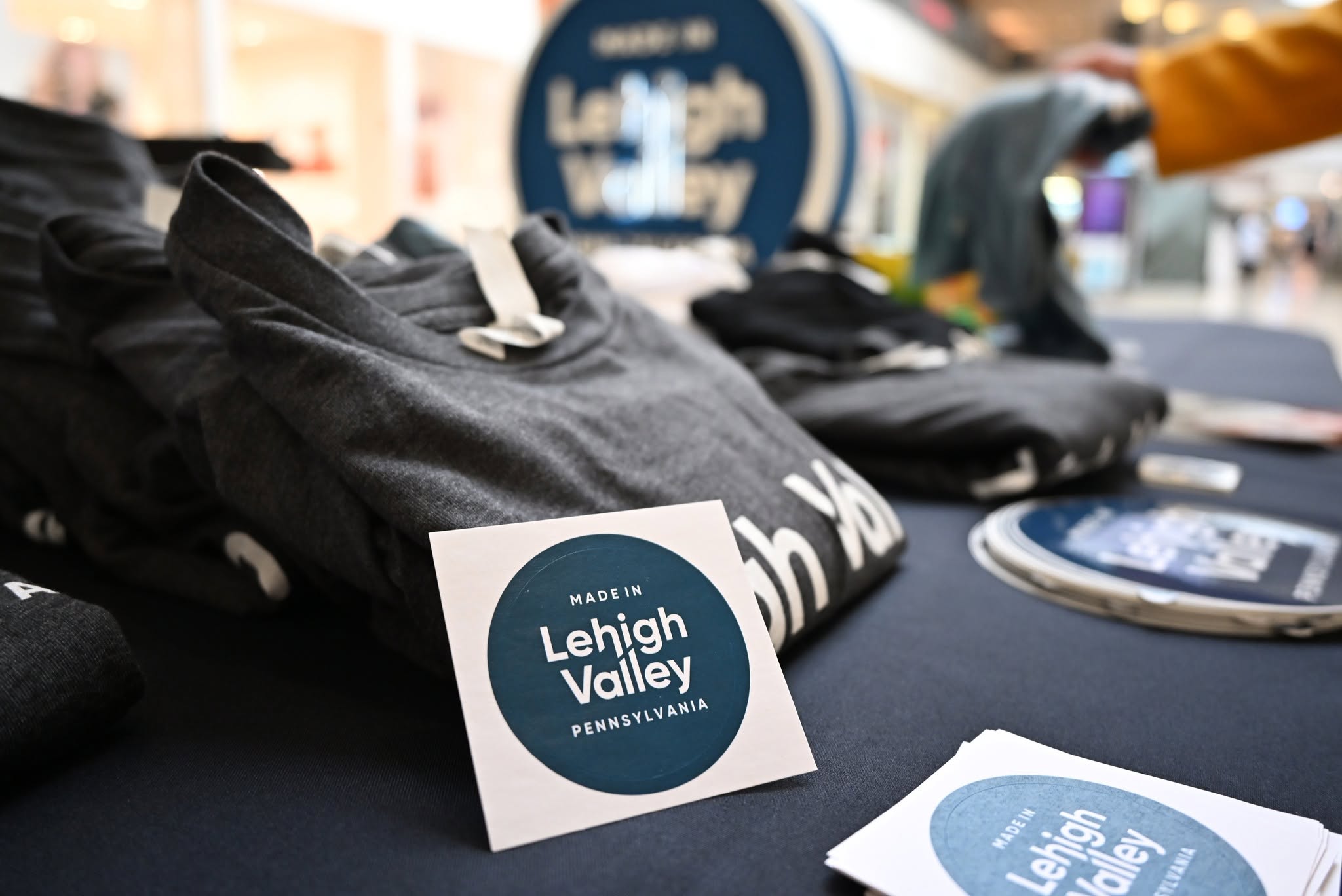
Center court at the Lehigh Valley Mall is a logical next step, and the mall was a willing partner. Opened in October 1976 in Whitehall Township, it remains the largest shopping center in the region at roughly 1.2 million square feet and about 146 stores, jointly owned by Simon Property Group and PREIT, and it has been quietly refilling space while enclosed malls elsewhere empty out. Toys "R" Us returned to the property this year.
"Lehigh Valley has established itself as one of the premier economic regions in Pennsylvania, and this installation is a celebration of that momentum," said Colleen Ansbach, the mall's General Manager. "As a long-standing anchor in this community, Lehigh Valley Mall is honored to collaborate with LVEDC to continue to highlight the growth, talent, and business opportunities that make our region thrive."
The Economy the Logo Is Describing
The Lehigh Valley's gross domestic product is $57.3 billion, up about 1.9 percent in a year, according to the U.S. Bureau of Economic Analysis. That makes Lehigh and Northampton counties, together, the 68th largest regional economy in the United States, with an output larger than the entire statewide economies of Vermont and Wyoming. Were the Valley a country, it would rank around 88th in the world.
It does that on a population of just over 708,000 people. That ratio is the whole point, and it is why the region keeps turning up in national rankings aimed at site selectors who have never driven Route 22.
Total employment is at an all-time high of 343,975, with unemployment at 4.3 percent. The average hourly wage is $29.93. Median household income has reached a record $84,260, up roughly $15,000 in five years, and sits above both the Pennsylvania and national medians. The poverty rate is 10.3 percent.
In March, Site Selection Magazine ranked the Lehigh Valley the No. 1 mid-sized market in the United States for economic development, counting 49 qualifying projects announced or completed during 2025. The magazine's Governor's Cup rankings cover markets of 200,000 to one million people and count projects of at least 20,000 square feet, $1 million in investment or 20 new jobs. It was the second time in three years the Valley took the top spot, after finishing third the year before, and it extended a run of top-ten finishes that now stretches a decade.
Manufacturing Makes the Most. Health Care Employs the Most.
Here is the nuance that the billboards cannot fit, and it is the most useful thing to understand about the Lehigh Valley economy.
Manufacturing is the largest single contributor to regional output. More than 700 manufacturers generate about $9 billion, or 16 percent of GDP, against a national figure of 11 percent, which puts the Valley in the top 15 percent of American manufacturing markets by GDP. Manufacturing employment has grown at roughly three times the national rate since 2010.
But manufacturing is not what most people here do for a living. By share of jobs, health care and social assistance is the largest sector at 20.6 percent, ahead of manufacturing at 10.8 percent and logistics at 10.6 percent, according to Chmura Economics JobsEQ data for the third quarter of 2025. Finance, insurance and real estate and professional and business services follow.
That combination is the actual asset. A region that makes a great deal of money from factories while employing the largest share of its workforce in hospitals and clinics is a region with two engines rather than one, which is precisely the thing the Lehigh Valley did not have in 1974. The story LVEDC is selling to site selectors is manufacturing. The story that protects residents from the next downturn is the diversification underneath it.
The labor market is also unusually porous. About 114,957 people commute into the Lehigh Valley to work, 109,122 commute out, and 201,093 both live and work here. The region is not a closed economy in either direction, which cuts both ways: it can draw workers from a very large radius, and it loses a comparable number every morning to New Jersey and Philadelphia.
Lilly, Chobani, and a Ranking Already Out of Date
What makes the timing of this particular photo op interesting is that the ranking the sculpture celebrates is already stale, and in the region's favor.
The 49 projects counted for 2025 do not include Eli Lilly's $3.5 billion manufacturing campus, announced on January 30 of this year for Fogelsville in Upper Macungie Township. It is the largest single economic development project in the region's history and the largest life sciences investment in Pennsylvania's: roughly 850 permanent jobs for engineers, scientists, technicians and operations staff, about 2,000 construction jobs, and a build that runs to 2031. The plant will produce injectable medicines and devices, including the next generation of obesity drugs. Lehigh Carbon Community College has already won a $5 million state grant to train workers for it.
Nor does it include Chobani. In September, the yogurt maker announced a $1.2 billion operation a few miles from the Lilly site, taking over the 1.5 million square foot Keurig Dr Pepper plant on Industrial Boulevard in Upper Macungie. It is the largest single agricultural investment in Pennsylvania history. The plant is expected to employ 900 people, keeping about 300 existing workers and adding 600 over five years, with production starting in 2027. It will process three billion pounds of milk a year, close to 30 percent of everything Pennsylvania's dairy farms currently produce, which is why the state attached up to $127 million in loans and grants for dairy farmers on top of $50 million for the site itself.
Two of the largest industrial announcements in the region's history landed within eight months of each other, in the same township.
They were not isolated, either. The projects that did count toward the 2025 ranking were mostly the unglamorous middle of the economy: a $20 million B. Braun expansion in Hanover Township, Lehigh County, with 200 jobs making components for IV treatment; a 122,000 square foot FLSmidth Cement factory in Allen Township; a $20 million, 90,000 square foot plant for the Turkish candy maker Kervan USA straddling Bethlehem and Lower Nazareth townships; a Kerry Group coffee roasting and extraction operation in Hanover Township, Northampton County; a $20 million Bosch Rexroth logistics center in Bethlehem next to its North American hydraulics hub; a Phoenix Tube stainless-steel tubing plant, also in Bethlehem; Filter King and Myers Emergency & Power Systems in Bethlehem Township. None of those will ever get a billboard, and no one outside the townships they landed in is likely to remember a single one of them. But they are what the top ranking is actually built from. Add them up, project by unglamorous project, and you get the 49 that put the Lehigh Valley first in the country.
Three Companies, One Point
The companies LVEDC put on stage Wednesday were chosen to make a single argument, which is that none of this is new.
Crayola has been making crayons here since 1903, when Binney & Smith turned out its first box of eight at a mill on the Bushkill Creek in Easton and sold it for a nickel. The company had been grinding pigment since 1885, and the name was coined by Alice Binney from the French word for chalk. Manufacturing moved to Forks Township in 1978 and never left, and the brand now pulls visitors into downtown Easton through the Crayola Experience.
"Crayola's roots in the Lehigh Valley run deep. We are proud of the generations of employees and families whose talent and dedication have helped our company grow while strengthening the region's rich manufacturing heritage," said Marta JeBran, Director of Government & Community Affairs at Crayola. "This sculpture is a meaningful symbol of the pride, creativity, authenticity, and craftsmanship that define the Lehigh Valley."
Martin Guitar predates Crayola by more than six decades. Christian Frederick Martin founded the company in New York City in 1833 and moved it to Nazareth in 1839, buying eight acres in a largely Moravian, German-speaking town whose rolling country reminded him of home. Six generations of the family have run it since.
Scott Gervais, Chief Operating Officer at C.F. Martin & Co., made the shortest and sharpest case of the morning.
"A company only lasts that long if they're in the right place. People want to live here, and that's why companies like ours compete and remain here. So, when you stop by the sculpture, take a photo and share it. Tag it. Tell the world where you are, because great products made by great people are made here in the Lehigh Valley."
Freshpet is the modern entry. The pet food company opened its first Lehigh Valley kitchen in Hanover Township, Northampton County, in 2013 and has expanded repeatedly since, including an $84 million capacity project and a 99,000 square foot innovation kitchen, and it now employs roughly 600 people in the region. Sharon Prince, the company's Head of Internal Communications, represented Freshpet at the unveiling.
"The Lehigh Valley has been an important part of Freshpet's growth, and we're proud of the roots we've built here and excited about what's ahead," said Billy Cyr, Freshpet's CEO. "'Made in Lehigh Valley' gives us an opportunity to tell that story together and show that great products are made here, great teams are built here, and iconic brands can thrive here."
The People Are Already Arriving
The part of the regional story that gets the least attention locally is the part outsiders find most striking: people are moving here, in a corner of the country where that is not the norm.
The Lehigh Valley has added about 21,000 residents since 2020, a 3.1 percent increase. That is roughly in line with the national rate and close to eight times Pennsylvania's, in a state that has lost population overall. A net 11,000 of those arrivals came from somewhere else, chiefly New York City, northern New Jersey and the Philadelphia suburbs, at a time when the cities they left were shrinking.
The growth is also broad rather than concentrated. Of Pennsylvania's 2,560 municipalities, Bethlehem ranked second for population growth between 2020 and 2025, Upper Macungie Township third and Easton seventh, and 85 percent of the Valley's municipalities added people over those five years, Allentown included.
Most consequential for employers is the age of the newcomers. Both Lehigh and Northampton counties rank in the top 10 percent of all U.S. counties for population growth among 18 to 34 year olds, with Northampton first in Pennsylvania and Lehigh seventh. A region whose manufacturing workforce is aging into retirement is, at the same time, one of the Northeast's better destinations for young adults.
The quality-of-place rankings have followed. USA Today readers named Bethlehem's Main Street the best in America and Hotel Bethlehem the country's best historic hotel for a fifth consecutive year. Forbes listed Bethlehem among its best places to retire. Realtor.com has put the 18104 ZIP code among the nation's hottest for five years running. Livability has kept Bethlehem in its top 100 places to live for five straight years. Lehigh Valley International Airport placed second in the country for small airports in Newsweek's readers' poll, two years in a row.
What Could Still Stop It
The constraint on all of this is no longer attracting projects. It is housing the people those projects need.
The Lehigh Valley Planning Commission has put the regional shortfall at roughly 9,000 housing units. Lilly and Chobani between them will need something close to 1,750 workers who do not currently hold those jobs, plus the 2,000 construction workers Lilly's build requires, and both sites sit in the same township. A region that cannot house its new hires does not get to keep them, and the commuting figures show how easily workers here cross a state line.
Exports, by contrast, are climbing: $4.5 billion through the first nine months of 2025, up from $4 billion for all of 2024, ahead of comparable Northeast markets including Bridgeport, Buffalo and Rochester. The products leaving the Valley are outrunning the housing being built in it.
What Philadelphia and Cleveland Actually Did
The two comparisons LVEDC reached for are worth separating, because they are not the same thing.
Philadelphia's LOVE was art before it was a landmark. Robert Indiana designed the image as a painting in 1964 and it reached the public as a Museum of Modern Art Christmas card in 1967. The six-foot aluminum version was lent to the city for the 1976 Bicentennial and installed at JFK Plaza. When it was due to leave in 1978, Fitz Eugene Dixon Jr. bought it and gave it to the city for good. The plaza eventually stopped being called JFK Plaza by anyone at all and became LOVE Park. The sculpture was restored and reinstalled in 2018.
Cleveland's script signs are the closer model, and the one Cunningham named. Destination Cleveland put up the first three in 2016 and had six scattered around the city by the end of 2018, in parks, at the airport and on the lakefront, for exactly the reason LVEDC is doing this: to get residents to broadcast the place on their own feeds, at no cost to the agency.
The difference is that a logo asks for a trust an artwork does not. LOVE earned its place in Philadelphia's identity over four decades, and it was never selling anything. A brand mark starts with none of that credit and has to be adopted, which is something the public either does or quietly declines to do. The honest test of this one will not be Wednesday's photographs. It will be whether, two years from now, anyone stops in front of it without being asked.
Why a Region Needs a Logo at All
Underneath the campaign is a problem that has less to do with pride than with payroll. Employers here compete for workers against metro areas people can already picture, and the Valley's recognition has lagged its performance by about a decade.
That gap has a specific cause. For 30 years the Lehigh Valley was explained to outsiders through the collapse of Bethlehem Steel, a story so large that it swallowed everything that came after it. The region kept making things the entire time. Nobody outside it was keeping count.
LVEDC's description of the Valley as one of America's "coolest and most authentic" markets is marketing language rather than a ranking, and should be read as such. But the independent reporting has started to arrive on its own. The New York Times has described the local economy as on fire. The Daily Mail, in England, wrote up Allentown's affordability for people leaving New York. Nearly 100 trade journal articles last year covered companies based here, including 16 leading publications in a single month.
The mall opened in 1976, the same year Philadelphia borrowed a sculpture for the Bicentennial and then decided it could not give it back. Half a century later, a region that spent most of that stretch being defined by what it used to make has put its own name in the middle of its busiest room, between a Macy's and a JCPenney, and asked people to pose with it.
A six-foot logo is a modest thing for a $57.3 billion economy to want. The sculpture explains none of it: not the GDP, not the 49 projects, not the two billion-dollar plants going up in Upper Macungie. It just says, we are proud. For a region that spent 30 years being defined by a mill that closed, finding the collective strength to rebrand itself and climb onto an upward trajectory can only be explained by Lehigh Valley pride.
At a Glance
- LVEDC unveiled a 6-foot-by-7-foot "Made in Lehigh Valley" sculpture in the Lehigh Valley Mall's center court on Wednesday, October 14. It was fabricated by Inaflash Sign & Design of Emmaus.
- It is the first of several planned. LVEDC wants to put more in downtowns and outdoor spots across the region, on the model of Cleveland's script signs.
- Crayola, making crayons here since 1903, Martin Guitar, in Nazareth since 1839, and Freshpet, here since 2013, all sent representatives to the unveiling.
- The Lehigh Valley's GDP is $57.3 billion, larger than the statewide economies of Vermont or Wyoming, on a population of just over 708,000.
- More than 700 manufacturers produce about $9 billion, or 16 percent of regional GDP, against 11 percent nationally.
- Manufacturing is the largest share of output, but health care and social assistance is the largest share of jobs at 20.6 percent, ahead of manufacturing at 10.8 percent and logistics at 10.6 percent.
- Site Selection Magazine ranked the Valley the No. 1 mid-sized market in the country for economic development on 49 qualifying 2025 projects, the second time in three years.
- Eli Lilly's $3.5 billion Fogelsville campus, about 850 jobs, and Chobani's $1.2 billion Upper Macungie plant, about 900 jobs, were both announced after that count closed.
- The region has added roughly 21,000 residents since 2020. The Lehigh Valley Planning Commission puts the housing shortfall at about 9,000 units.