Hamdi Ulukaya did not want to announce his company's biggest Pennsylvania bet at the factory. He wanted a dairy farm.
So on September 1, the founder and chief executive of Chobani stood beside a freestall barn at Crystal Spring Farm in North Whitehall Township, outside Schnecksville, where the Sell family milks 100 cows. Five generations have worked that ground. The family bottles about a quarter of its own milk and cream and turns some of it into ice cream for the farm store, and the rest goes out through Land O'Lakes. More than 100 state and local officials, farmers and reporters filled the lawn to hear Ulukaya and Gov. Josh Shapiro announce that Chobani would spend $1.2 billion to buy and rebuild the Keurig Dr Pepper plant 15 miles away in Upper Macungie Township.
"Crystal Spring Farm is a true American dairy farm," Jacob Sell, the farm's production manager, told the crowd as the first speaker of the day. "Every cow in our herd was born and raised right here on our farm and we grow all of our own feed."
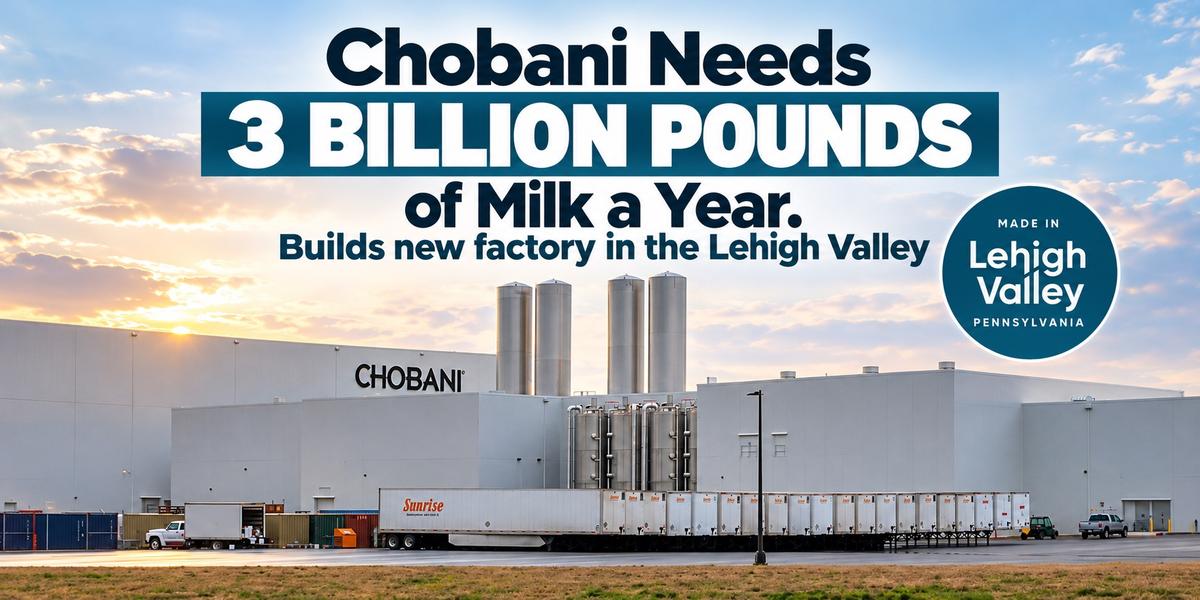
The headline numbers went around the region within the hour: $1.2 billion, 900 jobs, the largest single agricultural investment in Pennsylvania history. The number that matters most to how this story turns out got less attention. At full capacity, the Upper Macungie plant will take in more than 3 billion pounds of milk a year, and Ulukaya wants every pound of it to come from Pennsylvania.
That milk does not exist yet. Finding it is now the state's job.
The Math Behind 3 Billion Pounds
Pennsylvania produced about 9.7 billion pounds of milk in 2025. Chobani's appetite at full scale works out to roughly 30 percent of that, a single buyer absorbing nearly a third of the state's output.
Put another way, 3 billion pounds is what somewhere between 140,000 and 150,000 cows produce in a year at current Pennsylvania yields. The Sell family's herd is 100.
And the state has been moving in the wrong direction. Pennsylvania's milk production has fallen about 10 percent over the past decade. It still has more dairy farms than any state except Wisconsin, about 4,300 of them, nearly all family owned, but its herds are smaller than those in the big Western dairy states and its production per cow trails theirs. For years the question on Pennsylvania farms was where their milk would find a home, as bottlers closed or consolidated and processing capacity drifted elsewhere. Chobani turns that question around. The question now is where all this milk is going to come from.
"Three billion pounds is a massive amount of milk," Ulukaya acknowledged at the announcement. He said talks with Dairy Farmers of America and Land O'Lakes, the two cooperatives that will supply the plant, had been encouraging and that Chobani had commitment letters in hand. "The trust and the confidence is very high, but we still have some work to do."
He also suggested the target might grow. There will probably be "a lot more need for milk than we said," he told the farm press.
A Shepherd's Son and a Closing Kraft Plant
To understand why Chobani is making this bet, and why it chose to make it at a farm, it helps to know where the company came from.
Ulukaya grew up in a Kurdish family in eastern Turkey that raised sheep and goats and made its own cheese and yogurt. He came to the United States in 1994 to study English, and before he ever ran a factory he spent two years working on an upstate New York dairy, milking about 70 cows. "In my soul, I'm a farmer," he told the crowd at Crystal Spring.
He started a small feta business in upstate New York, and in 2005 he saw an advertisement for a yogurt plant that Kraft Foods was shutting down in South Edmeston, New York, a hamlet in rural Chenango County. He bought it with a loan backed by the U.S. Small Business Administration and hired four of the departing Kraft workers as his first team.
"I didn't see the broken walls or how old the building was," Ulukaya said in Schnecksville. "I saw the people who were closing the factory."
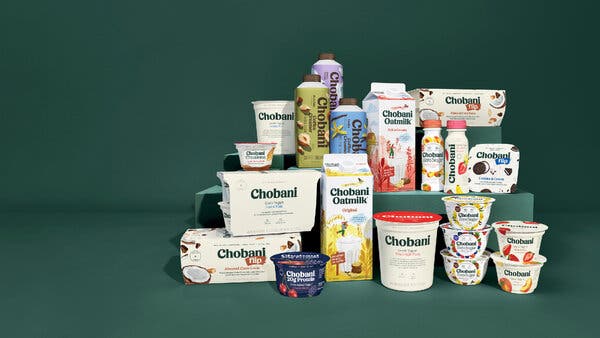
The first cups of Chobani reached store shelves in 2007. At the time, thick, strained Greek-style yogurt was less than 1 percent of the American yogurt market. Within about five years, the South Edmeston plant employed around 1,000 people and Chobani had passed $1 billion in annual sales. By 2017, Greek yogurt accounted for roughly half of all yogurt sold in the United States, and Chobani had passed Yoplait to become the country's second-largest yogurt maker overall. It remains the top-selling Greek yogurt brand in the country.
More yogurt meant more milk from the farms around South Edmeston, which is the part of the story Ulukaya told most often on the farm in Schnecksville.
"The treasure is in the town, it is in the farmland," he said, "and these people who work with their hands every single day."
How Chobani Grew Into a $20 Billion Company
The expansion came fast. In 2012 Chobani opened a second American plant in Twin Falls, Idaho, which became the largest yogurt factory in the world. It bought a dairy company in Victoria, Australia, the year before and began making yogurt there. In 2014 the private equity firm TPG put $750 million into the company to fund new product lines.
The company also built a reputation for how it treats the people on its production floors, which is unusual for a food manufacturer and worth knowing as it becomes one of the larger employers in Lehigh County. In April 2016, Ulukaya announced that Chobani would give its employees shares equal to 10 percent of the company, allotted by length of service and payable when the company goes public or is sold. That fall it introduced six weeks of paid parental leave, since raised to 12 weeks. In 2021 it raised its minimum hourly pay to $15. Roughly 30 percent of its workforce has been made up of immigrants and refugees, a hiring practice that drew boycott calls and threats in 2016 and that Ulukaya has never backed away from. He founded the Tent Partnership for Refugees, a network of companies that hire refugees, the same year.
Not every chapter went smoothly. In 2013 the company recalled yogurt after customers reported swollen and bloated cups, traced to a mold common in dairy. A plan to go public at a valuation above $10 billion was filed in 2021 and withdrawn in 2022, after five straight years of net losses.
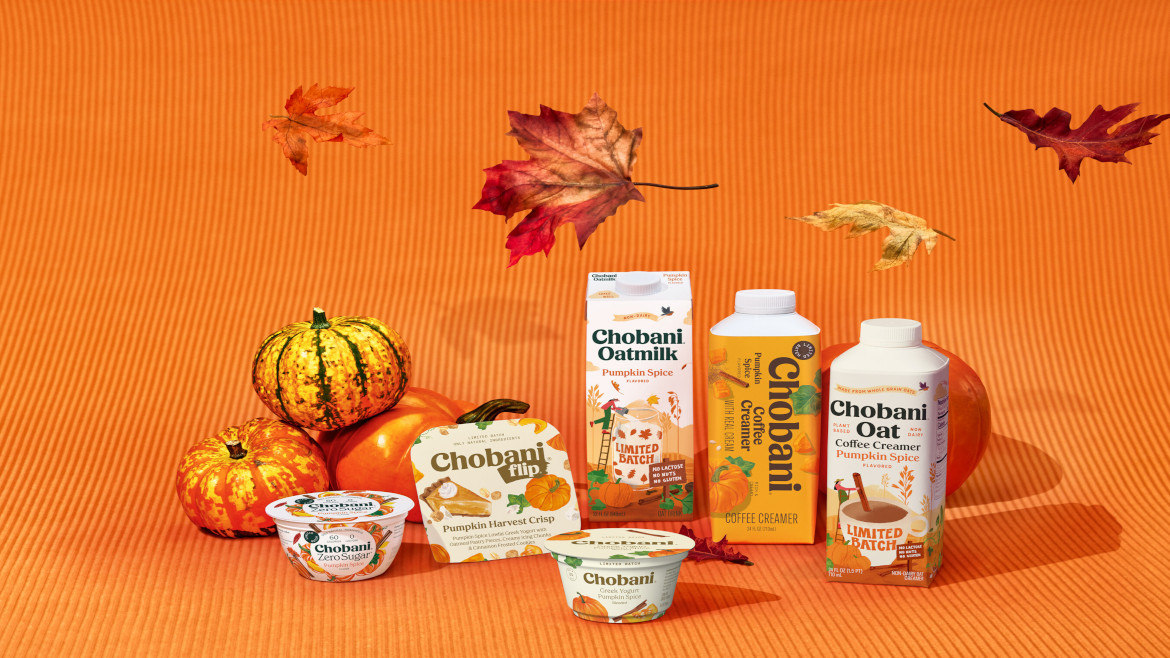
Since then the company has broadened well past yogurt. It added oat milk and coffee creamers in 2019. In December 2023 it bought La Colombe, the Philadelphia coffee roaster known for its canned draft lattes, for $900 million, which gave Chobani a Pennsylvania business before this deal was ever discussed. In 2025 it bought the meal delivery company Daily Harvest.
The money followed. In October 2025, Chobani raised $650 million in new equity at a reported valuation of about $20 billion, and it is now spending more than $4 billion across its American plants: a $500 million expansion in Twin Falls, a new $1.2 billion dairy plant in Rome, New York, a La Colombe expansion in Norton Shores, Michigan, and now the Lehigh Valley. Ulukaya said Chobani's sales have grown about 20 percent a year over the past three years, and he wants capacity quickly.
What the Upper Macungie Plant Will Make
The Lehigh Valley plant will not make yogurt, at least not at first. It is being built around milk itself.
Chobani says it will produce a milk with more protein and less sugar than ordinary milk, using a process that removes water to concentrate the protein. It will be sold as a multi-serve milk for families and serve as the base for high-protein shakes and other new dairy products. The plant will have up to 10 production lines.
The technology is the same one behind Chobani Super Milk, a shelf-stable milk the company introduced in 2024 that has never been sold in stores. It has been made only for donation, to the American Red Cross for disaster relief and to food banks near Chobani's plants, more than 2.5 million cartons so far. Each 32-ounce carton carries 13 grams of protein per serving, about 50 percent more than regular milk, with 25 percent less sugar and no sugar added. Because it keeps at room temperature until opened, it suits food pantries that lack refrigeration.
The closest competitor most shoppers would recognize is Fairlife, the filtered high-protein milk made by Coca-Cola, which has been one of the fastest-growing products in the dairy case. High-protein drinks have become one of the few real growth stories in a fluid milk business that has otherwise been shrinking for decades, and that is the market Chobani is chasing.
The location was chosen for distribution as much as for milk. A plant on Industrial Boulevard sits within 500 miles of about 40 percent of the country's population, with Interstate 78 and rail at the door.
A Plant That Has Been Reinvented Before
The address, 7356 Industrial Boulevard, has been making food and drink for more than half a century. Kraft Foods ran a plant there for 44 years before closing it in 2016. Finding a new tenant was an early priority for the Lehigh Valley Economic Development Corporation, and three years later Keurig Dr Pepper opened a $220 million manufacturing and distribution operation on the site with 378 jobs. The campus now covers about 1.5 million square feet.
"Getting this site reused was one of my first projects in this job," said Don Cunningham, LVEDC's president and CEO. "History comes around, and tomorrow that plant will be bigger and better than we could have ever dreamed."
The symmetry is hard to miss. Chobani was born in a plant Kraft walked away from in upstate New York, and its newest operation sits on ground Kraft walked away from here.
The transaction is also tied up with Keurig Dr Pepper's own corporate reshuffling. The beverage company is selling Chobani the plant and warehouse for about $125 million and, in the same deal, selling back its minority stake in Chobani for $800 million, as it works through an $18 billion acquisition of the coffee company JDE Peet's and a planned split of its business in two. Keurig Dr Pepper told investors it expected the sale to close in the third quarter.
The roughly 300 people working at the plant are being offered jobs with Chobani, and the company plans to add about 600 more over five years. The first phase is a $270 million project, with production expected to start by early summer 2027, only six to eight months after closing. That is a year ahead of the Rome, New York plant, which Chobani started building from the ground up in 2025. Buying a working factory with equipment and a trained staff already inside is what made the speed possible.
"When I first walked through this factory, I knew there was something special here," Ulukaya said. "The facility, the equipment, the scale, but most importantly, the people. There's already an incredibly talented team here that knows how to make great food."
The Deal That Was Almost Zero
It nearly did not happen, and the reason was water.
Dairy processing uses large volumes of water and sends large volumes back out as wastewater, and the western Lehigh County sewer system did not have obvious room for what Chobani would need as it added product lines. At one point, Ulukaya said, he told his team that "the possibility of this happening is almost zero, because we're talking about a lot of municipalities, and the wastewater is extremely important."
Water has a history with this company. In 2012 Chobani paid a $130,000 fine to the Susquehanna River Basin Commission for drawing water in New York without the required permits over several years. Last year, its Idaho expansion came with an agreement to pump an additional million gallons of groundwater a day from the Snake River Plain aquifer. Any community taking on a major dairy processor is right to ask about water first, and the Lehigh Valley did.
The fix came from the neighbors. Allentown, Lower Macungie Township and South Whitehall Township agreed to temporarily lend Upper Macungie up to a combined 1 million gallons a day of their own future wastewater capacity, if Chobani's operations need it. Their allotments are restored as the Lehigh County Authority builds new treatment capacity over the next few years under a regional sewage plan the state Department of Environmental Protection approved in April. State and local officials signed nondisclosure agreements during the recruitment, and the authorities negotiating the water knew they were working with a food processor but not which one.
For Allentown, lending capacity to a plant in another municipality was not an automatic yes.
"Regionalism sounds easy after a big win, but it takes real work to achieve," said Allentown Mayor Matt Tuerk. "As Mayor of Allentown, I have an unshakeable commitment to the residents I serve, and supporting an investment outside of the city presented a challenge. Thankfully, Chobani made the choice easier with a commitment to our community and the opportunity for every Allentownian to get a good job at their new plant."
Jeff Fleischaker, who chairs the Upper Macungie Board of Supervisors, made the case in numbers. More than 36,000 people work at businesses in the township, he said, and only about 2,000 of them live there. Jobs on Industrial Boulevard are paychecks for the whole Valley.
Lehigh County Executive Josh Siegel put it in terms of what happens after the shift ends.
"The folks who work in this plant in Upper Macungie will live in apartments in downtown Allentown. They will visit Main Streets in Emmaus and Coopersburg. And they will patronize businesses all around the Lehigh Valley."
Why Pennsylvania Lost Fairlife and Won Chobani
Pennsylvania has been trying to land a plant like this for close to a decade. A 2017 study commissioned by the state and the Center for Dairy Excellence recommended that the state go after a major new dairy processor, and Agriculture Secretary Russell Redding has treated it as a central goal ever since.
The state came close once and lost. It chased Fairlife's newest plant, a facility built to process 5 billion pounds of milk a year, and in 2023 Fairlife chose upstate New York instead. But the pursuit left Pennsylvania with tools it used this time, including the site program that is now giving Chobani $50 million in loans and grants, and a large-scale dairy processing tax credit the legislature created in 2022 to win Fairlife. Chobani may qualify for that credit as it scales up, and Redding said it may be adjusted to fit.
One difference, Redding said, was the kind of farm each company was willing to buy from. Fairlife was focused on securing large volumes. Ulukaya was willing to take milk from farms of every size, which matters enormously in a state built on 100-cow herds like the Sells'.
The other difference was that Ulukaya asked for something unusual. Before committing, he questioned whether Pennsylvania farmers could actually produce the milk, and he asked the governor to invest in the farms themselves.
"This was a direct ask of Hamdi to the governor to say we need to make farm-level investments," Redding said.
The answer was up to $127 million in loans and grants for Pennsylvania dairy farmers to expand herds and modernize, separate from the money for the plant site, plus $10 million over three years for the Center for Dairy Excellence and the Agriculture Department's dairy development work.
"What the governor and his team have done, providing funds to support the farmers to increase the herd, is something very unique," Ulukaya said. "I've not seen that before."
Farm by Farm
What happens next will not look like dairy growth in Texas or Idaho, where a single new operation can bring 10,000 or 30,000 cows at once. Pennsylvania's version will come one farm at a time: a son or daughter deciding to come home instead of selling the herd, another barn, a few hundred more cows, a robotic milker that lets a family get more from the land and the people it already has. Every one of those decisions needs a lender willing to finance it, and the strongest argument a farmer can bring to a bank is a buyer who has publicly committed to taking the milk for years.
There are real costs on the way. Expansion means more feed, more land, more labor in an industry that already struggles to find it, and more manure to manage under nutrient rules meant to protect the Chesapeake Bay watershed. Some of the milk Chobani buys at first will simply shift away from other buyers, and the competition for supply should help prices for farmers, which is the point, while squeezing processors that have had the market to themselves.
For Redding, the stakes are mostly about keeping farms in business that otherwise would not be.
"How do you keep as many of these 4,300 farms as you can?" he said. "How do you get the co-ops to really work with them to get herd-level improvements and efficiencies? How do you help them get expansions if they want to?"
He called the announcement "the biggest change for our dairy industry in a generation." At the farm, he spoke directly to the people who will decide whether it works.
"Every dairy farmer across this Commonwealth, every cooperative, processor, large and small, I want you to hear this moment for what it is," Redding said. "It's a moment of hope."
Two Billion-Dollar Plants, One Township
Chobani is the second billion-dollar manufacturing commitment to Upper Macungie this year. In January, Eli Lilly announced a $3.5 billion campus in Fogelsville, and the two sites are a few miles apart. They are very different bets. Lilly is building something new from the ground up to make advanced medicines, a project that runs to 2031. Chobani is taking over a working plant, keeping the people already in it and turning on new lines next summer, with a supply chain that reaches back through Lehigh County's own farm roads to dairies across the state.
For Lehigh Valley farms specifically, the plant puts a major milk buyer next door. Crystal Spring is 15 miles from the factory.
Putting two plants of this size in one township puts pressure on more than the sewer lines. PPL Electric Utilities is spending more than $8 billion on its grid from 2026 through 2029, and it expects electric demand on its system could triple over the next decade, driven largely by advanced manufacturing, new data centers and other large industrial users. Upper Macungie now has two of the region's largest new industrial customers within a few miles of each other.
Chobani has already started showing up. The day before the announcement, the company delivered a truckload of yogurt and shelf-stable milk to Community Action Lehigh Valley, which runs the Second Harvest Food Bank of the Lehigh Valley and Northeast Pennsylvania. In other towns where it operates, it has paid off school lunch debt, funded a firehouse and a community center, and set up local grant funds. Whether that habit carries over here will be one of the clearer measures of what kind of neighbor it turns out to be.
Twenty-one years ago, Ulukaya walked into a closing Kraft yogurt plant in a town most Americans had never heard of and decided the people inside it were worth more than the building. On Industrial Boulevard there is a plant that Kraft also left behind, 300 people already on the line, and a promise of 600 more. What happens there will be decided by people in milking parlors from Schnecksville to Lancaster County, and the first test comes next summer when the new lines start running.
At a Glance
- Chobani will invest $1.2 billion over five years to buy and convert the 1.5 million square foot Keurig Dr Pepper plant at 7356 Industrial Boulevard in Upper Macungie Township. It is the largest single agricultural investment in Pennsylvania history.
- The plant will employ about 900 people: roughly 300 current workers who are being offered jobs with Chobani, plus about 600 new hires over five years.
- A $270 million first phase is set to begin production by early summer 2027, making high-protein, lower-sugar milk and high-protein shakes on up to 10 production lines.
- At full capacity the plant will use more than 3 billion pounds of Pennsylvania milk a year, about 30 percent of the 9.7 billion pounds the state produced in 2025, or the output of roughly 140,000 to 150,000 cows.
- Pennsylvania milk production has fallen about 10 percent in a decade. The state is offering up to $127 million in loans and grants to help dairy farmers expand, plus $50 million for the plant site.
- Dairy Farmers of America and Land O'Lakes will supply the milk. Pennsylvania has about 4,300 dairy farms, second only to Wisconsin.
- The deal almost fell apart over wastewater. Allentown, Lower Macungie and South Whitehall agreed to lend Upper Macungie up to 1 million gallons a day of future capacity to make it work.
- Chobani was founded in 2005 when Hamdi Ulukaya bought a closing Kraft yogurt plant in upstate New York with an SBA-backed loan. It was valued at about $20 billion in October 2025 and owns Philadelphia's La Colombe coffee.
- The Upper Macungie site was a Kraft plant for 44 years before closing in 2016, then a Keurig Dr Pepper operation from 2019.