
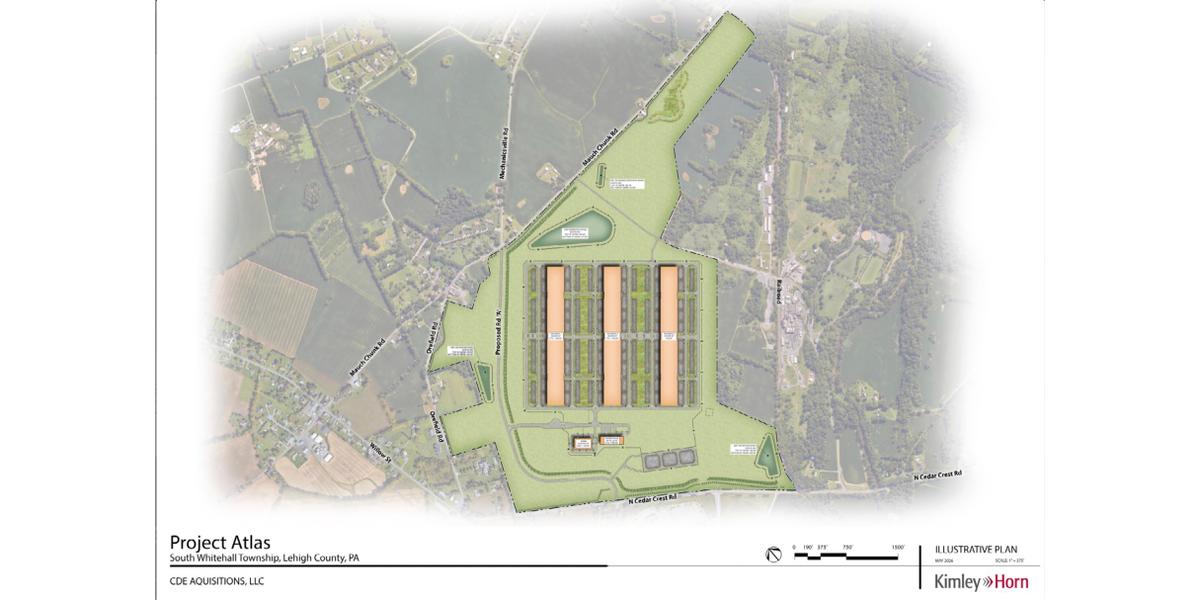
As Edged US pushes its 1.5-million-square-foot “Project Atlas” data center toward an August vote in South Whitehall Township, the most visible face of the opposition is Dr. David M. Caruth, a township resident, former Parkland School Board candidate and 20-year Verizon executive who says he is preparing a federal civil-rights case to stop the hyperscale campus proposed across the street from Parkland High School.
This story follows our earlier coverage: South Whitehall postpones the Project Atlas vote to August after a packed meeting.
A ‘Backyard Apple Tree’ vs. an ‘Industrial Orchard’
Caruth is careful to draw a distinction he says gets lost in the debate: this is not an ordinary data center. Having spent two decades at Verizon, he says he knows traditional facilities well, the everyday server hubs that run smartphone apps, store cloud photos and process credit-card swipes, using, in his words, “no more energy than a typical grocery store.” A hyperscale campus like Project Atlas, he argues, is a different species entirely: “the equivalent energy scale of half a million homes,” built for heavy machine learning and enterprise, military and government workloads. Township filings put the campus at roughly 725 megawatts, a figure that underscores his point.
“These facilities are needed in modern society. There is no argument there. I am not anti-hyperscale data center,” Caruth said. “I am fundamentally anti-placement. You do not drop a heavy, energy-guzzling industrial tech hub directly next to where our children learn, play sports and participate in extracurricular activities.” His preferred alternative, he says only half in jest, is the Nevada desert: endless sun for solar power and, since Edged says its closed-loop cooling uses no water, no need for local water either. “The only reason they are stubbornly trying to force it into our suburban Pennsylvania neighborhood is because it is cheaper for them,” he said.
Who Caruth Says Is Behind It
Project Atlas is being advanced by Edged US, which Caruth says is financed by Endeavor and, according to leaked text messages he says surfaced at the July 9 meeting, is ultimately intended for tech giant Microsoft, though Edged has not publicly confirmed those claims. Publicly, the developer has framed the campus around jobs and tax revenue, describing roughly 250 permanent positions and an investment it has pegged near $8.9 billion.
What the Community Fears
The objections aired on July 9, and building for months across online forums and grassroots events, span a wide range. Residents cite gridlock and altered traffic patterns during a projected four-year construction phase and beyond; the structural risk of building a massive complex on ground Caruth describes as unstable and “heavily ridden with active sinkholes”; and unknown long-term environmental effects, from diesel backup-generator emissions to depletion of the local water table.
The Concern No One Else Is Raising
Beyond the traffic and the sinkholes, Caruth has centered an argument rooted in his own life as the father of a daughter with autism: the effect of a hyperscale campus’s constant low-frequency hum and micro-vibrations on neurodivergent children. For a child on the autism spectrum, he says, that persistent sensory input can trigger “a state of constant neurological ‘fight or flight,’” causing physical distress, anxiety and an inability to focus. “Placing this facility right across from a high school introduces a barrier to education and well-being for vulnerable students who deserve a safe, distraction-free learning environment,” he said.
A Meeting, and a Phone Left Open
The controversy turned personal at the July 9 hearing. Caruth says that as more than 500 residents waited to speak, a member of the development team sat in the auditorium with his phone out in plain view, typing, and that a resident seated behind him photographed the screen. According to Caruth, the messages, exchanged between Edged’s David Salinas and prominent Lehigh Valley developer Lou Pektor, showed the two mocking the crowd, referring to residents as “dirty,” “toothless” and “stupid” and joking that “there is no way to fix this stupid.”

One of the text exchanges Dr. Caruth says a resident photographed on a development-team member’s phone during the July 9 meeting.
Pektor, Caruth says, has since claimed online that photographing the screen was “highly illegal.” Caruth rejects that: in a publicly funded meeting, with a phone left open in a crowded auditorium, he argues, there is “zero expectation of privacy,” and the resident “did not hack a device or steal data; they simply documented public behavior occurring in a public space.” Caruth also says the same texts revealed the developers’ anxiety over roughly $4.7 million in mandatory off-site infrastructure upgrades, utility connections and regulatory costs required by the township and PennDOT before a single brick could be laid, what he calls the real “roadblocks” the developers are trying to bypass or offset through zoning variances.
A Civil-Rights Gambit
Caruth, who holds a doctorate focused on cognitive psychology and spent 20 years navigating corporate and regulatory battles at Verizon, says he is preparing a federal legal strategy built on the Americans with Disabilities Act and the Fair Housing Amendments Act. His argument: that public entities cannot approve a land use that creates an environment which functionally discriminates against people with disabilities, and that dropping a source of “severe, continuous environmental stressors” beside a public school infringes on disabled students’ rights to equal access to education. He says the framework drew national attention, including a People magazine feature, during an earlier hyperscale fight, and that he intends to “fully leverage that established playbook.” As for the specifics he will bring to the Aug. 19 hearing: “We can’t show our cards. … You’ll have to wait and see.”
Tax Breaks, and a Push to Hit Pause
Caruth argues the campus only lands in suburban Pennsylvania, rather than the desert, because of cost: years ago, he says, state lawmakers lured big tech in with uncapped sales-and-use tax exemptions on data-center equipment that “bleed tax revenue away from our local communities.” He sees the tide turning, pointing to Senate Bill 1345, sponsored by state Sen. Jarrett Coleman, a former Parkland School Board member, which would let municipalities impose an 18-month moratorium on data-center applications while they rewrite zoning rules. The bill advanced out of a Senate committee on a 10-1 vote. “He gets it,” Caruth said of Coleman.
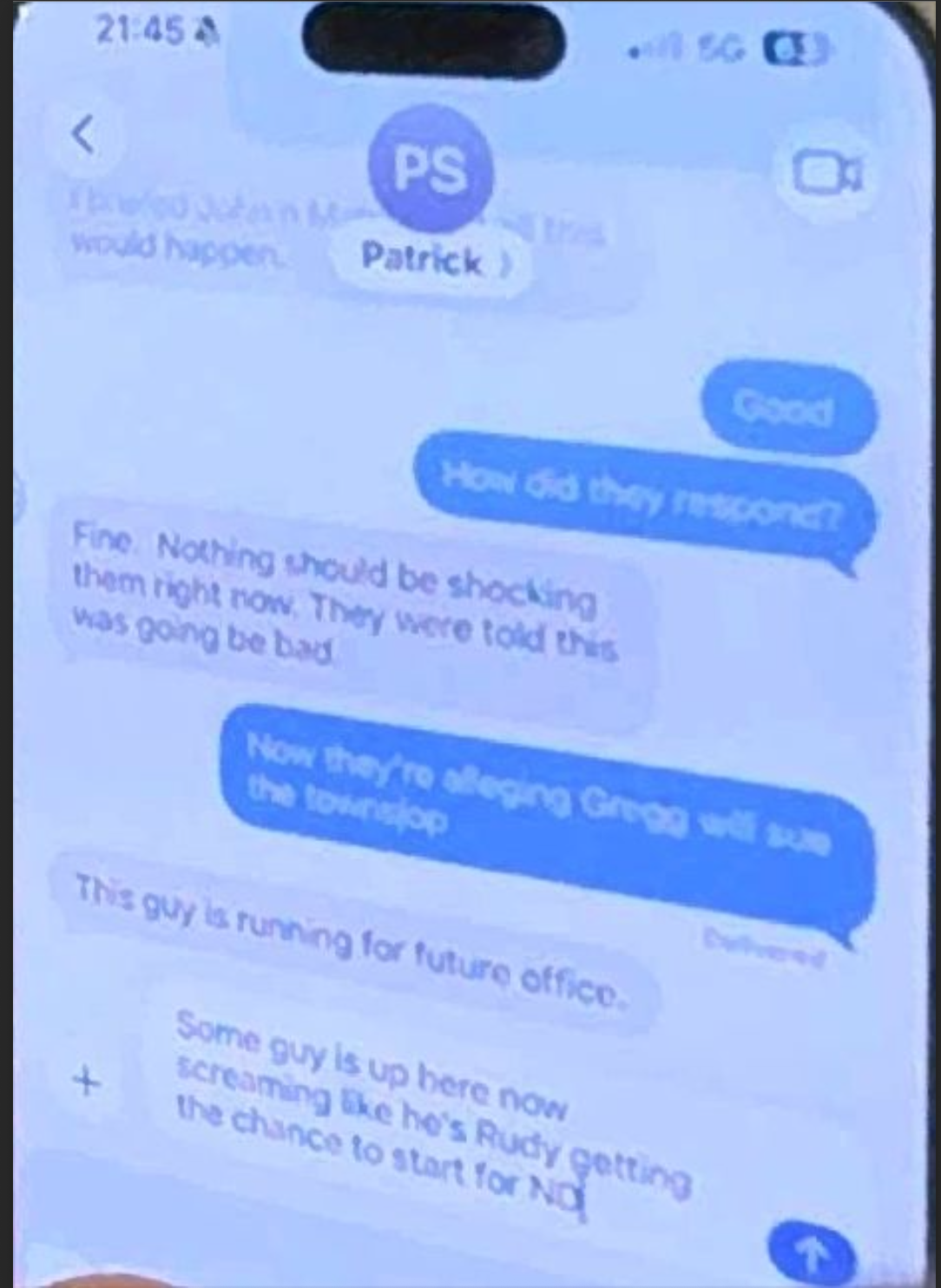
Another of the photographed exchanges from that night, provided by opponents of Project Atlas.
‘It Can Happen in Your Backyard Next’
Caruth’s message to the rest of the Lehigh Valley is blunt: the threat is not unique to South Whitehall. “If it can happen across the street from Parkland High School, it can happen in your backyard next,” he said, pointing to the same pressures, grid strain, potential utility-bill increases, water risk and quality-of-life disruption, facing any township where a data center is quietly proposed. He says his coalition is assembling a “battle-tested blueprint” other communities can use, and that since the People magazine feature, parents of neurodivergent children and military veterans from around the country have reached out for help organizing. What does the coalition want? “A full stop. Nothing less,” Caruth said. The Planning Commission takes the plan up again on Aug. 19.
At a Glance
Dr. David M. Caruth, South Whitehall resident, former Parkland School Board candidate and 20-year Verizon (Fortune 30) executive, is leading the opposition to Project Atlas.
The project: Edged US’s “Project Atlas,” a ~1.5 million-sq-ft, ~725-megawatt hyperscale data center at 2493 N. Cedar Crest Blvd., across from Parkland High School.
Caruth’s stance: “not anti-data-center, anti-placement.”
Community concerns: traffic, sinkholes/geological instability, grid and water strain, diesel-generator emissions, and sensory impact on neurodivergent students.
Legal plan: a federal ADA/Fair Housing Amendments Act civil-rights action to freeze the project.
Caruth’s allegations from the July 9 meeting: he says photographed texts showed developers (he names Edged’s David Salinas and developer Lou Pektor) mocking residents, and that the end user is Microsoft, though Edged has not confirmed those claims.
Backdrop: PA Senate Bill 1345 (Sen. Jarrett Coleman) would let municipalities impose an 18-month data-center moratorium.
Next: Planning Commission vote Aug. 19.