A wave of large data-center proposals has set off zoning battles across the Lehigh Valley, with one massive campus on the former Air Products site rejected in Upper Macungie, a multimillion-square-foot project advancing across from Parkland High School in South Whitehall, and intensifying backlash in Lower Mount Bethel Township.
As developers chase land for power-hungry data centers, Lehigh and Northampton county municipalities are scrambling to update zoning ordinances and respond to organized resident opposition. The Lehigh Valley Planning Commission says at least 16 local governments are now working on data-center rules, and several recent hearings have drawn standing-room-only crowds.
Upper Macungie zoners reject the former Air Products site campus
On May 27, 2026, the Upper Macungie Township Zoning Hearing Board unanimously denied a request tied to a proposed data-center campus on the former Air Products site at 7300 Cetronia Road, a 194-acre property.
The proposal called for a roughly 2.6 million-square-foot campus of three data center structures. Air Products & Chemicals, Inc. had sought to have the use treated as “similar” to uses permitted in the township’s Light Industrial zoning. The board rejected both a request to continue the matter and the relief petition itself.
The hearing drew a packed, unified crowd of neighbors who opposed the project, citing energy and infrastructure demands and broader community impacts. State Sen. Jarrett Coleman told the board, “I don’t think this is a good fit,” questioning whether the Lehigh Valley was the right place for the campus. A formal written decision was expected within 45 days, and the applicant had 30 days from that decision to appeal in court.
South Whitehall’s Atlas project advances next to a high school
In South Whitehall Township, a project known as the Atlas Industrial Data Center has become a flashpoint because of its location: roughly 410 acres of undeveloped farmland near Parkland High School.
The applicant, CDE Acquisitions LLC, originally proposed six buildings totaling 5,038,100 square feet on land tied to Jeras Corp. The Lehigh Valley Planning Commission reviewed the plan on Jan. 23, 2026, and unanimously approved a comment letter to forward to township officials. Residents who packed early meetings raised alarms about energy use, noise, pollution and the wisdom of building so close to a school.
“It’s insanity to be putting this near a high school and homes,” said South Whitehall resident Joel Gilley.
“I’m imagining being outside and hearing that noise 24/7,” said David Sussman, who lives about 1,100 feet from the site.
The developer later revised the plan, shrinking it to five buildings totaling 1,556,702 square feet: three data centers of about 492,285 square feet each, an administration building of roughly 40,680 square feet and a warehouse of about 39,167 square feet. The revision also cut planned parking from 966 spaces to 399 and projected weekday traffic from 3,865 trips to 1,154.
Crucially for the zoning fight, the property sits in South Whitehall’s Planned Innovation, Research and Technology (PIRT) District, where data centers are permitted by right as long as they meet specific regulations, limiting the township’s ability to simply say no.
Lower Mount Bethel backlash splits a “sleepy town”
In Northampton County, a proposed hyperscale data center in Lower Mount Bethel Township from J.G. Petrucci Company and Peron Development has triggered some of the region’s most heated opposition.
Township Supervisors Chair Chris Cook said he initially welcomed the project before reversing course after a developer town hall. “I don’t think there’s nothing worth the loss of that farmland,” Cook said, describing the community reaction as overwhelming. He also said the dispute had turned personal: “I’ve been getting a lot of harassing phone calls. I’ve been threatened.”
Residents have organized through a Change.org petition and a Facebook group, voicing concerns about lost farmland, property values, noise from cooling systems, and air, light and water impacts on what Cook called “a small, sleepy town.” Developers have emphasized that the project remains in early stages with no final designs, while pointing to potential tax revenue and investment.
Municipalities race to rewrite zoning
The proposals have prompted a region-wide rush to update local codes. The Lehigh Valley Planning Commission says it has reviewed or will review data-center ordinances from 16 municipalities across both counties: Upper Macungie, South Whitehall, North Whitehall, Upper Saucon, Lower Saucon, Lowhill, Palmer, Plainfield, Bushkill, Moore, Washington, Upper Mount Bethel, Upper Nazareth and Lower Nazareth townships, plus the city of Allentown and Chapman borough.
Individual projects keep surfacing beyond those zoning rewrites. Allen Township has approved plans to convert a 1-million-square-foot warehouse on Liberty Drive into a data center, and the citizen-run Track Data Centers group counts 57 proposed data centers across Pennsylvania.
The LVPC’s core recommendation is to treat data centers as a conditional or special-exception use rather than a by-right use, giving municipalities more control. Other suggested standards include:
Requiring disclosure of the water source used for cooling.
Limiting noise at property lines to 55 decibels.
Mandating large setbacks and landscape buffers to soften visual impact.
Encouraging onsite renewable power, such as solar or geothermal, and sustainable building practices.
Lowhill Township’s ordinance is being treated as a model by several northern Lehigh County communities, including Slatington and Heidelberg, Lynn, Washington and Weisenberg townships. “Other environmental regulations we typically recommend include provisions for onsite power generation like geothermal or solar,” said Mary Grace Collins, an LVPC community and regional planner.
The Side Effects Driving the Scrutiny
Behind the zoning fights is a growing national debate over costs that critics say are easy to overlook when a project is pitched mainly as jobs and tax revenue. A single hyperscale data center can draw as much electricity as a mid-sized city and consume millions of gallons of water a year for cooling, resources that come from the same grids and watersheds local residents depend on.
The water demand is striking. Reporting compiled by the climate outlet The Cool Down notes that one Google data center in Oregon used more than 274 million gallons of water in a single year, and that hyperscale facilities nationwide could draw as much as 150 billion gallons over the next five years, roughly the annual use of 4.6 million households. On the power side, data centers are projected to make up a fast-growing share of U.S. electricity demand through 2030, pressure that can push up costs for everyone on the grid, the same dynamic now playing out in PPL’s territory.
Critics also point to an equity problem: the permanent job count at a finished data center is usually small relative to its footprint, while the environmental and infrastructure costs are borne locally. Researchers cited in the reporting estimate data-center-related pollution could carry public-health costs of around $20 billion a year nationally by 2030, and note that communities often lack basic data on how much water or power a given facility will use before it is approved.
That information gap is what the LVPC’s recommendations, water-source disclosure, limits on electrical demand, noise caps and renewable-energy requirements, are designed to close. Experts quoted in the reporting also argue for “community benefits agreements” and standardized reporting so residents can weigh the trade-offs before, not after, a facility arrives. For Lehigh Valley townships rewriting their codes, that is the case for moving carefully: once a campus is approved and built, its draw on local water and power is locked in for decades.
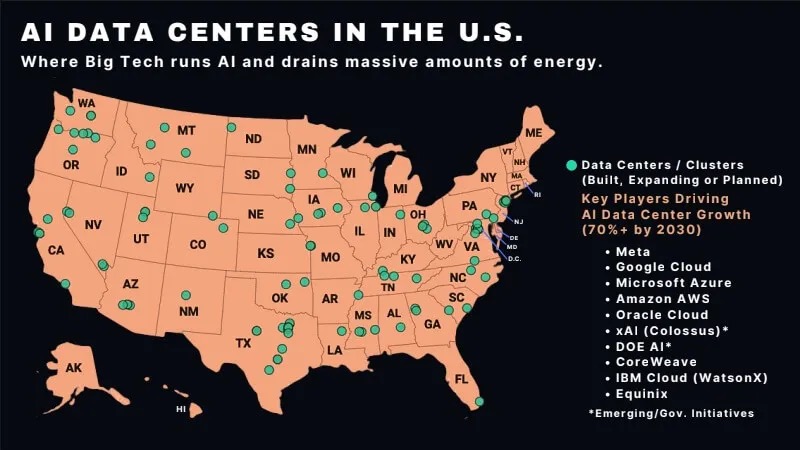
AI data centers are multiplying nationwide, driven by Big Tech’s computing needs, and their energy and water demands sit at the heart of the local zoning debate.
What comes next
The outcomes remain uncertain. Industry observers note that many data-center proposals ultimately fail because of financing complexity and the need to line up customer contracts before zoning approvals. But where projects sit on by-right land, as in South Whitehall’s PIRT district, the central battleground will be the conditions and regulations attached to approval rather than an outright ban.
For now, the pattern across the Valley is consistent: large proposals, packed hearings, and municipalities working quickly to put guardrails in place before the next application arrives.
Lehigh Valley Data Center Zoning at a Glance
Upper Macungie’s zoning board unanimously denied a roughly 2.6 million-square-foot campus on the former Air Products site at 7300 Cetronia Road on May 27, 2026.
South Whitehall’s Atlas project, by CDE Acquisitions LLC, sits on about 410 acres near Parkland High School; it was revised from 5,038,100 to 1,556,702 square feet.
The Atlas site is in South Whitehall’s PIRT District, where data centers are permitted by right under specific regulations.
Lower Mount Bethel’s J.G. Petrucci and Peron Development proposal drew intense backlash; Supervisors Chair Chris Cook reversed his early support.
The Lehigh Valley Planning Commission says 16 municipalities are working on data-center ordinances.
LVPC recommends conditional-use status, water-source disclosure, 55-decibel noise limits, large setbacks and onsite renewable power.
Lowhill Township’s ordinance is being used as a model by several northern Lehigh County communities.