On a cold December evening in 1741, a small group of Moravian settlers gathered in a humble stable at the confluence of Monocacy Creek and the Lehigh River. As they sang a hymn containing the stanza "Not Jerusalem, lowly Bethlehem," they christened their new settlement with the name that would endure for nearly three centuries.
The story of Bethlehems founding begins not in Pennsylvania, but in the religious ferment of eighteenth-century Europe. The Moravian Church, one of the oldest Protestant denominations, had been revived in 1727 under the patronage of Count Nicholas von Zinzendorf in Saxony. Driven by a fervent missionary spirit, the Moravians looked westward to the New World as a base for spreading their faith among Native American communities.
The Purchase and First Settlement
On April 2, 1741, William Allen of Philadelphia sold 500 acres of land to Henry Antes, acting on behalf of Bishop David Nitschmann, for the establishment of a Moravian settlement. The first tree had been felled around December 21, 1740, by David Nitschmann Sr. with the help of Martin Mack. Thirteen settlers constituted the first inhabitants of what would become one of the most remarkable planned communities in colonial America.
What made Bethlehem extraordinary was not merely its founding but the communal system the Moravians established. Known as the General Economy, this system operated from 1741 until the 1760s. Every member of the community contributed their labor and shared resources equally. There was no private ownership: the community functioned as a single economic unit devoted to both self-sufficiency and missionary work.
A Self-Sufficient Community
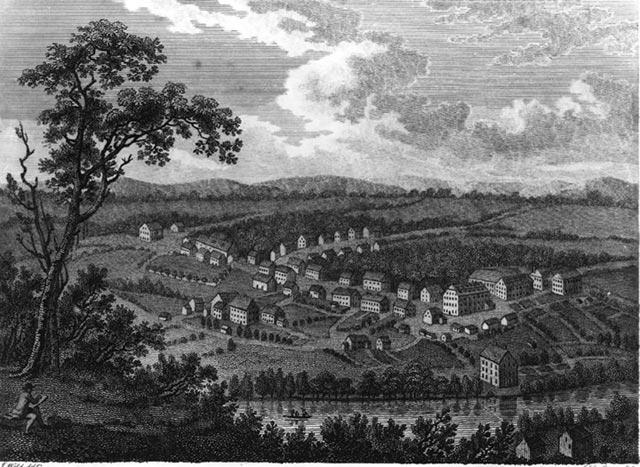
The industriousness of the Moravians was staggering. Within just two years of their arrival, they had built a saw mill, a soap mill, wash houses, a grist mill, an oil mill, a tannery, a blacksmith shop, and a brass foundry. By 1747, thirty-five distinct crafts, trades, and industries were operating in the settlement. The Moravians were not merely surviving in the wilderness: they were thriving.
The settlement grew rapidly. From the original thirteen settlers, Bethlehem expanded to over 1,200 residents in just twelve years. This growth was carefully managed. Unlike the haphazard development of many colonial towns, Bethlehem was a planned community from its inception, with buildings arranged according to function and social organization.
Education and Missionary Work
Perhaps the most progressive aspect of Moravian Bethlehem was its commitment to education. In 1742, the Moravians founded what would become Moravian College: the sixth-oldest college in America and, remarkably, the first institution in the colonies to educate women. This commitment to female education was revolutionary for its time and reflected the Moravians belief in the spiritual equality of all people.
Bethlehem served as the headquarters for all Moravian missionary activity in North America. From this base, missionaries ventured into the frontier to work with Native American communities, learning indigenous languages and establishing missions throughout the region. The Moravians approach to missionary work was notably respectful for its era, emphasizing cultural exchange rather than forced conversion.
A Living Legacy
Today, the Historic Moravian Bethlehem District stands as one of the best-preserved Moravian settlements in the world. The original buildings, including the 1741 Gemeinhaus (community house), the Sisters House, and the Brothers House, still line the streets of downtown Bethlehem, testifying to the vision and determination of those thirteen settlers who arrived at the banks of the Lehigh nearly three centuries ago.
In 2024, the Historic Moravian Bethlehem District was inscribed on the UNESCO World Heritage List, joining iconic landmarks around the globe and confirming what the Lehigh Valley has long known: that the story of Bethlehems founding is not merely local history, but a chapter in the story of human civilization itself.