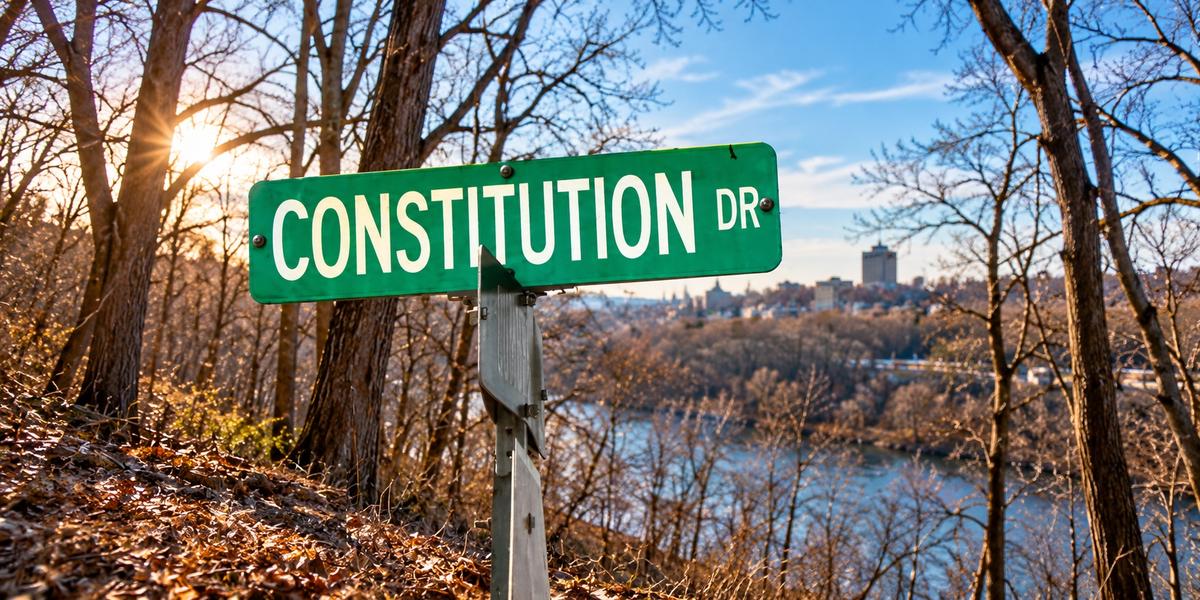
Almost every town has a road like this one. A few miles of gravel where the streetlights quit, the trees close in, and the teenagers go at night to scare each other. In Allentown it is Constitution Drive, and it has been collecting stories for as long as anyone can remember: a one-legged ghost walking two red-eyed dogs, a family of violent albinos, a whistling in the woods that comes from every direction at once.
Here is the thing about Constitution Drive. Strip away the campfire material and what is left is stranger than the legends. This is a road laid across land handed out in the most notorious land swindle in Pennsylvania history, mined for iron, quarried for stone, bought up by Bethlehem Steel, dumped on for decades, and now sitting inside a 500-acre public park while a 190-unit apartment complex is approved at its western end. There are two abandoned quarries in the woods above it full of mildly radioactive rock. None of that needs a ghost.
What the Road Actually Is
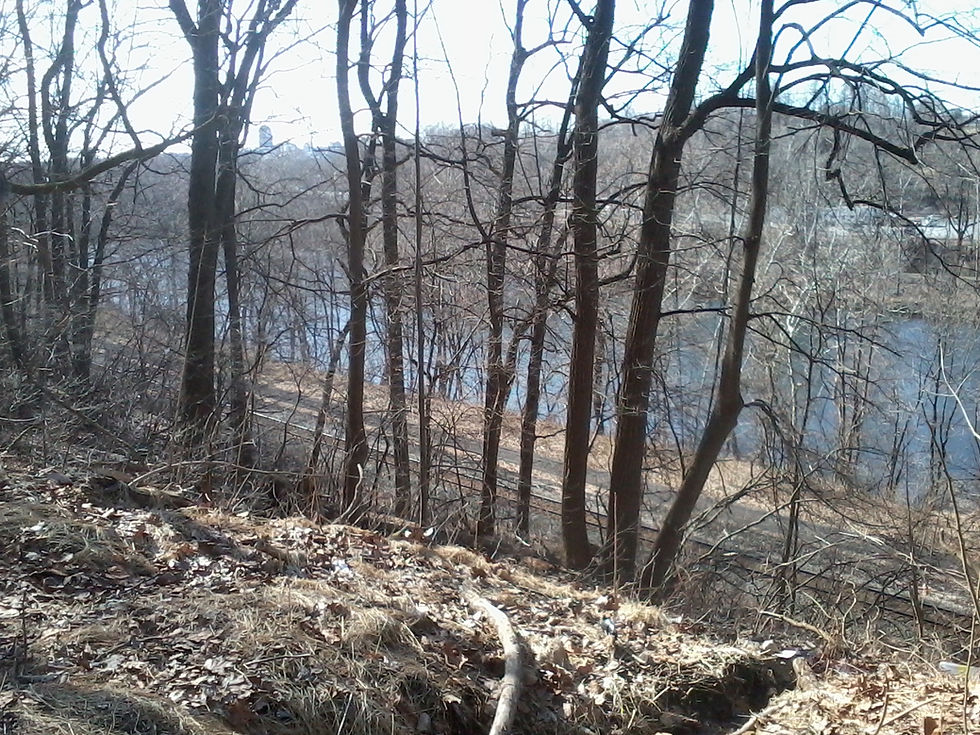
Constitution Drive runs a little under three miles along the south bank of the Lehigh River, straddling the line between the City of Allentown and Salisbury Township, with an active freight railroad on one side and the flank of Lehigh Mountain rising on the other. Its western end is a paved residential block in South Allentown. Then the pavement ends and it becomes a single lane of gravel that winds into the woods toward Bethlehem, with hairpin turns and a long drop to the water below.
That split personality is the whole story of the road. One end has mail delivery. The other end has, for most of the last century, been effectively nobody’s.
The houses at the paved end are older than most people assume. One of them, a semi-detached stone home, was built in 1864, when the far side of the Lehigh from downtown Allentown was iron country and workers lived within walking distance of the furnaces and mills. Real estate listings on the street now sell it as a block of “charming historic homes dating back to the 1800s,” which is true, and which sits oddly beside the road’s other reputation.
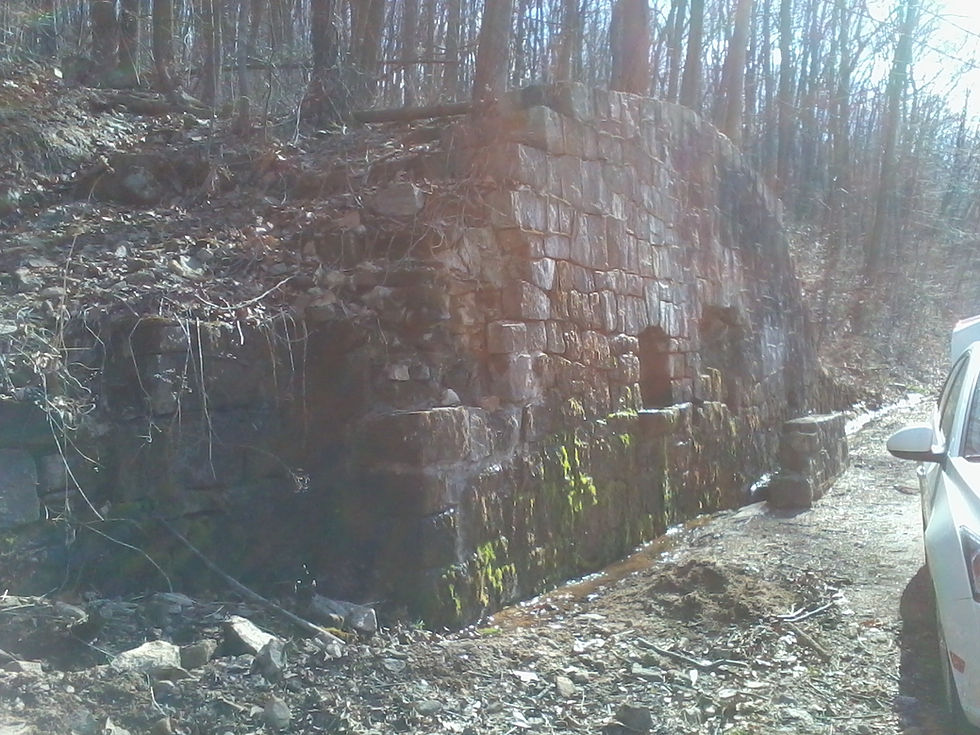
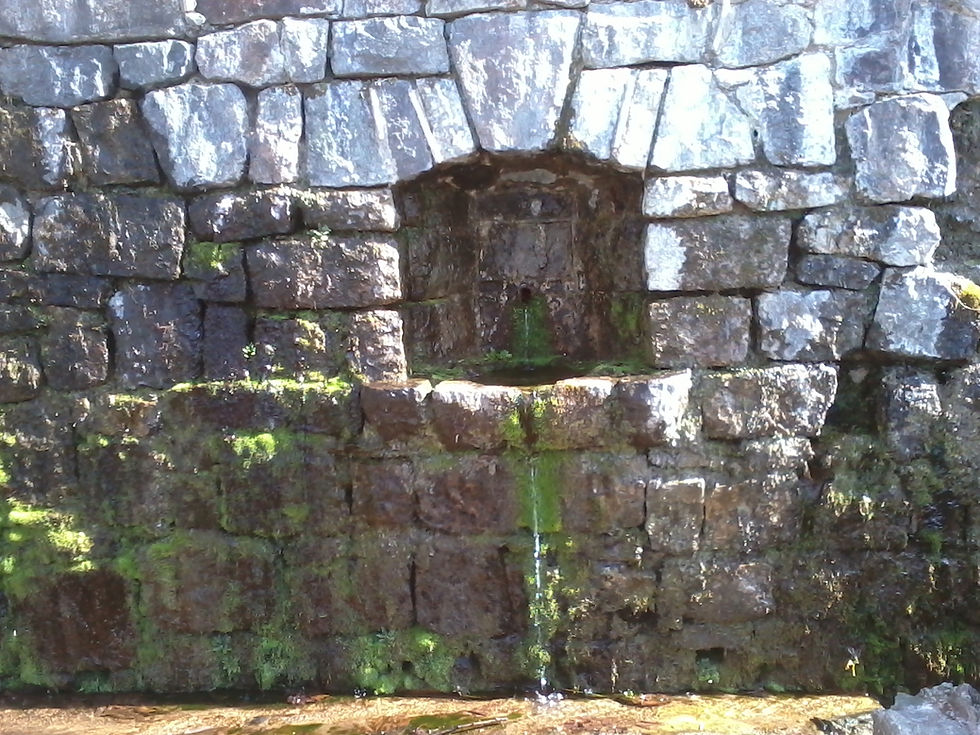
Partway along the gravel is the one landmark everybody who uses the road knows: a wall of cut stone set into the hillside with water running out of it, mossed over and still flowing. Locals call it the fountain. No record turns up of who built it, or when, or what it was built to do.
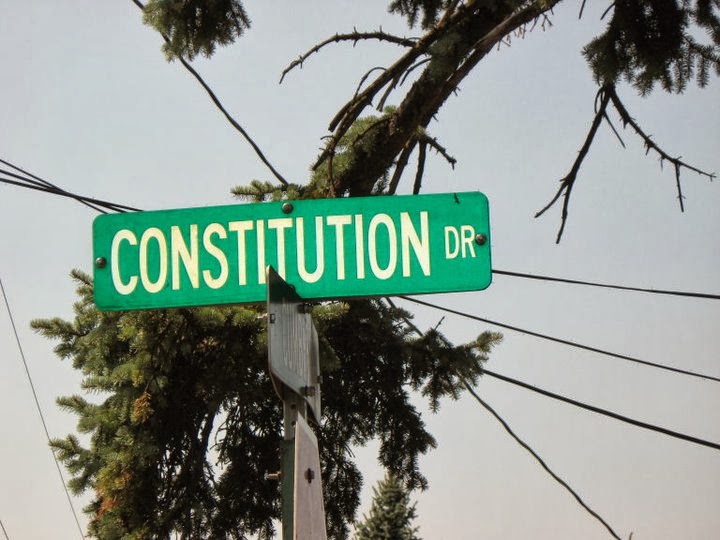
What nobody seems able to explain is the name. No available history of the road says who named it Constitution Drive, or when, or why.
The Walking Purchase Comes Home
The land the road crosses was one of the first pieces of the Lehigh Valley to change hands in the 1737 Walking Purchase, the fraud by which William Penn’s sons claimed an enormous tract of Lenape territory by measuring how far a man could walk in a day and a half, then hiring runners instead of walkers.
Three men were chosen for that walk. One of them was Solomon Jennings, and Jennings is the reason the park on Lehigh Mountain spent decades being called Walking Purchase Park. In the spring of 1736, the year before the walk, William Allen conveyed 200 acres to Jennings on the south side of the Lehigh River, described in the record as two miles above Bethlehem, in recompense for his services. That parcel sits in what is now Allentown and Salisbury Township, right where Constitution Drive runs.
Jennings himself did not finish the job. He dropped out exhausted before noon on the first day, roughly nineteen miles in from Wrightstown, while the other two runners kept going and kept going, and the Lenape witnesses walked away in disgust. He kept the land. When he died it passed to his son John, who sold it in 1764 to Jacob Geissinger for £1,500. Geissinger family descendants held ground on the mountain into the 1950s.
So the oldest documented fact about this road is that it crosses a payoff.
Iron, Timber and Two Forgotten Quarries
Through the nineteenth century Lehigh Mountain was worked hard. Timber came off it, sandstone came out of it, and iron ore was mined on it, peaking in the years after the Civil War and running out around 1885. The mountain is not Valley limestone. It is a block of the Reading Prong, and its bedrock is banded hornblende gneiss and granitic gneiss between roughly 570 million and 1.6 billion years old, shoved into place during the building of the Appalachians.
That geology is why Constitution Drive has a second, quieter fame that has nothing to do with ghosts. Two overgrown quarries sit above the road, an upper and a lower, cut into altered Byram granitic gneiss. The rock there carries an unusual suite of minerals: allanite, bastnäsite, thorite, titanite, zircon and pyrite, which is to say thorium, uranium, cerium, yttrium, lanthanum and zirconium. Rare earths and radioactives, in the woods, inside the city limits.
Mineral collectors have known about it for years. Robert Beard’s guidebook Rockhounding Pennsylvania and New Jersey lists the spot as a numbered site, filed under its rare earth minerals. The quarries are not marked, not maintained and not obvious, and the rock is hot enough to register on a Geiger counter, which is a better reason to be careful out there than any of the stories.
Bethlehem Steel Owned the Quiet
The reason the woods above Constitution Drive never filled in with houses is corporate. By the late 1950s Bethlehem Steel had bought up large parts of Lehigh Mountain, holding it as a buffer around its riverside operations. After Hurricane Diane tore through the Lehigh Valley in August 1955, accounts of the land’s history describe the company building dike systems along the river here.
A steel company sitting on hundreds of acres it had no intention of developing is the most underrated fact about Constitution Drive. It is what kept the mountain wooded and empty through the decades when the rest of the Valley was being subdivided, and empty land beside a city is exactly the condition in which both dumping and folklore thrive.
The unwinding began in 1989, when Wildlands Conservancy bought 156 lowland acres along the Lehigh River from Bethlehem Steel and another 232 acres in the uplands. Lehigh County added 141 acres in 2006, purchased from the Bethlehem Water Authority. Stitched together, that is roughly 530 acres, jointly owned by the City of Allentown, Salisbury Township and Lehigh County, with a master plan first drafted in February 2008 and revised in June 2010 to unify the pieces as Lehigh Mountain Park. Recent township discussions describe the park as about 480 acres. Either way, the legendary haunted road is a park access road, and has been for years.
The Legends, and Where They Came From
Now the stories, because they are worth taking seriously as stories.
The man and his dogs. This is the durable one, the version almost everyone in the area has heard. A man was walking two dogs near the tracks when a train struck him and took off his leg. In the harsher telling he was not killed outright but lay on the isolated road for two days and bled to death, and his dogs never left him and died there too. He is said to still be walking them, and the dogs’ eyes are said to glow. The detail that keeps the legend alive is a good one: people claim that after a snowfall you can find two sets of dog tracks on the road accompanied by a single human footprint.
The albinos. The other famous one holds that a family of albinos lives in the woods along the road, throws stones at passing cars, attacks anyone who comes near the property, and will push your car into the river if you get out and walk away from it. This one has an actual, documented, deeply unglamorous solution. A blogger who drove out and knocked on the door found the property owner perfectly friendly, not remotely maniacal, and not an albino. The owner offered the likely origin himself: a previous resident kept a large number of pot-bellied pigs, and pale pigs caught in headlights at two in the morning, at the edge of the woods, make a very convincing monster. Local radio DJs then ran with the albino story on air and sent a fresh generation of carloads out to look. The one home deep in the woods on the road has been owned since 1978 by a man named John Eberhard, whose gate and attack dog signs have probably done their own work on the legend.
The whistling. This is the one that resists a tidy answer. People describe a loud, oddly melodic whistling that seems to come from every direction in the woods at once, likened to an orchestra of flutes or to disembodied wind chimes, appearing and disappearing over months. It is not only a nighttime story either. One local recorded it around noon on a sunny day in 2014, with the drip of a natural spring audible underneath it.
The escalations. Then there is the material that has grown on the legend the way legends grow: a screaming girl in the woods, glowing red eyes, and claims of murders and even lynchings on the road. Those last ones circulate widely and are worth naming plainly, because no record behind them turns up anywhere. Moonshiners are a better bet. The mountain has springs, the Lehigh Valley was a genuine center of illegal distilling in the 1920s with federal agents breaking up stills in the countryside around Hellertown and Bath, and camps in these particular woods are part of the local telling of why the road got its reputation in the first place.
The Documented Trouble
The road does not need invented crimes, which is the sad part. In November 1987 The Morning Call laid out what was actually happening on Constitution Drive: burglaries, rapes, arson and people firing guns into the dark. A former Salisbury Township police chief put it about as directly as a police chief can, saying the area naturally encourages crime because of its seclusion.
The steadier problem has been garbage. Constitution Drive has been a magnet for illegal dumping for decades, household trash and construction debris tipped over the bank toward the river, and the signs threatening prosecution have never made much difference.
By 2011 the public owners were trying to close the place up at night. Lehigh County applied to the state Department of Conservation and Natural Resources for a $25,000 grant to install three automatic gates on timers, opening in the morning and closing at dusk, two of them at either end of Pump House Road. County Commissioner Glenn Eckhart, a former Salisbury Township commissioner, said the hope was that the gates would secure the park against dumping and stop vehicles from “driving all over the property.”
That January, on the 27th, Salisbury’s commissioners voted 5 to 0 to adopt the master plan, a roughly $1.4 million wish list of signage, security gates, a boat launch, pavilions, a park office and education center, and a 75-space parking lot. Neighbors along Constitution Drive came to complain about illegal ATV riding and hunting. Board President John Brown pointed out that township police did not have the manpower to patrol the park “unless you want to put up taxes.” Township Manager Randy Soriano said the gates would help deter the ATVs. One resident summed up the enforcement problem better than any of the officials: “They’re like weeds. You stop weeding, they’re going to grow.”
2026: Pave It, Burn It, Open It
Fifteen years later the same road is back on the agenda, and the conversation has changed tone completely. In January 2026 Salisbury Township’s Environmental Advisory Council named Walking Purchase Park a priority for the year and began assembling recommendations for the commissioners.
Among them: paving the park’s unpaved road and making it plowable in winter, something Wildlands Conservancy wants done before any possible transfer of the park’s administration; completing a full tree inventory during 2026; and looking at prescribed burns to knock down underbrush and reduce wildfire risk in dry years. The council is also working toward guaranteed public access dawn to dusk. “They are looking to make it so that everybody has access dawn to dusk,” said EAC chair Michele Lopez. Commissioner Heather Lipkin, the council’s liaison, framed the task as getting three governments and a conservancy pointed the same way: “We would like to present a coherent plan to all our partners.”
Read that against 1987 and you can see an entire arc. A secluded dumping ground that police wrote off as a lost cause is now a park that officials are arguing about how best to open.
The Fishbowl
The other end of the road is getting the opposite treatment. On March 11, 2025, Allentown’s Zoning Hearing Board granted variances for 190 apartments at 836 Constitution Drive, near East Wyoming Street, on a 17-acre property that locals and officials alike call the fishbowl, because it sits 30 to 40 feet below the properties around it and is ringed by steep slopes.
The developer, Statewide Partners, already had approval from 2018 for six three-story buildings with the same 190 units. The new plan trades them for three four-story buildings at 55 feet, which needed a height variance and permission to disturb steep slopes. “We reduced the number of buildings from six to three, and that modified the site to less of a development impact,” principal Zachary Juffe told the board, and the revised layout pulls the buildings away from the neighbors who objected while leaving more of the trees standing. Board member Scott Unger noted it disturbs less real estate than what was already approved. Neighbors were not entirely sold, one warning that the fishbowl floods several times a year and another that the slopes would erode their yards. Juffe put the build at twelve to eighteen months.
So the legendary gravel road is about to have a few hundred new neighbors at one end and a repaving debate at the other.
Why the Stories Stuck
Folklore needs a vacuum, and Constitution Drive had a perfect one: a wooded, unlit, unpaved corridor with almost no residents, held for decades by a steel company that wanted nothing built on it, close enough to two cities that every carload of bored teenagers in the Lehigh Valley could get there in fifteen minutes. Add a railroad, which supplies the genuinely dangerous element in the ghost story, and springs in the hills, which supplied the moonshiners. The road did not invent its reputation. Its owners and its geography did.
The legends will outlast the explanations, because they always do. The pot-bellied pigs will never catch up with the albinos. But the road has a better story than the one it gets told about it, and most of that story is on the record: a Walking Purchase payoff, iron and sandstone, a quarry full of thorium, Bethlehem Steel’s buffer land, thirty years of other people’s garbage, and a slow, contested, still unfinished attempt to turn all of it into a park.