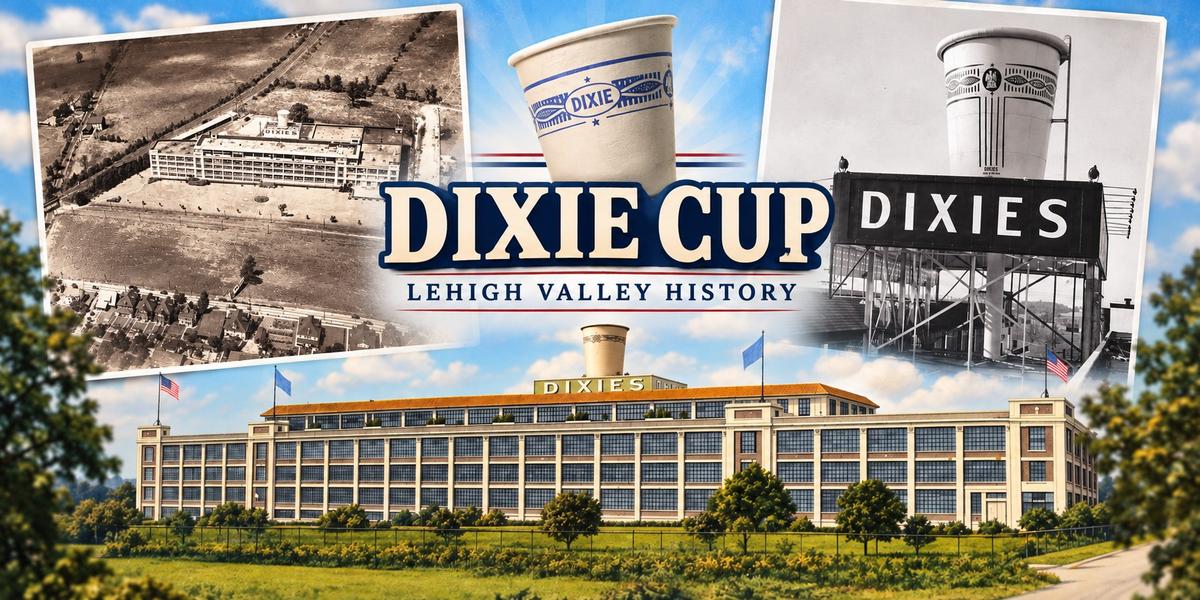
For more than a century, a giant paper cup sat on a rooftop in Wilson Borough and told travelers on Route 22 exactly where they were. The factory beneath it started as a public health idea, made a fortune selling people something they would throw away, employed generations of Easton-area families, and then sat empty for longer than it ever ran. Now, after two rejected tax deals, a suspicious fire and a brownfield cleanup that county officials called nearly impossible, the building is being rebuilt as 412 apartments. This is how the Dixie Cup got here, and how it nearly did not survive the wait.
It started with a fear of shared drinking cups
In 1907, a Boston attorney named Lawrence Luellen began working on a problem that sounds strange now and was deadly serious then. Public drinking water in America was served from a common tin cup or dipper, chained to the fountain, used by everyone who passed. Tuberculosis was everywhere. A doctor who was one of Luellen’s clients needed disposable cups to test patients’ sputum, and Luellen saw a bigger market than a laboratory.
He designed a small wax-coated paper cup, then made it commercially useful by inventing the machine that dispensed it: drop a penny, get a cold drink in a clean cup. In April 1908 he incorporated the American Water Supply Company of New England. Working alongside him was his brother-in-law, a young Kansan named Hugh Moore, who took the roles of secretary, treasurer and director in the territorial companies Luellen spun up.
The science arrived at exactly the right moment. In 1908, Lafayette College biology professor Alvin Davison published a study with a title built for newspapers: “Death in School Drinking Cups.” In Kansas, public health officer Dr. Samuel Crumbine was already campaigning against the common dipper. State after state passed laws banning it. Moore was not a passive beneficiary. He spoke at the Pure Food Show and published an advocacy sheet called “The Cup Campaigner,” which is to say he helped manufacture the demand he then filled.
On December 15, 1910, the ventures were consolidated as the Individual Drinking Cup Company, headquartered in New York City with $200,000 in capital. Moore became secretary, treasurer, general manager and eventually president. By 1912 the product had a name, the Health Kup, and a semi-automatic production line.
Where the name came from
“Health Kup” sold hygiene. It did not sell charm. In 1919 the company renamed the product the Dixie Cup, borrowing the word from a line of dolls made by Alfred Schindler’s Dixie Doll Company, which shared a building with the cup operation in New York. The name had nothing to do with the product and everything to do with the fact that people liked saying it.
The 1918 flu sent the company to Easton
The influenza pandemic of 1918 did for the paper cup what no advertising campaign could. Sales exploded. Health officials pushed sanitation, offices and schools and railroads bought in bulk, and the company’s New York plant could not keep up.
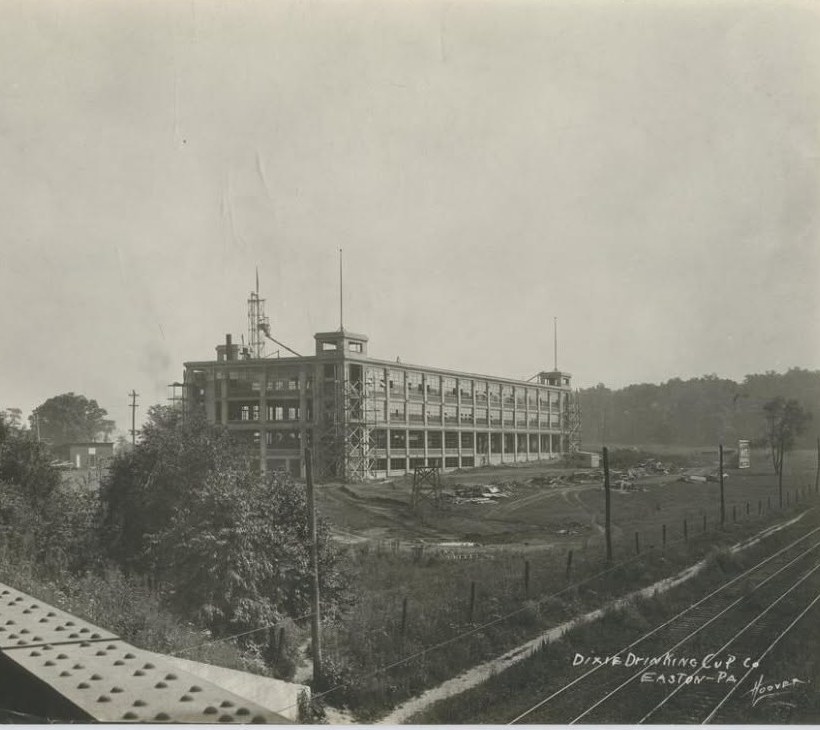
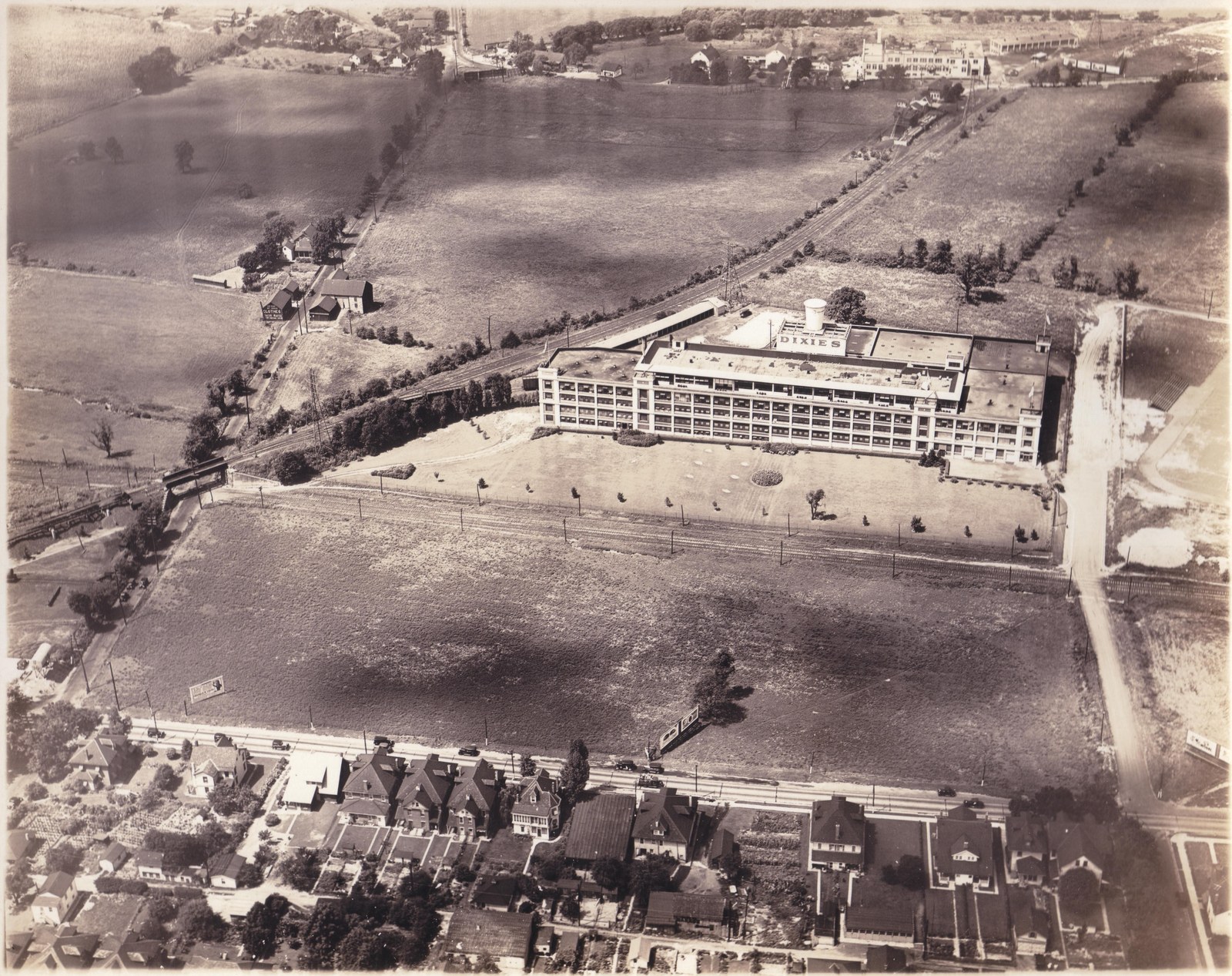
Moore went looking for room. He found it on farmland in Wilson Township, on 7 acres at the southeast corner of Northampton Street where the Eastern & Northern railroad crossed, bought from Andrew Edelman at $3,000 an acre. The First National Bank of Easton financed the building with a $280,000 loan on eleven-year terms at 5 percent interest.
The plant opened in April 1921 with 80,000 square feet and 78 employees. Twenty-eight of them came down from New York. The other 50 were hired locally in the first year. New York’s loss was the Lehigh Valley’s gain, and the building would eventually sprawl to roughly 640,000 square feet.
Ice cream, radio and the lids people collected
The company’s second act was not about disease at all. In 1923 it partnered with Weed’s Ice Cream and Carry Ice Cream to sell individual servings of ice cream in a cup. Early attempts failed. Then someone shrank it: a two and a half ounce cup for a nickel, and the Dixie became a treat instead of a precaution.
What followed was a masterclass in early consumer marketing. The company sponsored a radio program, the Dixie Circus, on NBC and CBS. It printed premiums on the underside of the lids, first circus characters, then Hollywood stars, then wartime themes. Children bought ice cream to get the lid. Some of those lid collections are still in attics across the Valley.
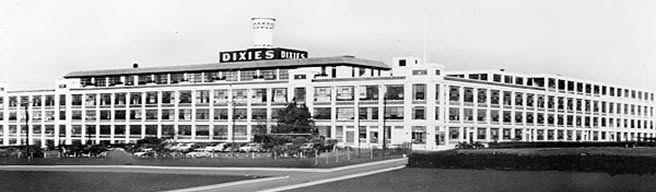
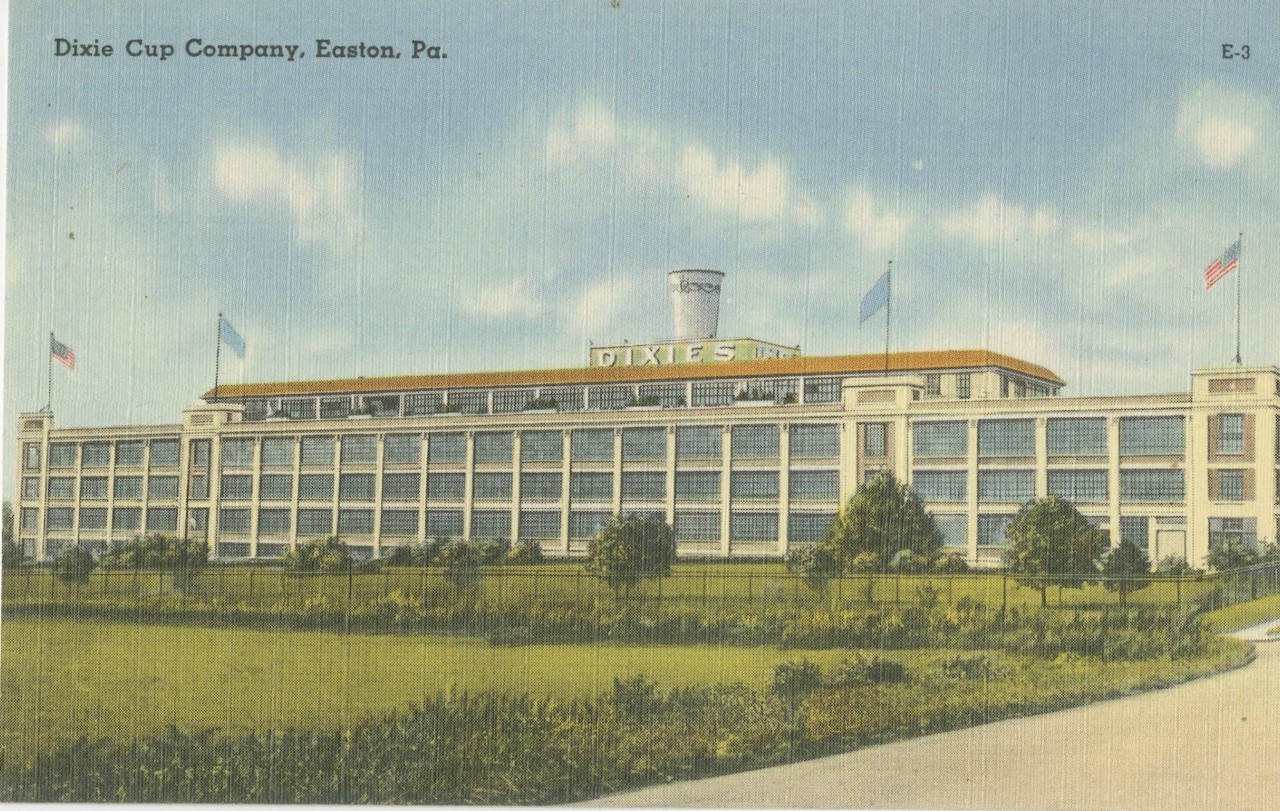
In 1936 the Individual Drinking Cup Company merged with the Vortex Cup Company of Chicago, picking up the cone-shaped cup and a dry-waxing process, and operated as Dixie-Vortex. In 1943 it took the name everyone already used: the Dixie Cup Company. Postwar, it opened plants in Fort Smith, Arkansas, Brampton, Ontario, Anaheim, California, and Lexington, Kentucky, a detail worth remembering for what happens later.
The cup on the roof
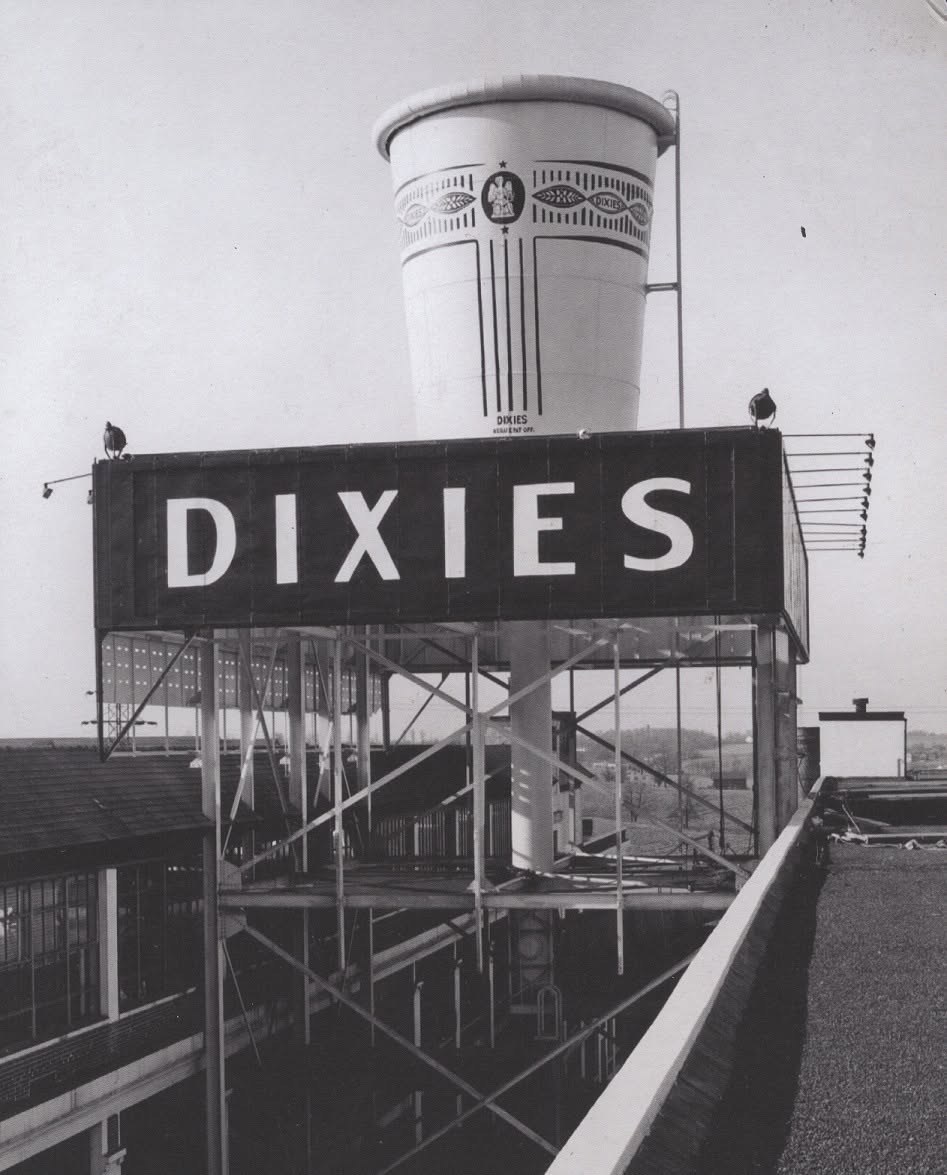
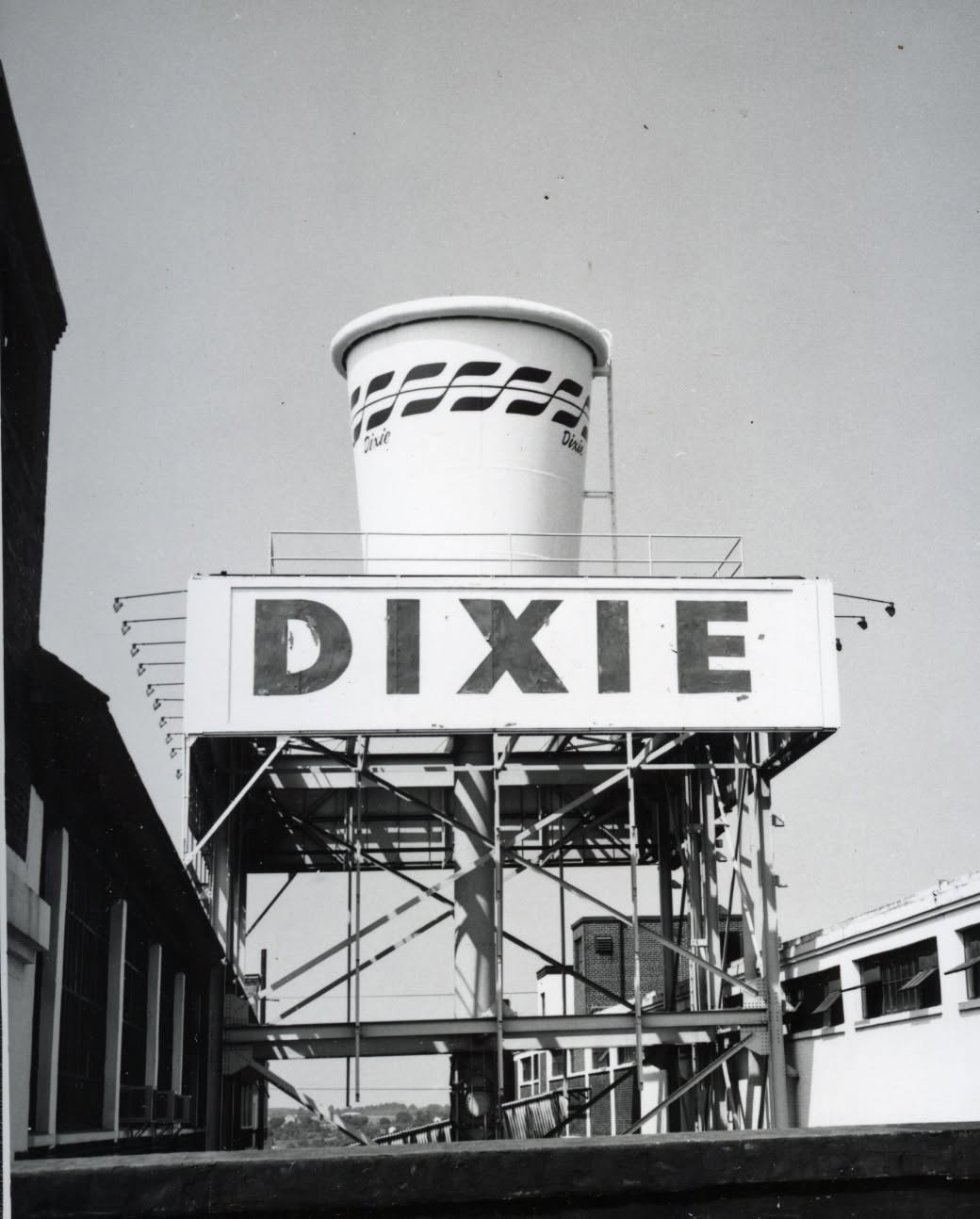
The landmark that made the plant famous was not a sign. It was plumbing. The 50,000-gallon rooftop water tower was built in the shape of a Dixie Cup, painted with the product’s own graphics, and lit so that it worked as a billboard 24 hours a day. Below it sat block letters spelling out the brand. Generations of Lehigh Valley kids measured the drive home by when the cup came into view.
Sold, resold, and moved down the road
Hugh Moore sold in 1957, approving a merger with the American Can Company. He stepped down as an officer and stayed on as a consultant, and he stayed in Easton.
After that the plant belonged to a chain of owners who had never met the men who built it. American Can was acquired by the James River Corporation of Virginia in 1982. James River became Fort James in 1997. Fort James was absorbed into Georgia-Pacific, which is owned by Koch Industries, and that is who owns the Dixie brand today.
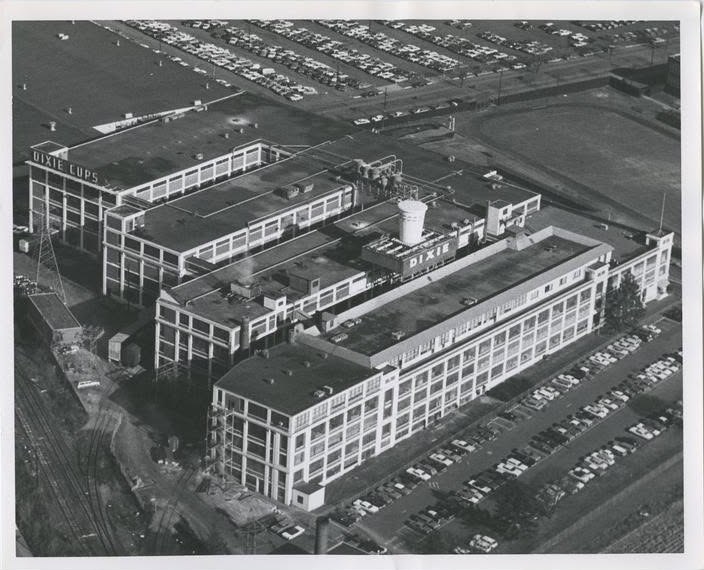
The Wilson Borough plant itself closed in 1983. Production moved a few miles up to a modern facility in Forks Township, built in the early 1980s, and the original building was left to a few warehouse tenants and then to nothing at all.
The Valley’s connection to the product finally ended in 2021. Georgia-Pacific closed the Forks Township plant at 605 Kuebler Road, citing collapsing demand after amusement parks, theaters and offices shut during the pandemic, and consolidated production in Lexington, Kentucky. Roughly 190 people lost their jobs. A century of cup-making in Northampton County was over.
Forty years of rot
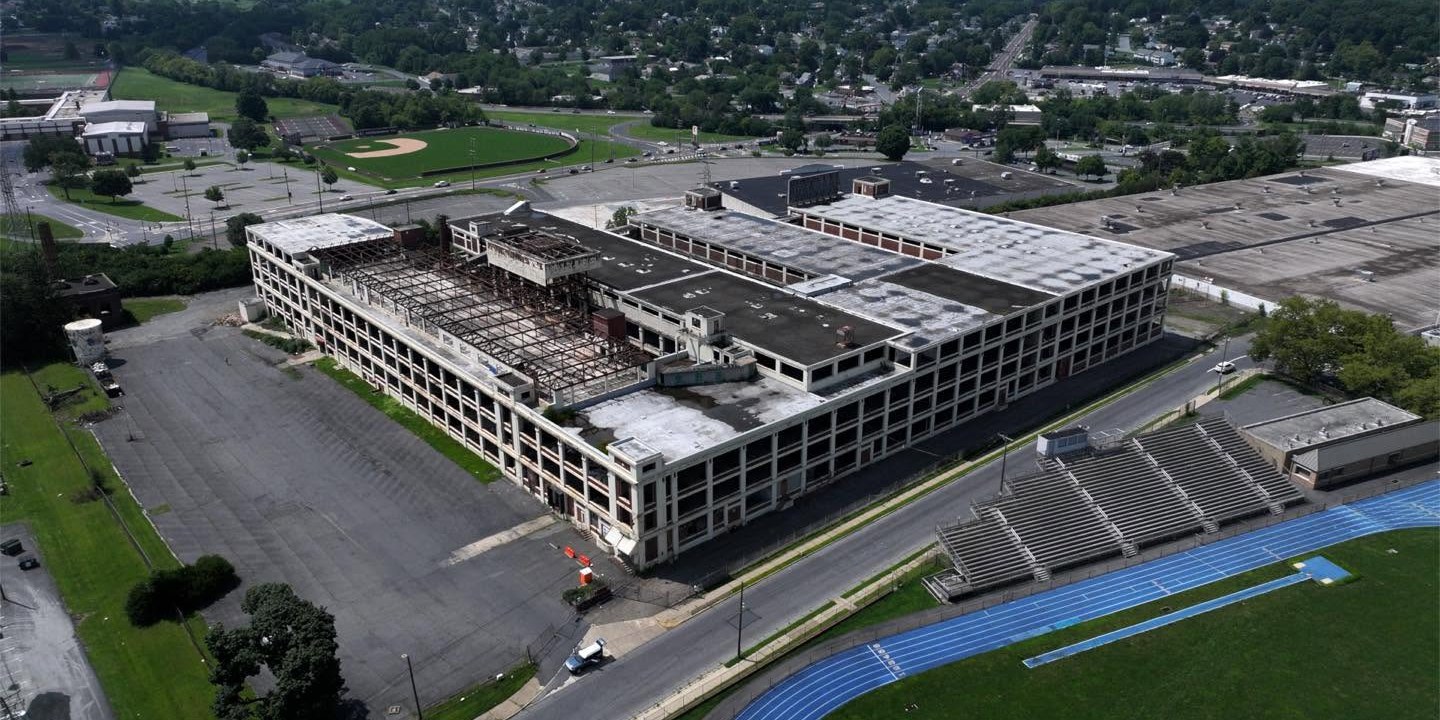
What the closing left behind was not just an empty building. It was a brownfield. The site held a large volume of hazardous waste and materials, underground tanks that had stored industrial chemicals, asbestos and lead paint through hundreds of thousands of square feet. Northampton County Executive Lamont McClure would later describe it as a nearly impossible site to remediate.
Developers pitched ideas over the years and none of them survived contact with the cleanup costs. The property was listed at around $10 million. Meanwhile the building became a regional attraction of the wrong kind: urban explorers filmed inside it, photographers published galleries of its collapsing floors, and the roof opened up to the weather.
On the morning of March 14, 2025, dozens of firefighters were dispatched to a working industrial fire at the complex around 6:42 a.m. Crews came in from multiple towns. Wilson Borough Fire Chief Joe Sipel called the circumstances suspicious.
The developer who took it on
Skyline Investment Group, led by managing partner Brian Bartee, put the building under a purchase agreement and started spending before the deal was fully closed. Bartee has more than two decades in commercial real estate and a personal tie to the area: his mother lives in Easton.
Skyline pulled the old chemical tanks, stripped asbestos and lead paint, and worked the property through Pennsylvania’s Act 2 voluntary cleanup program, then waited on the state Department of Environmental Protection to certify it. By early 2026 the company had put roughly $14 million of its own money into a building it was still trying to finance.
The preservation piece came through on February 20, 2026, when the former Dixie Cup factory was listed on the National Register of Historic Places. That listing does two things at once. It obligates the developer to preserve the building’s historic fabric, and it unlocks historic tax credits that make the arithmetic work. “It’s huge from a preservation perspective,” Bartee said. “This assures that every historic piece of that building is going to be preserved.”
Two votes, two rejections
The financing fight is the part of this story that nearly ended it. Skyline asked for tax increment financing, a 20-year arrangement in which most of the new property taxes generated by the redevelopment would be redirected to pay down the debt that built it.
Wilson Borough approved its share. So did the Wilson Area School District. Northampton County Council was the holdout. On November 6, 2025, council voted 5-4 against the TIF district, splitting across party lines: Democrats Jeff Warren, Kelly Keegan, Jeff Corpora and Ken Kraft in favor; Republicans John Brown, John Goffredo and Tom Giovanni joined by Democrats Ron Heckman and Council President Lori Vargo Heffner against. A negotiated $1.1 million payment to the county’s affordable housing fund did not close the gap.
Opponents called it a handout to a well-heeled developer, and questioned whether the affordable housing contribution was anywhere near adequate for a project of that size. Supporters pointed at four decades of failure on the same parcel.
“We’ve waited over 40 years for this project to get done,” Wilson Borough Council President John Burke said. “It’s a definite letdown.” McClure was blunter, saying council had turned a chance for progress into another chapter of missed opportunity.
Bartee’s response was to keep going. “The project will move forward,” he said. “We’re going to keep spending money.”
Skyline came back with a second request, sweetening the affordable housing payment to $2 million. In June 2026, with a differently composed council, the answer was no again, this time 3-6.
Not everyone is celebrating
The criticism is not only about tax policy. About three quarters of the apartments are planned as one-bedrooms of roughly 900 square feet at around $1,900 a month, with two-bedrooms of about 1,400 square feet near $2,800. The developer calls the range mid-market. Some residents hear something else.
Luke Gumbrecht, a lifelong Lehigh Valley resident, compared the cup to the Statue of Liberty in what it means locally, then put the objection plainly: “No working-class person in this area can afford that.”
The cup comes down
On the morning of April 30, 2026, a 500-ton crane lifted the 50,000-gallon cup off the roof and set it on the ground at about 8:30. A crowd gathered to watch, and much of it was family.
Sue Breen of Easton came because her father worked there. Oliver Gabrielli’s father spent 35 years in shipping and receiving. Barbara Young, a Wilson Borough native, watched because her father walked to work at that plant for 45 years, and her husband Robert’s uncle helped make the cups. Kim Lightcap had family on the line too.
“It’s going to be receiving the care that it needs, and it’s going to be preserved for everybody to enjoy,” Wilson Borough Mayor Donald Barrett said.
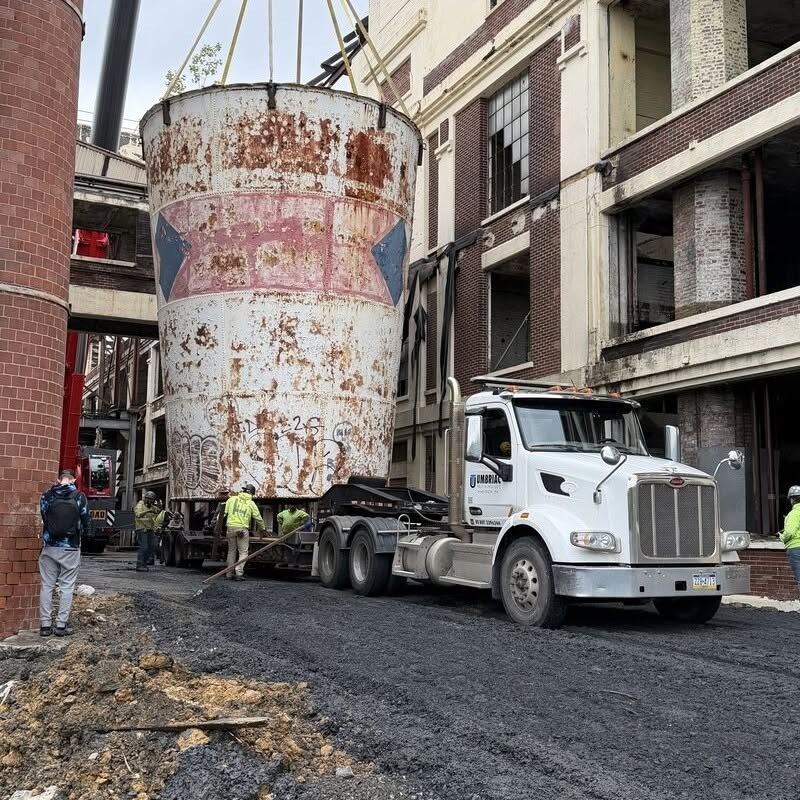
The cup is not going to a scrapyard. Skyline hired Bruce Rosenbaum, a designer known for steampunk restorations and for an episode of the Netflix series “Amazing Interiors,” to refurbish it. The plan is to make the inside of the cup a room: a fiberglass ceiling, Dixie memorabilia, and an AI guide named Trixie to answer visitors’ questions about the factory. A new, larger fiberglass replica is planned for the roof of the finished building.
“This original Dixie Cup is so iconic, but this is going to be the first time in the history of its existence that the whole community will be able to interact with the cup,” Bartee said.
A film crew got there first
Before the apartments, the building got one last role. In August 2026, the shuttered plant served as a location for “Men of Granite,” an independent feature shot across the Lehigh Valley by A Channel of Peace, the nonprofit production company founded by Bethlehem native Daniel Roebuck and his wife, Tammy.
Roebuck, a working character actor for four decades, co-wrote and directed the film with his daughter, Grace Roebuck Butler. The story follows four Vietnam veterans who serve as the honor guard at a memorial cemetery and the 19-year-old sentenced to community service alongside them after damaging the graves. The cast includes Joe Estevez, Touchstone Theatre founder Bill George, John E. Brady, Butch Patrick, and Southern Lehigh High School senior Noah Schafer as the teenager.
The production worked through the Valley from August 1 to 17, filming at Union Cemetery in Hellertown, the Northampton County Courthouse, Hotel Bethlehem, Yocco’s Hot Dogs, Lehigh Valley International Airport and St. Luke’s Sacred Heart campus, with additional scenes planned in Florida.
On August 19 the company posted behind-the-scenes photos from the Dixie site, writing that 1921 Dixie “provided the backdrop for one of our scenes” and thanking the owners for allowing them to film. “These were some deeply emotional scenes for our actors,” the post said. The film is aimed at a Veterans Day 2027 release, which would put it in theaters around the time the first tenants are moving into the building behind those shots.
What is actually being built
The project is branded 1921 at Dixie Avenue, after the year the plant opened. Current plans call for 412 apartments inside the shell of the main building, up from the 405 units approved earlier, along with a movie theater, indoor golf and pickleball, a podcast studio, office and retail space, a public restaurant, a dog-friendly bar and lounge, walking trails, and a park where the restored cup will sit as the centerpiece.
Total cost runs around $185 million. Skyline projects roughly 320 construction jobs and more than 200 permanent positions once the complex is running. The main building is expected to take about 16 months to convert, with leasing beginning roughly eight months after construction starts and completion targeted for 2027. The developer has aimed to break ground in late September 2026.
What Hugh Moore left behind
Moore never moved away. After selling the company he stayed in Easton and spent his later years and a good deal of his money on causes that had nothing to do with paper: peace organizations, world federalism, and population policy. He died in 1972 at 85.
His name is still on the ground here. Hugh Moore Park stretches 520 acres between the Lehigh River and the Lehigh Canal, and the National Canal Museum operates within it. Down the hill, Lafayette College holds the Hugh Moore Dixie Cup Company Collection, thousands of pages covering 1905 to 2008, which is where much of the company’s documented history now lives.
The plant outlasted the man by eleven years and then sat empty for forty-three. If the current schedule holds, people will be living inside it in 2027. A new replica will go up on the roofline, but the original cup, the one that spent a century telling drivers they had reached Easton, will sit restored in the park out front, where people can finally walk up to the thing they spent their whole lives driving past.
At a Glance
- Lawrence Luellen incorporated the American Water Supply Company of New England in 1908, after a Lafayette College study helped turn the shared public drinking cup into a health scandal. The Individual Drinking Cup Company followed in 1910, run by his brother-in-law Hugh Moore.
- The Health Kup was renamed the Dixie Cup in 1919, borrowed from a doll company that shared the building in New York.
- Surging sales during the 1918 flu pandemic pushed the company out of New York. Moore bought 7 acres in Wilson Township at $3,000 an acre and opened an 80,000 square foot plant in April 1921 with 78 employees, 50 of them hired locally.
- A 1936 merger with the Vortex Cup Company produced Dixie-Vortex, renamed the Dixie Cup Company in 1943. Moore sold to American Can in 1957 and stayed in Easton until his death in 1972.
- The Wilson Borough plant closed in 1983 and production moved to Forks Township. Georgia-Pacific closed that plant in 2021, cutting roughly 190 jobs and ending a century of cup-making in the Valley.
- The building sat vacant for 43 years as a brownfield holding chemical tanks, asbestos and lead paint. A fire the borough fire chief called suspicious broke out in March 2025.
- Northampton County Council rejected tax increment financing twice, 5-4 in November 2025 and 3-6 in June 2026, though Wilson Borough and the Wilson Area School District both approved their shares.
- The factory was listed on the National Register of Historic Places on February 20, 2026, which unlocked historic tax credits and obligated the developer to preserve the building.
- The 50,000-gallon rooftop cup was lowered by a 500-ton crane on April 30, 2026, and is being restored by designer Bruce Rosenbaum for display in a public park, with a new replica planned for the roofline.
- In August 2026 the vacant plant served as a filming location for “Men of Granite,” an independent feature directed by Bethlehem native Daniel Roebuck and his daughter Grace Roebuck Butler, aimed at a Veterans Day 2027 release.
- Skyline Investment Group is converting the 640,000 square foot building into 412 apartments with a movie theater, indoor golf and pickleball, a podcast studio, a restaurant and a public park, at a cost of roughly $185 million, targeted for completion in 2027.