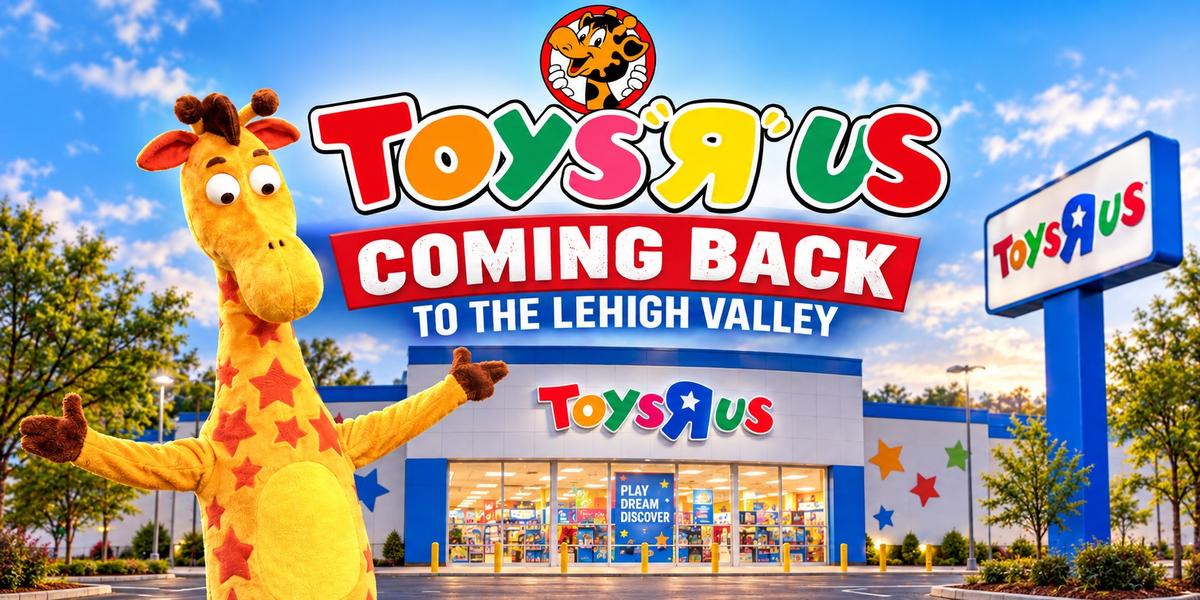
Toys “R” Us returns to Whitehall Township on Thursday, eight years after the Valley’s store went dark and roughly a parking lot away from where it stood. What is opening is a licensed seasonal shop, one of 120 going up nationwide this fall. The company whose name is on the sign no longer sells toys. Understanding why is a story about the Lehigh Valley, and about what private equity did to one of the most dominant retailers America ever built.
What Opens Thursday
The shop is tentatively set to open September 24 on the upper level of Lehigh Valley Mall, near the escalators, in the space Aerie vacated. It is a seasonal holiday store scheduled to run through early 2027, built for the ten or twelve weeks that carry the toy business rather than the ten months that follow.
Inside will be a curated selection rather than warehouse aisles: LEGO, Barbie, Hot Wheels, Pokémon and KPop Demon Hunters, with interactive play zones and appearances by Geoffrey the Giraffe. The national program includes Creator Studios, candy shops and cafés at some locations, though which of those reach Whitehall has not been specified.
Whitehall is one stop on a large map. The brand announced 120 new standalone U.S. stores for this holiday season, taking it from about 40 American storefronts to 160. Twenty-one are in Pennsylvania, among them King of Prussia, Exton Square, Willow Grove, Oxford Valley, Wyoming Valley, Viewmont, Capital City, Millcreek, Ross Park and Monroeville. The Lehigh Valley gets one.
The Valley Had Two of These Stores, and Lost Both in the Same Year
Lehigh Valley Mall sits between MacArthur Road and Grape Street, and for years the “R” Us brands had the block on both sides.
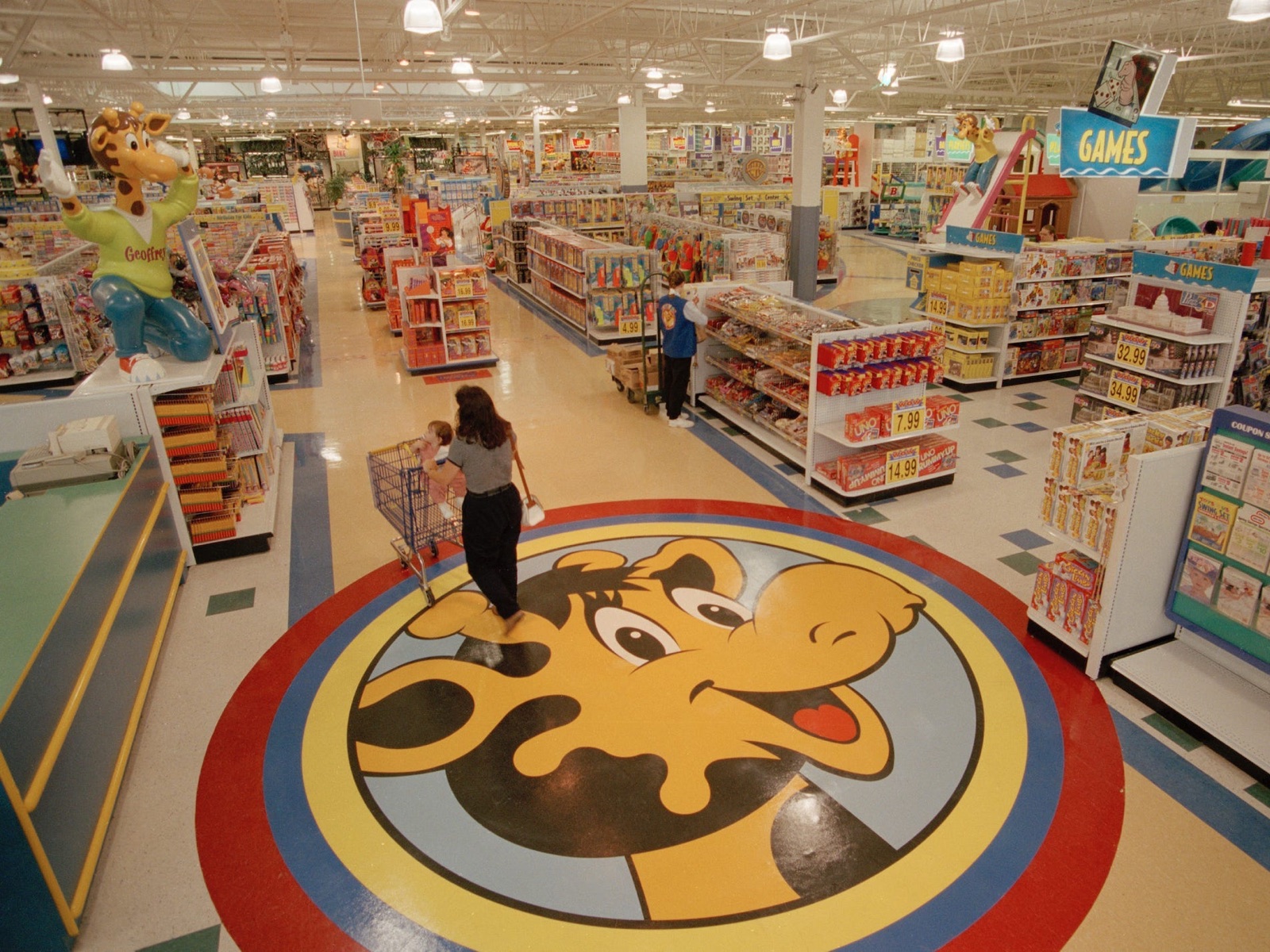
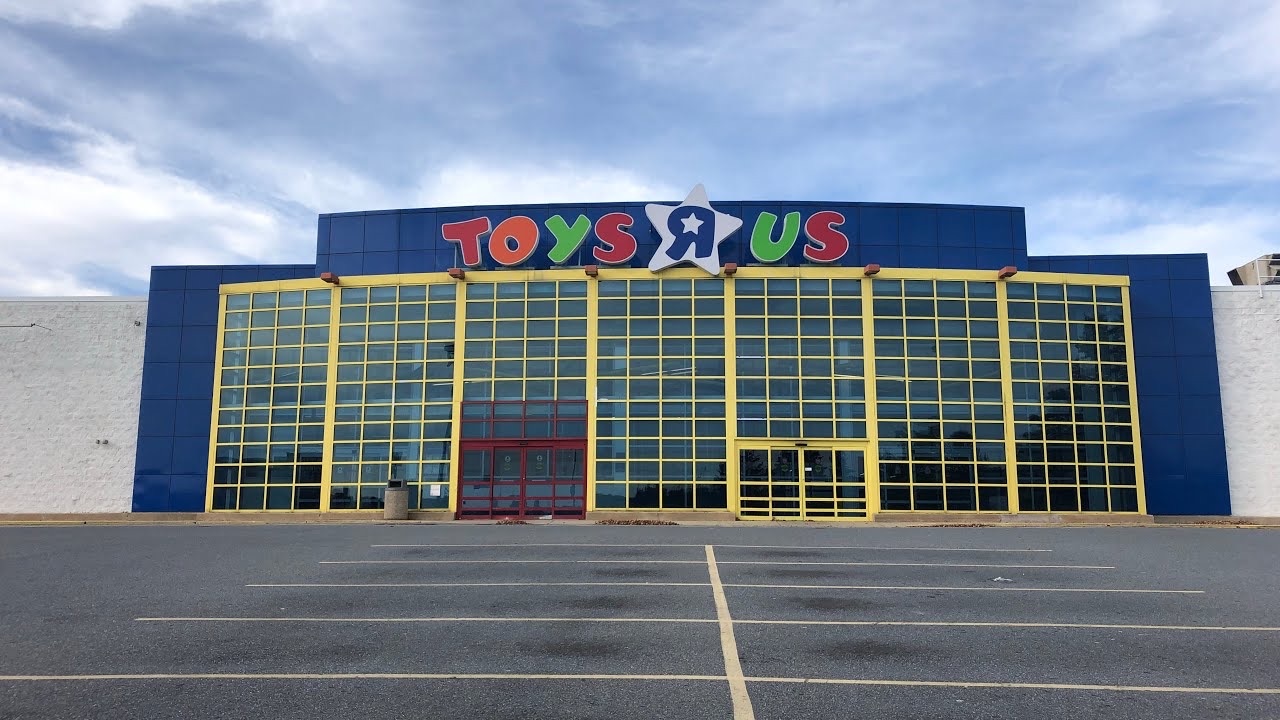
The toy store was at 955 Grape Street, a roughly 42,000-square-foot box of exactly the kind the chain built by the hundreds: high shelves, concrete floor, bicycles hanging overhead, the sealed-glass action figure case you had to find an employee to unlock. It anchored one end of a retail corridor that has been the Valley’s commercial spine since the mall opened on October 6, 1976. A Babies “R” Us operated separately at 600 Lehigh Valley Mall, close enough that a family could handle a baby registry and a birthday present in one trip.
Both closed in 2018, in the same national liquidation that took 28 Pennsylvania stores and finished on Friday, June 29, when the last American Toys “R” Us locations shut their doors after seventy years. The Valley’s employees were let go without severance, as were roughly 33,000 others nationwide.
The Grape Street building then did what empty big boxes do here. It sat vacant for about a year. In December 2019, Lomax Carpet & Tile Mart bought it for approximately $3.2 million and spent heavily to turn the toy shelving into a flooring showroom. “It’s been great to resurrect a beloved Toys ‘R Us building and restore it into a great place for flooring consumers to shop and save,” company president Michael Longwill said then.
Lomax has since moved up the road to MacArthur Towne Center at 2570 MacArthur Road, and the building is on its third life. It is now Tesla Whitehall, the carmaker’s first Lehigh Valley location, listed at 955 Grape Street with showroom hours, demo drives and a service center on site.
Baby gear, then toys, then carpet, then electric cars. One building, tracking what this valley spends money on.
The Brand Never Fully Left, and Most People Missed It
The return being announced this week is not the brand’s first. Toys “R” Us has had a Lehigh Valley address continuously since 2022, inside the Macy’s anchoring the same mall, part of a rollout that put 451 branded shops in every Macy’s in America. Simon’s mall directory lists it. The new seasonal store will open in the same building as a Toys “R” Us that has been operating for four years.
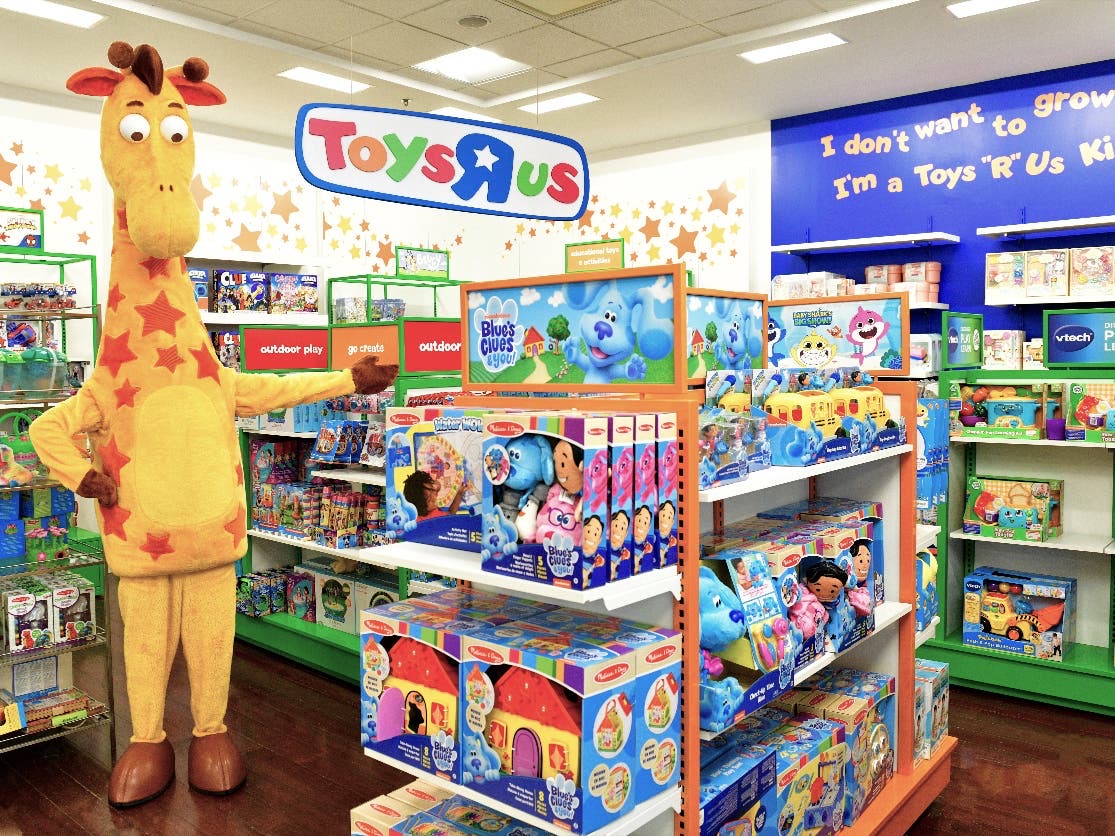
Babies “R” Us came back the same way. In 2024, Kohl’s began installing Babies “R” Us shops in 200 of its stores, nine in Pennsylvania, including Upper Macungie Township and Palmer Township. Both are a short drive from where the real one used to be.
That is the model now, and it is worth being precise about it.
The Company on the Sign Is Not the Company Behind the Counter
Toys “R” Us, the retailer, does not exist. Toys “R” Us, the trademark, is an asset owned by WHP Global, a New York brand management firm holding more than 16 brands that generate upward of $9.5 billion in retail sales. WHP does not operate toy stores. It owns a name and licenses it out.
The operator in Whitehall is Go! Retail Group, a family-owned company from Austin, Texas that has run seasonal retail since 1993 and took on the Toys “R” Us license in 2023. Valley shoppers have met this company before without knowing it: Go! is behind the Go! Calendars, Toys & Games shops that have come and gone at Lehigh Valley Mall and Palmer Park Mall, the sort of store that appears in October and is gone by Valentine’s Day.
“This is a major moment for Toys ‘R’ Us as we significantly expand our presence,” said Jamie Uitdenhooven, executive vice president of Toys “R” Us at WHP Global. Go! Retail Group CEO Gideon Schlessinger made the emotional case: “There’s something special about walking into a Toys ‘R’ Us store.”
He is right about the feeling. It is just worth knowing the feeling is the product, and the lease ends in the spring.
How a Baby Furniture Store Became the Biggest Toy Seller in America
Charles Lazarus opened a baby furniture store in Washington, D.C. in 1948, aimed squarely at the families the postwar boom was producing. He found the flaw in his own business quickly: furniture lasts. A family bought a crib once and never returned. Toys break, children outgrow them, and there is always another birthday.
In 1957 he opened a store in Rockville, Maryland that sold nothing but toys and called it Toys “R” Us. The concept was to run a toy store like a supermarket: vast inventory, self-service aisles, shopping carts, low prices, fully stocked year-round instead of only at Christmas. Nothing like it existed. Geoffrey the Giraffe joined the advertising in 1965.
Interstate Department Stores bought in, acquiring Lazarus’s operations in 1967 and 1969. Then came the chapter almost nobody remembers: Interstate filed for bankruptcy in 1974. The department stores were the failure and the toy business was the only healthy thing left, so the company shed everything else, and in 1978 it emerged under Lazarus with the toy chain’s name on the corporation.
The run that followed made retail history. Toys “R” Us became the definitional “category killer,” the big box that takes one department out of the department store and does it so completely that everyone else quits. Kids “R” Us launched in 1983 to try the same thing with children’s clothing. Babies “R” Us opened in Westbury, New York in April 1996, and in February 1997 the company bought the 78-store Baby Superstore chain for $376 million. Independent toy shops closed across the country, and mall chains like KB Toys were left fighting over what remained.
Losing the Lead
The dominance was shorter than the nostalgia suggests. Starting around 1990, Walmart began treating hot toys as loss leaders, selling them at or below cost to pull families through the door. By 1998 the crown was gone: Walmart took 17.4 percent of the U.S. toy market against 16.8 percent for Toys “R” Us, which had held 18.3 percent a year earlier. The company that had killed the department store toy aisle was beaten by a discounter running its own playbook in reverse.
That same year it signed a ten-year exclusive deal to be the toy seller on Amazon, effectively renting out its own future online. Amazon began selling toys from other vendors anyway. The litigation ran until 2009, when Toys “R” Us collected $51 million and a lost decade it could not buy back. It acquired FAO Schwarz in 2006 and put $35 million into a 110,000-square-foot Times Square flagship with an indoor Ferris wheel, the kind of spending a company does to defend a brand rather than fix a business.
It was a struggling company by 2005. It was not a dying one. It had real estate, $11.1 billion in annual sales for the year ending that January (down 2 percent), and the strongest name in its category.
The Buyout, and How the Structure Actually Worked
On March 17, 2005, Bain Capital, KKR and Vornado Realty Trust announced a $6.6 billion buyout. The deal closed that July 21 and the stock stopped trading.
Here is the part that matters, stated plainly. The buyers did not pay $6.6 billion of their own money. They put in about $1.6 billion of equity and borrowed more than $5 billion, then placed that debt on the company they had just purchased. Toys “R” Us, not its new owners, owed it.
Vornado’s presence explains the second half of the structure. Vornado is a real estate company, and Toys “R” Us owned hundreds of buildings. The stores were split off into property entities, the Propco structure, separate from the operating company. Propco II alone issued $725 million in senior secured notes in 2009, with similar arrangements later in Spain, the United Kingdom and France. The operating company then paid rent to hold the real estate it had owned outright. Property that had been an asset became a monthly bill.
The result was a retailer carrying about $5 billion in long-term debt and spending roughly $400 million a year servicing it. That is $400 million a year that did not renovate stores that were visibly aging, did not raise wages, and did not build the e-commerce operation that might have met Amazon. Competitors were investing. Toys “R” Us was paying interest.
What the Owners Took Out
While the company serviced debt, its owners billed it.
Between 2005 and 2017, KKR, Bain and Vornado collected roughly $464 million from Toys “R” Us: about $185 million in advisory fees, $128 million in transaction fees, $143 million in interest on debt they held, and some $8 million in expenses.
The advisory agreement is worth reading closely. The sponsors were paid $15 million a year, rising 5 percent annually, and the contract specified that no minimum number of hours was required and that the fee was owed whether or not the company requested any services at all.
The transaction fees were 1 percent of the value of any financing activity, which meant the owners earned a cut every time the company borrowed more: $81 million on the 2005 buyout itself, $29 million on a 2010 credit facility amendment, $32 million on a 2014 amendment. Adding debt to the company generated fees for the people who had added it.
Set the numbers side by side. The sponsors put in $1.6 billion of equity. They drew out roughly $464 million in fees and interest over twelve years, independent of whether the company succeeded. When it failed, the equity was written off, but the fees had already been paid and kept.
The Collapse
The end came fast, and the debt is why.
In the summer of 2017, word spread that Toys “R” Us had hired restructuring lawyers. Vendors, who ship goods on credit and get paid later, took that as a warning and began demanding stricter payment terms. For a company with almost no cash cushion, that squeeze was fatal on its own. Days before filing, the board approved roughly $8 million in retention bonuses for executives.
The Chapter 11 filing came on September 18, 2017, with about $5 billion in long-term debt. The stated plan was to reorganize, close weak stores, and keep going. Shoppers in Whitehall were told the store was staying.
Then the holidays arrived. Customers who had read “bankruptcy” in the headlines stayed away, worried about gift cards and returns, and the fourth quarter that had to carry the company did not. Projected to run out of U.S. cash by May, the company filed to liquidate on March 15, 2018, covering roughly 800 U.S. stores. The last ones closed June 29.
Charles Lazarus died on March 22, 2018, at 94, one week after the liquidation was announced.
Who Got Paid, and Who Did Not
Bankruptcy is a queue, and retail workers stand at the back of it.
The 33,000 U.S. employees were laid off without severance. The lawyers and advisers working the case were paid about $56 million. A bankruptcy judge, Keith Phillips, approved roughly $14 million in performance incentives for the top executives, on top of the $8 million paid out just before the filing.
What happened next was unusual. Former employees organized, which nobody expects from a liquidated retail workforce with no union and no jobs. They campaigned publicly against KKR, Bain and Vornado, testified, and pressured public pension funds that invest in those firms, pointing at the $464 million the owners had drawn out. Senator Elizabeth Warren sent letters demanding answers from Vornado and the hedge funds involved.
In November 2018, KKR and Bain agreed to put $20 million into a hardship fund for former workers. The workers had asked for $75 million, the amount the company’s own written severance policy would have paid them. Vornado contributed nothing. Split across tens of thousands of people, the fund came to a few thousand dollars each, and it stands as one of the only times laid-off American workers have extracted anything from private equity owners after the fact.
Some of those people worked on Grape Street.
The Second Life of a Logo
What survived liquidation was intellectual property. A successor company, Tru Kids, formed in January 2019 and tried the obvious thing: opening stores. Two of them, in Paramus, New Jersey and Houston, small and experience-heavy, built with the retail startup b8ta. Both were closed by early 2021, the pandemic finishing what thin margins had started.
WHP Global took a controlling interest in March 2021 and changed the strategy completely. Rather than operate stores, license the name to companies that already have space and staff: Macy’s, Kohl’s for Babies “R” Us, WHSmith for airport shops, the Navy Exchange for military bases, and Go! Retail Group for standalone and seasonal locations. A 20,000-square-foot flagship opened at American Dream in the Meadowlands in December 2021. The brand now claims more than 1,500 locations in about 35 countries, a figure that counts shops inside other retailers, not warehouses of its own.
It is a real business, and a shrewd one. It also carries none of the risk that destroyed the old company, because the entity on the sign signs no leases, holds no inventory and hires no cashiers.
What It Means for the Mall
Lehigh Valley Mall runs to about 1.18 million square feet on two levels, anchored by Boscov’s, JCPenney and Macy’s, and owned in a joint venture between Simon Property Group and PREIT. It has been reworking its tenant list aggressively, with Texas de Brazil and Pop Mart among the arrivals as others have cleared out.
A seasonal Toys “R” Us fits that strategy well. Filling an empty upper-level storefront through the holidays with a name that pulls families off the escalator is close to free traffic for a landlord, and the short term means nobody is wagering much. For Go! Retail Group, a store that opens in the fourth quarter and closes in the first is not a fallback, it is the entire model.
What it is not is proof the Valley is getting a toy store back. If the shop performs, the thing to watch is whether it stays open past the early-2027 date or returns next fall on longer terms. That would be a real signal. A good December will not be.
Worth remembering as well: the independent toy and game shops around Bethlehem, Easton and Emmaus stayed open through all of this, including the years when the name on everyone’s childhood memory was a court docket. They will still be here in February.
On Thursday the sign goes back up in Whitehall, across the lot from where the real one stood. There is no reason not to enjoy it. It is just worth knowing what it is, and what happened to the last one.
At a Glance
- A Toys “R” Us seasonal shop is tentatively set to open Thursday, September 24, on the upper level of Lehigh Valley Mall in the former Aerie space, running through early 2027.
- It is operated under license by Go! Retail Group of Austin, Texas. The brand is owned by WHP Global, which licenses names rather than running stores.
- The Valley once had two “R” Us stores in Whitehall: Toys “R” Us at 955 Grape Street and Babies “R” Us at 600 Lehigh Valley Mall. Both closed in 2018.
- The Grape Street building became a Lomax flooring showroom in 2019 and is now Tesla Whitehall, the carmaker’s first Lehigh Valley store and service center.
- The brand has been in the Valley since 2022 anyway, as a shop inside the Macy’s at Lehigh Valley Mall; Babies “R” Us returned in 2024 inside Kohl’s in Upper Macungie and Palmer Township.
- Bain Capital, KKR and Vornado bought the company for $6.6 billion in 2005 using about $1.6 billion of equity and more than $5 billion of borrowed money placed on the company itself.
- The owners collected roughly $464 million in fees and interest from 2005 to 2017, including a $15 million annual advisory fee that required no minimum hours of work.
- Debt service ran about $400 million a year. The company filed Chapter 11 on September 18, 2017 and liquidated on March 15, 2018, closing the last U.S. stores on June 29 and ending about 33,000 jobs with no severance.
- After a worker campaign, KKR and Bain funded $20 million in hardship payments in November 2018. Workers had sought $75 million. Vornado paid nothing.
- Founder Charles Lazarus died March 22, 2018, a week after the liquidation was announced.