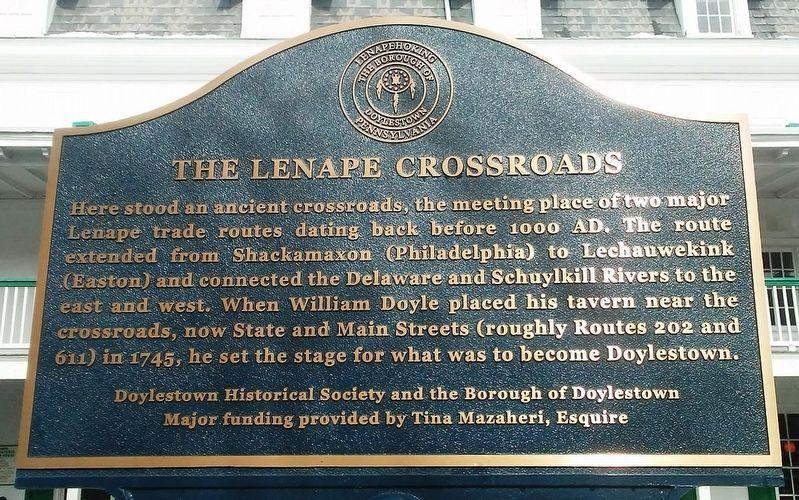
Stand at the point where the Lehigh River flows into the Delaware in Easton, Pennsylvania, and you are standing on ground that has been a crossroads for centuries. The Lenape people called this place Lechanwitauk, "The Place at the Forks", and for thousands of years before European contact, it was a gathering place, a trading post, and a site of cultural significance.
Penns Purchase and the Founding
In 1736, Thomas Penn, son of Pennsylvania founder William Penn, purchased the land at the forks of the Delaware. He had the site surveyed by Benjamin Eastburn, and in 1752, the city was formally named Easton, honoring Lady Juliana Fermor, Thomas Penns wife.
Before the American Revolution, Easton was the largest and most commercially significant community in the area, dwarfing both Bethlehem and Allentown. Its position at the confluence of two major rivers made it a natural hub for trade and transportation.
The Canal Hub
Eastons golden age as a transportation center came with the canal era. At Easton, the Lehigh Canal met the Morris Canal and the Delaware Division of the Pennsylvania Canal, creating one of the most important waterway junctions in the northeastern United States. Coal from the Lehigh Valley mines flowed through Easton on its way to markets in New York, Philadelphia, and beyond.
The canals brought prosperity and population. Eastons waterfront bustled with activity: boats loading and unloading, mule teams working the towpaths, merchants and laborers filling the streets. The city became a vital link in the supply chain that powered Americas industrial revolution.
The Crayon Capital
In 1900, a company called Binney & Smith opened a mill on Bushkill Creek in Easton, producing slate school pencils. Three years later, in 1903, the company produced something that would change the childhood of every American kid: the first box of eight Crayola crayons, selling for a nickel.
The name "Crayola" was coined by Edwin Binneys wife Alice, who combined the French word "craie" (chalk) with "ola" from "oleaginous" (meaning oily). From that small Easton factory, Crayola crayons spread to every classroom, every kitchen table, every childs hand in America.
The Crayola Experience, originally called The Crayola Factory when it opened in 1996, now operates as a major family attraction in downtown Easton, drawing visitors from across the region to the place where those first eight colors were born.
A City of Firsts and Crossroads
Eastons history is a history of convergence: rivers meeting, canals crossing, cultures mingling. It was one of only three cities where the Declaration of Independence was publicly read on July 8, 1776. Its Centre Square has been a gathering place for centuries. Lafayette College, founded in 1826, has educated generations on the hill above the forks.
Today, Eastons revitalized downtown (with its farmers market, restaurants, galleries, and the Crayola Experience) reflects the same spirit of convergence that has defined the city since the Lenape gathered at Lechanwitauk. The rivers still meet at the forks, and the city they created continues to reinvent itself.