
Bob Agentis has a question for the Bethlehem Parking Authority. Bethlehem “attracts many visitors to beautiful Downtown Bethlehem, a UNESCO destination,” he wrote this week in a long public Facebook post. So is parking enforcement until 9 p.m., in a limited two-hour zone, discouraging them from coming?
Agentis says he has been asking downtown merchants the same thing. “I have spoken to a few merchants who have expressed extreme frustration and disappointment with BPA,” he wrote. Some, he said, described their business as down “as much as 40%.” His conclusion: “While AI is increasing revenue for the Parking Authority,” there may be an adverse effect on retail commerce. He urged readers to ask local merchants “on your next visit on how the decision of BPA is affecting their businesses.”
Agentis is not a casual critic. He is a lifelong Bethlehem resident and Liberty High School graduate who worked several jobs, including a stint at Bethlehem Steel, before beginning a real estate career in 1967. He ran his own firm, Agentis Real Estate Corporation, from 1978 to 2015, working in commercial property, development, leasing and management across the Valley. Many more people know him for what he did after his wife of 47 years, his Liberty High sweetheart Judith Adele Agentis, was diagnosed with pancreatic cancer in 2012. He kept vigil at St. Luke’s Hospice House in Bethlehem and lost 35 pounds living on vending machine food. In 2013 he founded the Judith Adele Agentis Charitable Foundation “to make sure no one feels alone or depleted during those final chapters.” It began delivering weekly meals from Lehigh Valley restaurants to the hospice house and served more than 20,000 of them before the pandemic. In July the foundation presented a $45,500 gift to St. Luke’s, part of more than $100,000 it has given to the network’s hospice and palliative care programs since 2020.
The people who answered him did not need convincing. “Bethlehem parking authority is killing Bethlehem like a cancer. I’m sad. Something should be done,” wrote Matthew Suter. “Thanks for doing the homework Bob,” Sharon Weiner replied. “We don’t go downtown much anymore, unfortunately. Parking is the biggest deterrent.”
The thread kept circling back to one idea: other towns got rid of paid parking, and their downtowns came back to life. “Wonder if the city looked at the possible increase in revenue from businesses if the BPA was terminated,” Bill Bakos wrote. “Worked in Naples.” Michael Martucci agreed that Naples built “parking garages that are free” and “business is booming.” Agentis added that “it worked in Perth, Ontario, as well.”
It is a fair question, and a checkable one. So we went looking for the towns that actually removed meters, made downtown parking free or dissolved a parking authority, what happened to their businesses afterward, and what the research says about whether any of it would work in Bethlehem.
In August we explained who really owns parking in the Lehigh Valley and where all that money goes. This is the next question: whether Bethlehem needs to be charging for it at all.
What Parking Costs in Bethlehem Now
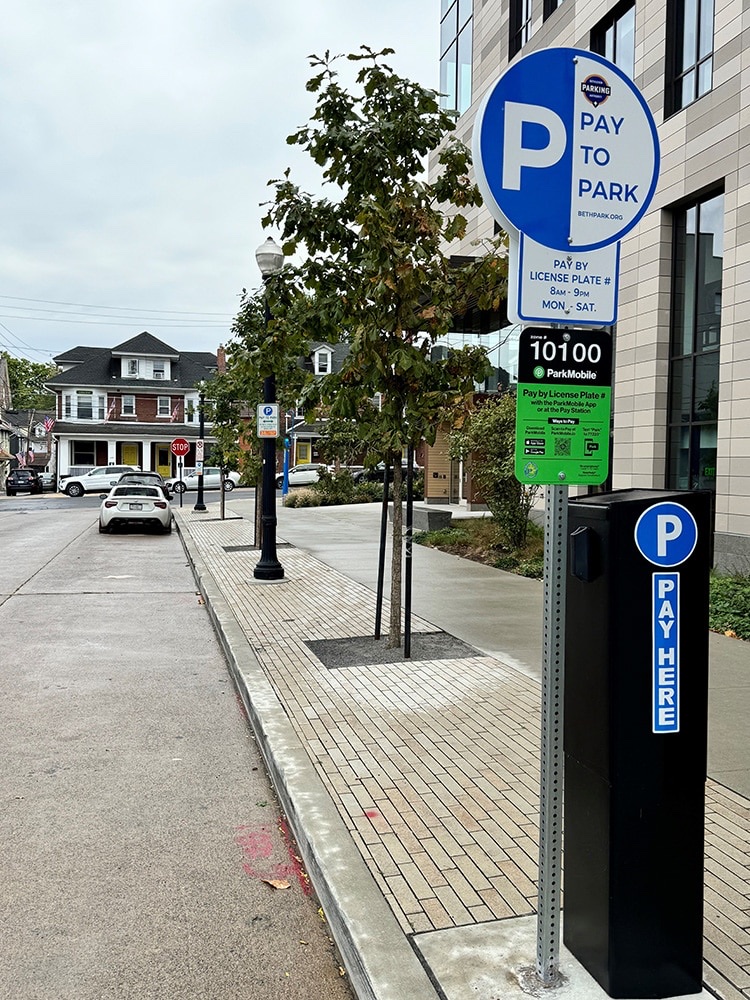
Start with the price, because it is higher than many people assume. Since ParkBethlehem launched in September 2024, the core downtown blocks, known as the RapidPark zone, cost $2.50 an hour with a two-hour limit. That rate had been $1.50. The walkable blocks just outside the core cost $1.50 an hour with a three-hour limit. Garages and lots cost $1.50 an hour, up from $1.
The on-street increase started with a vote. On February 29, 2024, the three Parking Authority board members present, Mark Jobes, Eugene Gonzalez and Karen Widrick, unanimously approved higher garage and lot rates drawn from a rate study by THA Consulting of Blue Bell, and sent the mayor a recommendation to raise high-demand meters by $1.00 an hour. Under city law the Authority only recommends meter rates; the mayor holds a public hearing and decides. The increase took effect that September.
Meters are enforced from 8 a.m. to 9 p.m., Monday through Saturday. That means a two-hour dinner on Main Street carries a $5 parking charge before anyone orders. “I think about the parking cost even going out to dinner,” Douglas Kilpatrick wrote in the thread. “Add $2.50 or more to the check. They’ve expanded the metered parking by a couple of blocks out from downtown.”
Miss the meter and the cost climbs. Under the city’s parking ordinance, an expired meter or overtime ticket is $15 if paid within 14 days, $35 after that, and $55 once a citation is issued. The Authority says fines across all violations run from $15 to $100, and unpaid tickets can end up before a district judge. It does not publish the fees to release a booted or towed car.
Those tickets add up to real money. The Authority’s 2026 budget projects $1.94 million in violation revenue.
Residents feel it too. Agentis wrote that in downtown neighborhoods, restrictions “limit opportunities to park even in front of your own home without having to purchase a permit.” Residential permits cost $20, with $10 renewals, and in December 2025 the Authority ended a practice, more than 20 years old, of issuing permits to vehicles not registered at an address inside the zone.
The Sensors Watching the Curb
Agentis also pointed to the technology behind enforcement, noting that the objective was “to reduce congestion and encourage people to use the Parking Garages.” The Authority works with Cleverciti, a Munich company whose AI-powered sensors mount above the street and track parking spaces from overhead. According to Cleverciti, a single sensor can cover up to 100 spaces.
The rollout, pieced together from the company’s announcements and the Authority’s own minutes:
- March 2025: Cleverciti announced a pilot with the Authority. It collects “occupancy, turnover, and compliance” data. Authority minutes describe a sensor pilot at The Commons lot that tracks arrivals, departures and payment compliance.
- October 1, 2025: Cleverciti announced an expansion in Bethlehem. The company said “automated alerts will notify officers when violations occur.”
- October 23, 2025: ParkHelp, a parking guidance company, closed its purchase of Cleverciti, which now operates as a wholly owned subsidiary.
- December 2025: the board approved $50,000 for Cleverciti parking availability signs. Two are at Broad and Long streets and at Broad and Rubel. Possible future sites include the 300 block of Main Street, the Main Street Bridge and the South Side.
- 2026: the Authority set a goal of piloting on-street occupancy sensors. Its April agenda listed “Parking Sensor Installation” and its June agenda listed a “Main Street Sensors Update.”
Earlier, the Authority budgeted $70,000 in 2024 for license plate readers in its lots. A separate 2023 smart loading zone pilot with a different vendor, Automotus, used plate-reading cameras.
A person still writes the ticket. City ordinance says an officer places the violation notice, and Cleverciti describes its goal as “achieving compliance rather than issuing tickets.” The Authority has not published how many sensors are installed, where they are, or how often their alerts lead to a citation.
The Towns People Point To
Naples, Florida. Downtown Naples does not charge to park in its public garages. The city built its first free garage in the Fifth Avenue South district in 1998 and a second in 2008, and a third, on First Avenue, cost $16 million for 364 spaces and was due to open in early 2025. They are not free to build. The garages are paid for by the city’s Community Redevelopment Agency, using tax dollars from homes and businesses inside a 550-acre district. The street’s revival also had a plan behind it: in 1993 merchants hired the planner Andres Duany, whose redesign helped turn what was then a dormant six-block shopping area into a regional destination. Free parking was part of a larger bet, not the whole of it.
Perth, Ontario. Perth gives drivers two hours of free on-street parking downtown, and asks them not to return to the same area for five hours. The program is funded jointly by the town and the Downtown Heritage BIA, the local business improvement association. Parking in town lots is not free: it costs $1.50 an hour, with no charge after 5 p.m. or on weekends. Perth is less a town without paid parking than a town where the downtown businesses help pay for the free spaces.
Lindsay, Ontario. This is the clearest success story we found. Downtown Lindsay went to free parking in 2015. By 2019, use of downtown spaces during busy periods had risen from 61 percent to about 80 percent, and the downtown business association’s general manager reported a “record low vacancy rate.” There was a cost. Without meters, the two-hour limit stopped being taken seriously, and the mayor acknowledged that “when we took them out the level of enforcement was lowered.”
West Dearborn, Michigan. In 2015 the city ended paid parking in its decks, lots and most meters, explicitly to attract developers, and paid for it through its Downtown Development Authority and general fund. It kept about 40 meters to keep customers turning over. “People don’t like to pay for parking,” merchant John Lossia said at the time.
Phoenixville, Pennsylvania. Closer to home, Phoenixville dissolved its parking authority in 2010. We did not find published data on how that changed downtown business, but it shows a Pennsylvania borough can do it.
Napa, California. Napa removed its downtown meters about three decades ago and has resisted bringing them back. In October 2023 its city council voted 4-1 against reinstating paid parking, even though the Downtown Napa Association and the local chamber of commerce supported it.
The Town That Went Back and Forth
Sarasota, Florida is the cautionary tale, and it cuts both ways. The city installed about 400 meters at $1 an hour in May 2011. Less than a year later, commissioners voted 3-2 to pull them out, recovering $23,500 of the $414,000 the meters had cost. Paid parking returned in 2019 at $1.50 an hour, after the city pointed to a long-running deficit in its parking fund. “Right now, for me, it’s a disaster,” one restaurant owner said.
The latest turn is the one Bethlehem should notice. In March 2026 Sarasota extended its enforcement hours. By August 4, commissioners had unanimously suspended the longer hours. “We talked to ourselves,” Vice Mayor Kathy Kelley Ohlrich said. “Clearly, it wasn’t the right thing.”
Other cities have pulled meters for a simpler reason: they lost money. Port Huron, Michigan removed its last 200 meters in 2022 after collecting $6,250 in a year while spending $16,893 to run them. Fort Smith, Arkansas voted 6-0 to remove its meters in August 2025. Corpus Christi, Texas is taking out 845 meters this year after a study found demand did not justify them. Those cases say little about Bethlehem, whose meters make money, but they show that removing meters is an ordinary municipal decision, not a radical one.
What the Research Actually Says
The honest answer is that paid parking can hurt a downtown or help it, and the dividing line is how full the spaces are.
When spaces sit empty, fees drive customers away. A peer-reviewed 2014 study by Kurt Hymel in the journal Economics of Transportation examined what happened to customer traffic when meters went in near two Starbucks locations. Where plenty of spaces were open, “a small 50 cent per-hour parking fee deters commerce,” reducing customer traffic “by almost 30%.” Where spaces were already full, he found “no evidence that meters help to increase customer traffic.”
A 2013 British study of roughly 90 towns, commissioned by parking and town center management groups, found that mid-size and smaller towns charging above-average parking rates saw a steeper-than-average decline in shopper foot traffic. The authors cautioned that this did not “conclusively demonstrate” that the charges were the cause.
When spaces are full, pricing can help. The best-known example is Old Pasadena in California, which installed $1 meters in 1993 and kept all the revenue in the district, using it to repay $5 million in street improvements. Before the meters, researchers found, employees had been taking the most convenient curb spaces. Afterward, sales tax revenue in the district rose quickly and soon passed that of a nearby mall with free parking. San Francisco’s SFpark program, which adjusted prices block by block, cut drivers circling for spaces by 30 percent in its pilot areas, though the city said its sales data could not prove cause and effect.
Free parking has a known failure mode. A 2015 review for the Welsh Government found that blanket free parking was used “primarily by town centre workers,” and so had “an unexpectedly negative impact” on shopper foot traffic. That is the same problem Lindsay ran into: take away the meter and employees park out front all day.
Merchants and shoppers often see it differently. A 2006 study in Bristol, England surveyed 126 retailers and 840 of their customers. The retailers estimated that 41 percent of shoppers arrived by car. The real figure was 22 percent. That finding does not translate neatly to Bethlehem, where far more visitors drive in, but it is a reminder that the loudest parking complaints and the actual effect on sales are not always the same measurement.
What It Would Mean for Bethlehem
The Authority already has the data that would settle the argument. Hymel’s research turns on one question: are the spaces full or empty? Bethlehem’s core blocks are priced as if they are the busiest in the city. If Weiner, Kilpatrick and the others are right that people are staying away, those blocks should now have open spaces at $2.50 an hour, and that is precisely the situation where the research says a fee costs businesses customers. The Cleverciti sensors the Authority is installing measure occupancy and turnover. That data exists. It has not been made public.
Elected officials have more power over this than it looks. The Parking Authority is independent, and its board is appointed by the mayor. But under city law, meter rates are set by the mayor after a public hearing, not by the board, and fines are set by City Council ordinance. So the $2.50 core rate, the 9 p.m. enforcement and the ticket schedule are not entirely out of voters’ reach. Sarasota rolled back its longer enforcement hours in less than five months once its commissioners decided it had been a mistake.
Getting rid of the Authority is harder than getting rid of meters. Bethlehem’s Parking Authority owns garages, and garages carry debt; the Authority’s 2026 budget lists $5.2 million under debt. In Morgantown, West Virginia, the bonds that financed that city’s garages include a condition that parking cannot be offered for free. We have not seen the terms of Bethlehem’s bonds, and whether they carry a similar condition is a question the Authority can answer. Any plan to dissolve the Authority, as Phoenixville did, would have to account for that debt.
Free parking costs someone. Naples pays for its free garages through a redevelopment tax district. Perth’s free street parking is funded partly by its downtown businesses. The Parking Authority brought in about $11 million in 2025, according to preliminary figures in its January minutes, and paid the city $650,000 across two transfers late that year. Making downtown parking free would mean deciding who covers that instead.
The merchants have not yet spoken on the record. The merchants Agentis talked to tied their losses to the period since the Authority began working with Cleverciti and ParkHelp. We have not been able to confirm sales figures independently, and Agentis’s advice to ask merchants directly is good advice. Publicly, the Downtown Bethlehem Association and the SouthSide Arts District advisory board endorsed ParkBethlehem in 2024. If you own a business downtown and parking has changed your numbers, we want to hear it: team@lehighvalley.com.
Questions for the Authority
LehighValley.com is putting these questions to the Bethlehem Parking Authority and will publish its answers:
- What share of RapidPark spaces are occupied, by hour, before and after the September 2024 rate increase?
- How many Cleverciti sensors are installed, where, and how many citations have followed a sensor alert?
- What did the THA Consulting rate study cost, and what did the Authority pay for the Cleverciti contract?
- Do the Authority’s bonds require it to charge for parking?
- What are the boot, tow and release fees, and how many unpaid tickets trigger a boot?
Where to Weigh In
The Bethlehem Parking Authority board meets on the fourth Wednesday of the month at 4 p.m. The next scheduled meeting falls on Wednesday, September 23, at the Authority’s office, 85 W. North St. The board has canceled or moved several meetings this year, including in February, May and July, so call ahead at 610-865-7123 to confirm.
“Let’s all go,” Kilpatrick wrote.
At a Glance
- Bethlehem’s RapidPark core costs $2.50 an hour with a two-hour limit, up from $1.50. Outer FlexPark blocks cost $1.50 an hour, and garages and lots cost $1.50 an hour.
- Meters are enforced 8 a.m. to 9 p.m., Monday through Saturday.
- An expired meter ticket is $15 if paid within 14 days, $35 after that and $55 once a citation is issued. The Authority budgets $1.94 million in violation revenue for 2026.
- Three board members, Mark Jobes, Eugene Gonzalez and Karen Widrick, voted on February 29, 2024 to raise garage and lot rates and to recommend a $1.00 increase for core meters.
- The Authority uses AI sensors from Cleverciti, a Munich company bought by ParkHelp in October 2025. Sensors alert officers; officers write the tickets.
- Naples, Florida offers free downtown garages, paid for by a redevelopment tax district. Perth, Ontario offers two free hours on the street, funded by the town and its downtown business association.
- Lindsay, Ontario went to free downtown parking in 2015 and reported record low vacancies, though time limits became harder to enforce.
- Sarasota, Florida removed its meters, brought them back, and in August 2026 suspended longer enforcement hours it had approved in March.
- Research finds parking fees hurt business when spaces sit empty and can help when spaces are full.
- The Parking Authority board’s next scheduled meeting is 4 p.m. Wednesday, September 23, at 85 W. North St. Call 610-865-7123 to confirm.