Parking has quietly become one of the most contested issues in Lehigh Valley downtowns. Allentown, Bethlehem and Easton have all raised rates, redesigned their meter systems and leaned harder on parking revenue, while residents and business owners push back at council meetings and parking summits. And in Hellertown, where downtown parking is still free, a new $19,340 borough study could determine whether that lasts.
But before the question of what parking costs comes a stranger one: who is actually charging you? In two of the Valley’s three cities, the answer is not city hall.
The Meters Don’t Belong to the City
Parking in Pennsylvania is usually run by a parking authority, and a parking authority is not a city department. Under state law it is a separate body corporate that, in the statute’s own words, “shall not be deemed to be an instrumentality of the municipality.” It has no taxing power. It issues its own debt. It owns its own garages. Its revenue is its own.
What the city keeps is the appointment power. In both Allentown and Bethlehem the mayor appoints the authority’s board, and each authority is carried as a “component unit” of the city in the annual audit. So the people setting most parking prices are appointed rather than elected, and the money they collect largely stays inside the authority instead of flowing to city services.
Easton is the exception, and that is exactly why its parking story reads so differently from the other two.
Bethlehem: Demand-Based Pricing and a Rate Schedule Locked In Through 2040
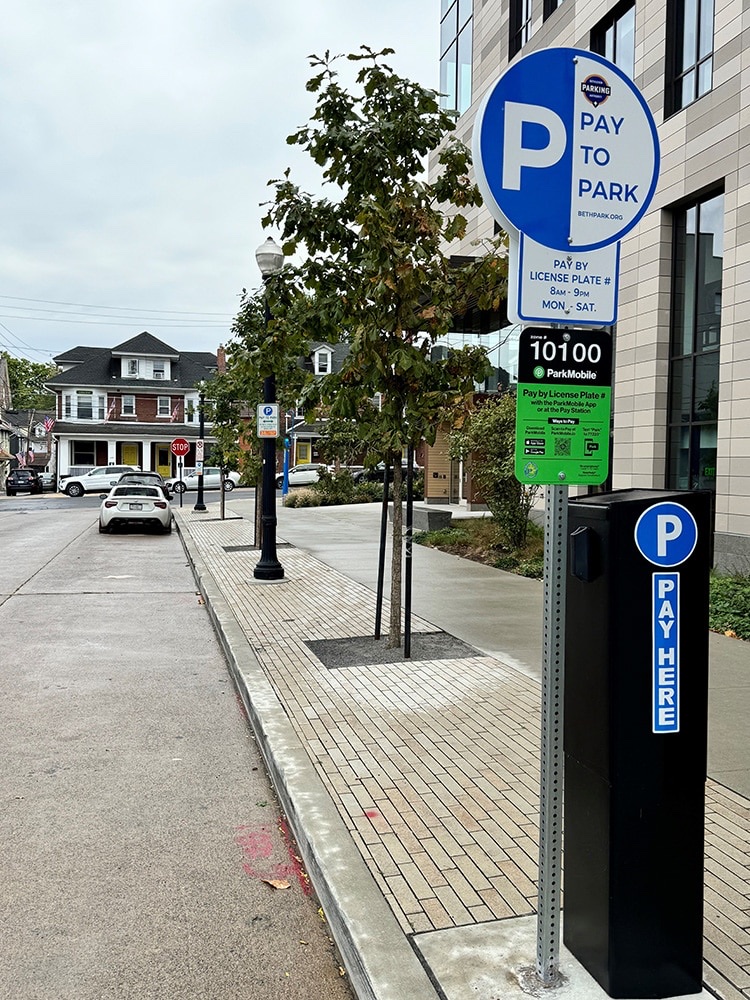
Bethlehem runs the most sophisticated parking operation in the Valley. In September 2024, the Bethlehem Parking Authority launched ParkBethlehem, the city’s first demand-based meter system, splitting downtown into two zones:
- RapidPark Zone: The core downtown blocks, about 30 percent of the meter system, at $2.50 per hour with a two-hour maximum. These premier spots previously cost $1.50 per hour with a three-hour limit.
- FlexPark Zone: Walkable blocks just outside the core, at $1.50 per hour with a three-hour maximum.
- Garages and lots: $1.50 per hour with a $12 daily maximum and no time limits. Parking is free on Sundays and holidays, except during special events.
Reserving a metered space with a meter bag costs $25 per day and requires two business days’ notice.
What actually went up. The increases behind the new system were steep. On-street rates in the high-demand core rose from $1.50 to $2.50 per hour, a 67 percent jump and the first on-street increase since 2019, while the maximum stay in those same spaces was cut from three hours to two. Off-street transient parking rose from $1 to $1.50 per hour, its first increase since 2021. All-day event parking went from $10 to $15. Lower-demand FlexPark blocks were held at $1.50, with their first 50-cent increase not scheduled until 2028.
The strategy is deliberate. Parking Authority Executive Director Steven Fernstrom framed the pricing as a way to “encourage turnover in your high-demand blocks and incentivize parkers to park at low-demand and off-street assets by providing a cheaper rate.” Charge more for the most convenient curb space, cap how long anyone can sit in it, and employees and all-day parkers move into garages that would otherwise sit half empty.
The Authority also locked in a schedule of off-street increases recurring every four years through 2040. Transient hourly rates rise 50 cents each cycle. Daily maximums climb $2 in 2028 and again in 2032, then $4 in both 2036 and 2040. Rates at the Broad Street Lot and the garages rise between $5 and $10 depending on the year. Event parking adds $3 in 2028, $2 in 2032, and $5 in both 2036 and 2040. Barring a reversal, a driver parking downtown in 2040 will be paying rates set in 2024.
And there is less parking than there used to be. While prices climbed, the downtown core lost spaces. The rebuilt Walnut Street Garage opened in November 2025 with 517 spots, replacing an older garage that held roughly 770, a net loss of 253 spaces, or about a third of that facility. The $27 million project was intentional rather than accidental: officials called the smaller garage “right-sized,” and the design freed an adjacent parcel near Main Street for retail and housing instead of underused parking deck. It is a deliberate bet on downtown density, but the practical result is that Bethlehem is charging more per hour for a slightly smaller pool of spaces.
Who sets the price. Authority over Bethlehem parking is split three ways, and the split explains a lot. The Bethlehem Parking Authority, established by city ordinance in 1988 and carried as an enterprise fund in the city’s books, sets garage and lot rates on its own. That is how a schedule of off-street increases running all the way to 2040 could be approved by an appointed board. On-street meter rates work differently: those went before the mayor and a public hearing before taking effect. Fines, which run from $15 to $100, are set by City Council ordinance. The Authority is technically independent, but the mayor appoints its board.
The friction: Bethlehem’s rate hikes have historically drawn resistance. When meters last jumped citywide, downtown merchants argued that Main Street’s mom-and-pop shops compete directly with the Promenade Shops and Lehigh Valley Mall, where parking is free, and that every dollar added at the curb makes downtown a harder sell. Business groups like the Downtown Bethlehem Association and SouthSide Arts District ultimately signed on to ParkBethlehem after the Authority built the program around their feedback, but the underlying tension between parking revenue and retail convenience hasn’t gone anywhere.
Allentown: The Cheapest Meters in the Valley, Paid For by Tickets
Allentown has the Valley’s largest parking operation and, by a wide margin, its cheapest meters. On-street parking runs $1 per hour. Two hours at an Allentown meter costs $2, against $5 in Bethlehem’s core and $6 at Easton’s Centre Square.
The Allentown Parking Authority, incorporated by City Council in November 1984 and governed by a five-member board appointed by the mayor, runs five Center City garages, leases 29 surface lots and a ramp, and oversees more than 1,500 meters, roughly 4,020 spaces in all. Its 2024 audit states plainly that the Authority “receives no financial support from the City, Lehigh County or Commonwealth of PA and has no taxing power.”
So where does the money come from? Not the meters. In 2024 the Authority collected $985,722 from meters and kiosks. It collected $5,867,364 from parking fines, penalties, scofflaw collections, towing, booting and release fees. Enforcement brought in roughly six times what the meters did.
That ratio is the structural fact underneath years of complaints in Allentown, where critics have long argued the Authority polices downtown as a revenue exercise. A cheap meter paired with aggressive ticketing is a coherent business model. It is simply a different one from Bethlehem’s, and it puts the cost on the person who slips up rather than the person who parks.
The debt: The Authority closed 2024 carrying $58,031,651 in outstanding bonds, with annual debt service of roughly $4.8 million, about $1.8 million of that principal and $3 million interest. In March 2024 it bought the 1,200-space 940 Linden Deck for $13.4 million, betting on crowds from the Moxy Hotel and the Archer Music Hall. Its debt service coverage improved to 1.19, up from 0.92 the year before, meaning the operation had recently been earning slightly less than it owed.
What the city gets: $209,280. That was the Authority’s transfer to the City of Allentown in 2024, against gross revenue of about $13.8 million. Allentown’s parking system is not a municipal piggy bank. It is a self-contained business that exists largely to service its own bonds.
Easton: A 31 Percent Parking Revenue Jump Is Balancing the Budget
Easton’s approach is more direct: parking is a budget line, and it’s growing fast.
The city’s 2026 budget projects roughly $4.45 million in combined meter and facility revenue, a 31.4 percent increase over 2025. That money is a key reason Easton has not raised property taxes in 18 years, a streak the 2026 budget extends to 19. During budget season, council members openly discussed meter rates as a lever to fund new hires and city services.
The resulting increases took effect on New Year’s Day 2026:
- Centre Square meters: $3 per hour, up from $2, with a two-hour limit
- Unit blocks off the Square (first blocks of North Third, South Third, East Northampton and West Northampton): $3 per hour, up from $2, with a three-hour limit
- All other metered spaces: $2.75 per hour, up from $1.50, with a three-hour limit. This is the largest jump in the city, an increase of more than 80 percent, and it covers most of downtown’s meters.
- Northampton Street lot: $3 per hour, up from $2, with a 10-hour limit
- North Fourth Street lot, first floor: $2.50 per hour, up from $2, with a two-hour limit
- Garages (South Third Street and North Fourth Street): a flat $2.50 per hour at all times, replacing a split structure that charged $2 during the day and $3 overnight at North Fourth. The discounted after-hours rate was eliminated.
Residents are paying more to park outside their own homes, too. Easton’s residential parking permit is rising to $175 per year for a household’s first car, $225 for the second and $275 for each additional vehicle. In his budget message, the mayor noted the permit program began in 1987 and argued that it has, over time, added to the parking squeeze for visitors, shoppers and diners.
Who sets the price. Easton is the outlier, and the plainest statement of it comes from the city’s own financial condition assessment: “Easton’s parking enforcement is run by City government.” The city collects the money from on-street meters, three parking lots and two downtown garages, and leases additional spaces from Northampton County and from the private owner of the Social Security Administration building. Parking revenue is carried as an ordinary General Fund line, listed alongside earned income tax and sewer revenue, which is exactly why it can be spent on everyday services and used to hold down property taxes.
An Easton Parking Authority was created by ordinance in 1951, and the city still lists a three-member board for it. But no agendas or minutes have been posted for that board since December 2021, and neither the 2026 budget message nor the city’s financial condition assessment mentions a parking authority anywhere. Whatever its formal status, it is not the body running the meters. Rates in Easton are set where every other city charge is set: in the mayor’s budget and council’s public hearings. That is why parking increases arrive alongside trash fees and police hiring, and why elected officials rather than appointees absorb the complaints.
The friction: Easton has just over 1,800 public parking spaces, and nearly half sit in its two garages, the Third Street Garage (2015) and the Fourth Street Garage (2023). The roughly 1,000 remaining street spots routinely fill up as the city grows and new apartment units keep coming online. Longtime residents say finding a spot downtown has become noticeably harder, and some accuse the city of mismanaging the system rather than lacking supply, pointing to garages that often sit underused while drivers circle for street spots. The frustration boiled over enough that City Council convened a parking summit that drew a full house, where residents complained that commercial reserved-space holders are consuming parking that could go to downtown residents, business owners and their customers, and that festivals like Bacon Fest and Garlic Fest squeeze what little is left.
Where the Money Goes
Follow the dollar and the three cities separate cleanly.
- Allentown: Revenue stays with the Authority, which services roughly $58 million in bonds. The city received a transfer of about $209,000 in 2024. Fines, not meters, carry the operation.
- Bethlehem: Revenue stays with the Authority, carried as an enterprise fund in the city’s books, and funds garage construction and the debt behind it. The rate schedule running to 2040 exists in large part to keep that debt covered.
- Easton: Revenue lands in the city’s General Fund as an ordinary revenue line and offsets property taxes directly. The mayor has said 80 percent or more of it comes from visitors rather than residents, which is precisely the argument for leaning on it.
Three cities, three destinations for the same dollar. One of them sends it back to residents.
A note on sourcing. The Allentown figures above come from the Allentown Parking Authority’s audited 2024 financial statements, which the Authority posts publicly on its own website. While reporting this story we were not able to locate a comparable publicly posted audit for the Bethlehem Parking Authority. That is not a claim that none exists, and it is not a suggestion that anything is being withheld. Authority records in Pennsylvania are obtainable through Right-to-Know requests, and we have not yet filed one. It does mean the Bethlehem figures here are thinner than Allentown’s, and the comparison between the two should be read with that in mind. Easton, by contrast, publishes no parking authority audit for a simple reason: its parking is not run by an authority, so the money shows up inside the city’s own budget and financial reporting rather than in a separate set of books. If you know where the Bethlehem document lives, we would like to see it: team@lehighvalley.com.
Why Easton’s Setup Stands Apart
Put the three systems side by side and Easton’s looks less like a variation than a different philosophy. Four things follow from running parking as a city function instead of handing it to an authority.
The money comes back to residents. This is the starkest contrast in the whole story. Allentown’s Parking Authority took in roughly $13.8 million in gross revenue in 2024 and transferred $209,280 to the City of Allentown, about one and a half percent of it. The rest went to operations and to servicing $58 million in bonds. Easton’s parking money lands in the General Fund, where it helps pay for police hiring and city services and has helped hold property taxes flat for 18 years, a streak the 2026 budget extends to 19. Same activity, same drivers, radically different destination.
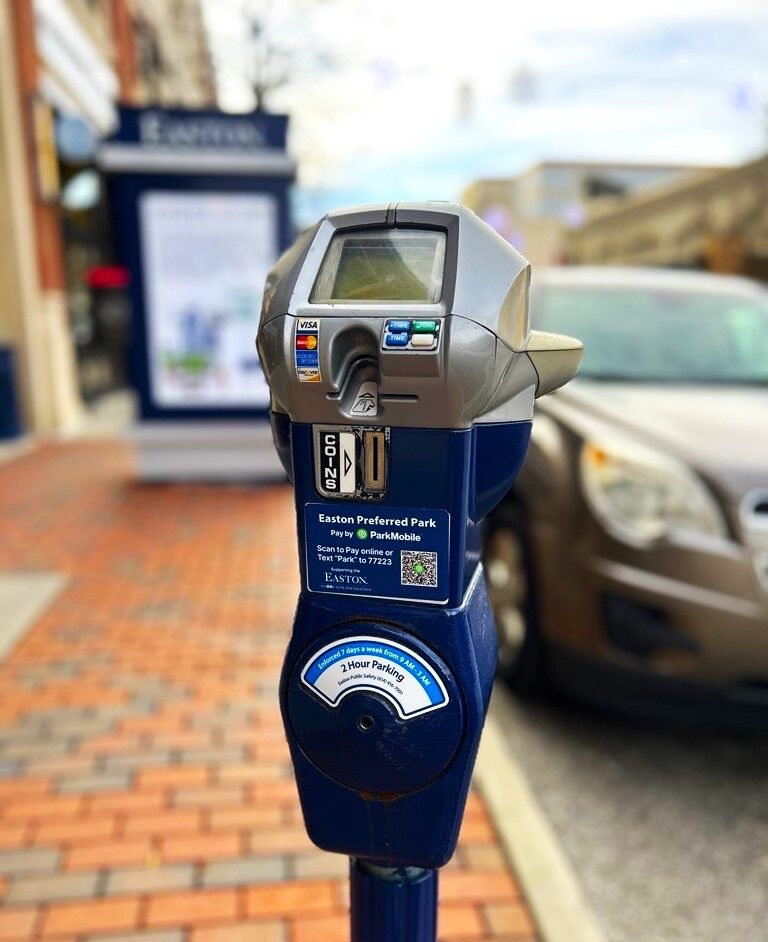
The people who set the price have to face voters. Bethlehem’s off-street rate schedule runs all the way to 2040 and was approved by a board the mayor appoints. Allentown’s rates are set by five appointees. In Easton the number is argued over in the mayor’s budget and council’s public hearings, in front of anyone who cares to show up, by people whose names appear on a ballot. When Easton residents got angry enough about parking, City Council convened a summit and sat through it. A city whose rate-setting body is appointed has no equivalent lever.
The incentive points at parking, not at ticketing. Easton earns from meters, lots and garages, so the system does better when more people park downtown. Allentown’s Authority collected $5,867,364 from fines in 2024 against $985,722 from meters, roughly six dollars of enforcement for every dollar of parking. Both are lawful, and both fund a real service. But one model earns when you park and the other earns when you slip up.
The books are open by default. Easton’s parking revenue sits on a line in a public city budget, next to earned income tax and sewer revenue. There is no separate entity, no separate audit to go hunting for, and no ambiguity about who answers for it.
The honest catch: none of this makes Easton cheap. Its drivers pay the Valley’s highest hourly rate, $3 at Centre Square against $1 at an Allentown meter, and most of the city’s other meters just jumped more than 80 percent in a single year. A city that funds services through parking has a standing reason to keep parking expensive, and the residents enjoying the tax freeze are not always the small business owners who feel the meter. Easton’s structure is the most accountable of the three. That is not the same as being the easiest place to park.
The Pattern All Three Cities Share
Strip away the details and the same story runs through all three. Downtown demand is up, driven by restaurants, events and a wave of new apartments. Each city has responded by charging more to leave a car in the most convenient places, whether at the meter in Bethlehem and Easton or on the windshield in Allentown. And in each, the loudest pushback comes from the same two groups: small business owners who fear paid parking sends customers to the suburbs, and residents who feel they’re paying more for a harder experience.
There’s also a structural reality none of them hides. Once parking revenue is load-bearing, whether it is holding down property taxes in Easton or covering bond payments in Allentown and Bethlehem, rates tend to move in one direction. Debt schedules do not care whether a downtown is having a good year.
Hellertown: The Last Free Main Street, For Now
Which brings the story back down Route 412. Hellertown has no parking authority at all, which means no appointed board, no bonds and no revenue line anyone is depending on. Parking on Main Street in Hellertown is free, with no meters, though it isn’t unmanaged: two-hour limits run from 8 a.m. to 6 p.m. on both sides of Main Street between Saucon and Clarke, a window the borough extended by an hour to protect turnover. A driver who parks for two hours pays $6 at Centre Square in Easton, $5 in Bethlehem’s RapidPark core, $2 at an Allentown meter, and nothing in downtown Hellertown.
That’s exactly why the borough’s new parking study matters. Hellertown Borough Council authorized the seven-task study in May at a cost of approximately $19,340, covering Main Street, Water Street and one block in each direction along Front Street. The borough is dealing with a small-scale version of the same pressures its bigger neighbors faced first. Council Vice President Larry O’Donnell noted that a 2008 study found the borough had adequate parking, but that traffic volume, business development and the number of restaurants on Main Street have all changed since.
No one on council has proposed meters, and most small-borough studies end in modest fixes like adjusted time limits, better signage and shared-lot agreements. But Bethlehem and Easton both started with studies too. When Hellertown’s results come back to council, residents will find out whether free parking on Main Street is a permanent feature or simply a stage every growing downtown eventually passes through.
And if the study ever does point toward paid parking, Hellertown will face the same fork its neighbors already took. It can hand the meters to an authority, the way Allentown and Bethlehem did, and gain a body that can borrow to build garages but answers to appointees rather than voters. Or it can run parking as a borough function, the way Easton does, and keep the money somewhere residents can see it. Judging by the three downtowns up the road, that structural choice, made once and rarely revisited, ends up mattering more than the hourly rate ever does.
LehighValley.com will continue following parking changes across the Valley, including the results of Hellertown’s downtown study.
At a Glance
- Bethlehem’s RapidPark core costs $2.50 per hour with a two-hour cap. FlexPark blocks just outside are $1.50 per hour for up to three hours.
- Bethlehem’s core on-street rate rose from $1.50 to $2.50 per hour, a 67 percent increase and the first since 2019, with the maximum stay cut from three hours to two.
- Bethlehem garages and lots run $1.50 per hour with a $12 daily maximum, and are free on Sundays and holidays except during special events.
- The rebuilt Walnut Street Garage opened in November 2025 with 517 spaces, about 253 fewer than the garage it replaced.
- Easton raised Centre Square meters to $3 per hour on New Year’s Day. Most other downtown meters jumped from $1.50 to $2.75, an increase of more than 80 percent.
- Easton projects about $4.45 million in parking revenue for 2026, up 31.4 percent, helping extend a property tax freeze that reaches 19 years.
- Two hours of parking costs $6 at Centre Square in Easton, $5 in Bethlehem’s RapidPark core, $2 at an Allentown meter and nothing on Main Street in Hellertown.
- Allentown has the Valley’s cheapest meters at $1 per hour, but its Parking Authority took in $5.87 million from fines in 2024 against $985,722 from meters.
- The Allentown Parking Authority carries about $58 million in bonds and transferred roughly $209,000 to the city in 2024.
- Allentown’s and Bethlehem’s parking authorities are separate legal entities with mayor-appointed boards. Easton runs parking as a city function, so its rates are set by elected officials in the public budget process.
- Easton keeps its parking money: revenue flows into the General Fund and helps hold property taxes flat. Allentown’s Authority passed about $209,000 of roughly $13.8 million back to the city in 2024.
- Hellertown Borough Council approved a roughly $19,340 parking study in May covering Main Street, Water Street and Front Street.