
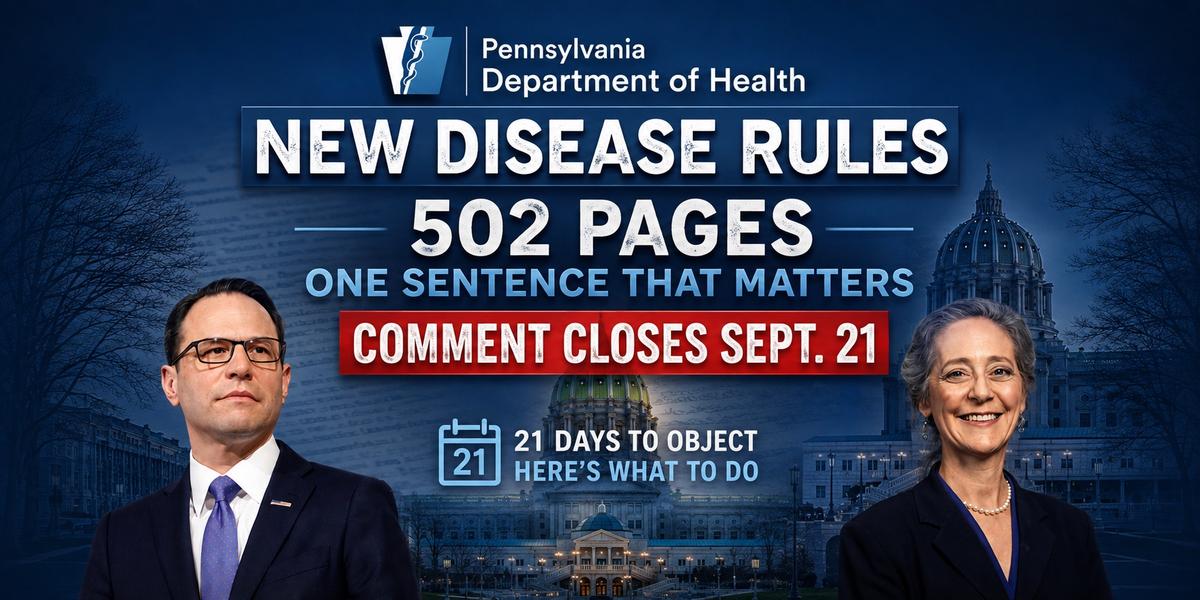
Pennsylvania’s Department of Health has proposed the largest rewrite of its disease control rules in a generation. The filing runs 502 pages. Buried inside it are four words that would give the department the school masking authority the state Supreme Court ruled in 2021 that it did not have, and a new section allowing investigators to enter an apartment, a school or a building on nothing more than their own credentials. The public comment period closes Sept. 21. After that, the window for objecting without a lawyer closes with it.
On Aug. 8, in the back half of a routine issue of the Pennsylvania Bulletin, the Department of Health published proposed rulemaking 10-242, a comprehensive rewrite of 28 Pa. Code Chapter 27.
Chapter 27 is the chapter that governs which diseases doctors must report, who can be isolated or quarantined, what happens when a child gets sick at school, and what a health investigator may do when they arrive at your door. Most of it was written in 1959. It was last substantially updated in 2001.
Pennsylvanians have until Sept. 21 to comment. As of Aug. 28, 184 comments had been filed with the Independent Regulatory Review Commission, the great majority of them opposed.
The proposal is signed by Secretary of Health Dr. Debra L. Bogen. It is not law, and it cannot become law without clearing several more steps. But the most consequential passage in the entire document is not hidden. The department wrote it down plainly, and it is worth reading closely.
The Corman Paragraph
To understand why, you have to go back to the fall of 2021.
In Corman v. Acting Secretary of the Pennsylvania Department of Health, the Pennsylvania Supreme Court threw out the Wolf administration’s order requiring masks in every school in the Commonwealth. The department’s own description of that case, written into this proposal, is that the court was “deciding whether the department had authority to issue a school-wide masking mandate during the COVID-19 pandemic.”
The court’s reasoning was narrow and technical. The department’s own regulation, Section 27.60, let it impose disease control measures only for the “surveillance” of disease. A masking mandate was not surveillance. The department could not exercise a power it had never written into its own rules.
That ruling is the reason Pennsylvania’s school mask mandate ended when it did. For a great many people in the Lehigh Valley, it is also the clearest memory they have of who decided what during the pandemic, and on what authority.
The court then added a line that has sat in the reports for five years, at 266 A.3d 484:
“Of course, the Department has the power to promulgate a different regulation, or to amend this one, to ... strip the ‘any other disease control measure’ catch-all of its limiting language.”
The department is now doing exactly that, and says so. From the preamble published Aug. 8:
“The foregoing decision influenced the department’s proposed amendments to this subsection, which propose to add ‘prevention, containment or mitigation’ as justifications for the implementation of all disease control measures available to the department under the act.”
Under the current rule, the department may take “any other disease control measure” it considers appropriate “for the surveillance of disease.” The proposed rule changes that phrase to “for the surveillance, prevention, containment or mitigation of disease.”
Four words. They are the difference between the regulation the Supreme Court read in 2021 and a regulation that would have survived that case.
What Investigators Could Do
Three new sections, 27.60a through 27.60e, would consolidate and expand the department’s investigative powers. Most people will never read them, so they are quoted here in full. They are short.
Proposed Section 27.60a(b):
“The Department or local health authority may enter an apartment, building, health care facility, school, college or university, or other location as necessary to conduct its investigation under this chapter if the representative presents documentation to establish that they are an authorized representative of the Department or the local health authority.”
Proposed Section 27.60a(c):
“A person may not obstruct or interfere with the Department or local health authority’s investigation under this chapter.”
The threshold for opening such an investigation would also drop. The current rule at Section 27.152 lets the department investigate a case or outbreak “judged by the Department or local health authority to be a potential threat to the public health.” The proposal deletes that qualifier and broadens the trigger to include “public health emergencies and unusual occurrences of diseases, infections and conditions.” The department’s explanation is that anything reported to it “would all be potential threats to the public health,” so the qualifier is redundant.
Critics read the same change differently. An “unusual occurrence” is not defined anywhere in the chapter, and a single case could qualify.
Two further sections extend this into schools and medical files. Proposed Section 27.60c would require a school to give the department or a local health authority “reasonable and timely access” to a student for contact tracing, “including access when classes are in session,” and would require school employees to let investigators “meet and speak with a student or other person in private.” The department grounds that in a 1970 statute, 35 P.S. Section 10103, which lets a minor consent on their own to testing and treatment for reportable diseases without a parent’s involvement.
Proposed Section 27.60e would give the department and local health authorities “access to” patient medical records held by practitioners and hospitals, and would let them demand electronic copies. Here too, a person “may not obstruct or interfere.”
None of these sections mentions a warrant.
Side by Side: What the Rules Say Now, and What They Would Say
Four comparisons, all taken from the filing itself. In the department’s Annex A, language in brackets is what would be struck and the rest is what would replace it.
| 1. When the department can impose a control measure | |
|---|---|
| Now, Section 27.60(a) Any disease control measure it considers appropriate “for the surveillance of disease.” | Proposed Any disease control measure it considers appropriate “for the surveillance, prevention, containment or mitigation of disease.” |
| Those four added words are what the 2021 school masking case turned on. The Supreme Court held that “surveillance” did not reach a mask mandate. | |
| 2. What opens an investigation | |
| Now, Section 27.152(a) “Any case or outbreak of disease judged by the Department or local health authority to be a potential threat to the public health.” | Proposed, Section 27.60a(a) “Any case, outbreak, public health emergency or unusual occurrence of diseases, infections and conditions.” |
| The requirement that the department first judge something a threat to public health is removed. “Unusual occurrence” is not defined anywhere in the chapter. | |
| 3. Entry | |
| Now, Section 27.152(b) “A person may not interfere with or obstruct a representative of the Department or a local health authority who seeks to enter a house, health care facility, building or other premises to carry out an investigation of a case or outbreak.” | Proposed, Section 27.60a(b) “The Department or local health authority may enter an apartment, building, health care facility, school, college or university, or other location as necessary to conduct its investigation under this chapter.” |
| The change is not only the added locations. Today’s rule is written as a prohibition on obstructing entry. The proposal is written as an affirmative grant of authority to enter, and it drops the tie to a particular case or outbreak. | |
| 4. Medical records | |
| Now, Section 27.152(c) An authorized representative “may conduct a confidential review of medical records.” | Proposed, Section 27.60e(a) The department “shall have access to and may conduct a confidential review of patient medical records,” and copies it requests “shall be transmitted electronically.” |
| Permission to review becomes a right of access, with copies on demand. | |
Two Years in the Making
This was not a rushed reaction to the measles outbreak now moving through Lancaster County and the plain communities. It is something more deliberate than that. The department has been building it for more than two years.
The department’s own preamble lays out the history. It held stakeholder presentations in the spring and summer of 2024. It met with local health departments on May 10, 2024, and with sister agencies that June. It circulated a final draft to other agencies in December 2025. The State Advisory Health Board approved the amendments on July 17, 2025. The department formally submitted the package to the Independent Regulatory Review Commission on June 4, 2026, two months before publication.
The proposal was approved roughly a year before Pennsylvania’s measles outbreak reached its current scale, and drafted two years before it. It was published on Aug. 8, in the middle of the outbreak, in a weekly state legal bulletin most people have never read.
That is the part worth sitting with. The change to Section 27.60 was not a reflex to a crisis. It was a sustained, multi-year effort to undo the effect of a Supreme Court ruling by rewriting the very sentence the court relied on, and the department put that reasoning in writing on page 5185 for anyone who got that far.
What the outbreak has supplied is the political justification. A department spokesperson has pointed to it directly, saying the administration “recognizes the need for updated disease reporting and response regulations as Pennsylvania deals with outbreaks of measles and cyclosporiasis.”
The outbreak itself is real and serious. The department’s Aug. 28 update reported 460 confirmed measles cases across 31 counties, 83 hospitalizations, and two measles-associated deaths, both in Lancaster County and both in unvaccinated people. One was an infant. They are Pennsylvania’s first measles deaths in 35 years and the first in the country this year. The department has declined to release further identifying details, citing the families’ privacy. State Treasurer Stacy Garrity has called the administration’s response to the deaths “political theater.”
What Else Is in the 502 Pages
The rewrite is far broader than the masking question, and some of it will land on ordinary households well before any emergency does.
More things become reportable. Practitioners and facilities would have to report 73 additional diseases, infections and conditions. Clinical laboratories would report 53 more. Veterinarians, four more. New entries include babesiosis, chikungunya, dengue, Powassan and Marburg. Reporting deadlines for some conditions, including salmonella, tighten from five days to 24 hours.
Vaccination records get reported by default. Proposed Section 27.36 would require every provider outside Philadelphia to report each immunization to the state registry, PIERS, “unless a patient has declined the reporting of an immunization in writing.” The report would include name, date of birth, gender, address, race and ethnicity. The department estimates 21,000 providers are affected and that 16,250 already report voluntarily. Several commenters have asked the review commission to flip this from opt-out to opt-in.
A new birth defects registry. Proposed Section 27.37 would require reporting of a long list of congenital anomalies. The department estimates a one-time build cost of $150,000 plus roughly $30,000 a year in maintenance, and $1,523,977 in first-year staffing. This section alone has a delayed effective date, tied to the registry’s launch.
Prenatal testing by default. Proposed Sections 27.99a and 27.99b would require practitioners to draw and submit blood for HIV and hepatitis C testing in pregnancy unless the patient objects, alongside expanded third-trimester syphilis testing.
The school fever rule changes. Under the current Section 27.72, a child is sent home at an oral or underarm temperature of 102 degrees. The proposal replaces that with 100.4 degrees rectal, ear or forehead, 100 degrees oral, or 99 degrees underarm. That is a meaningfully lower bar, and it will be felt in school nurses’ offices statewide.
And, cutting the other way, vaccine requirements loosen. Proposed Section 27.77 would add “a strong moral or ethical conviction similar to a religious belief” to the grounds on which a parent may decline vaccination for a child in a child care setting, matching the exemption that already exists for school-age children. The department also proposes to stop deferring to the federal advisory committee ACIP and to write a fixed list of required vaccines into the regulation instead, citing Protz v. Workers’ Compensation Appeal Board, a 2017 Pennsylvania Supreme Court case holding that an agency may not delegate its rulemaking to whatever an outside body recommends next. Dr. Cheryl Bettigole, executive director of the Penn Center for Public Health and a supporter of the rest of the package, filed a comment objecting to that loosening specifically.
Who Is Objecting, and on What Grounds
Opposition is organized and, in its stronger form, precise.
Sen. Michele Brooks (R-50) circulated a co-sponsorship memo on Aug. 12 announcing legislation to amend the Disease Prevention and Control Law of 1955 so that certain new Health Department regulations would carry a mandatory sunset date and require General Assembly approval before taking effect. Her memo argues the proposal would “significantly broaden the Department’s quarantine, isolation and masking authority ... all without any sunset date or requirement for legislative authorization.”
Brooks is not a bystander here. She chairs the Senate Health and Human Services Committee, one of the two committees the department is required by law to send this regulation to, and one of the two that will review the final version.
House Republican Leader Jesse Topper put the objection in explicitly pandemic terms. “We simply cannot have the kind of intrusive government overreach that we saw shut down businesses, take years away from kids in terms of their education and their development, basically increase our mental health issues amongst our youth, mask mandates,” he said. “And unfortunately, the regulations proposed by the administration give that kind of broad authority back to the Department of Health.” In a separate statement, he called the proposal “devoid of any understanding of our recent history of dangerous government overreach and the resulting public backlash.”
That is the argument at the center of the opposition, and it does not depend on any theory about what the department intends. The department is asking for the authority. Whether Pennsylvania is willing to grant it turns on how much trust the last five years left behind.
Among the filed comments, the sharpest ones ask the review commission for narrow, concrete fixes rather than withdrawal: require explicit parental notification before the department accesses a student during the school day, and make PIERS reporting opt-in rather than opt-out. Others ask the department to explain why narrower language “tied to defined outbreak conditions” would not accomplish the same goals.
Professional groups are engaging on technical grounds. The Pennsylvania Society for Respiratory Care asked the department to clarify whether a respiratory therapist who merely treats a patient with an already-reported condition incurs a separate reporting duty, and recommended removing the word “treats” from the trigger.
The department’s response to the broader criticism has been blunt. It says the changes update a 25-year-old regulation, that they are undergoing the comprehensive review the law requires, that it briefed the Legislature before publication, and that “any misconstruing of these proposed changes designed to scare Pennsylvanians is inaccurate and disingenuous.”
Two things about that. The regulations are not 25 years old. They were promulgated in 1959 and last significantly amended in 2001, which is the department’s own account on page 5132. And on the specific question of whether this expands the department’s power, the filing answers for itself: it states in plain language that it is adding “prevention, containment or mitigation” as grounds for disease control measures because the Supreme Court held that “surveillance” alone did not reach school masking. Readers can decide for themselves who is misconstruing what.
LehighValley.com sent written questions to the Department of Health on Aug. 31, copied to the rulemaking’s public comment inbox. They include whether the amended Section 27.60 would give the department authority to issue a statewide school masking requirement, whether Section 27.60a(b) authorizes entry into a private residence without a warrant or consent, and why isolation under Section 27.61 requires no court order when compelling a physical examination under Section 27.82 does. We asked for a response by Sept. 4. This story will be updated with the department’s answers, and we will publish them in full.
The Constitutional Questions
A regulation is not self-executing. It operates inside constitutional limits it has no power to rewrite, and this one brushes against several. What follows is general information about how these rules work, not legal advice about any particular situation.
Start with the Commonwealth’s side of the ledger, because it is substantial and any honest account has to include it. Pennsylvania has real authority to protect public health, granted by the Disease Prevention and Control Law of 1955 and by the Administrative Code of 1929. Since Jacobson v. Massachusetts in 1905, the U.S. Supreme Court has held that individual liberty is not absolute and may be restrained to protect the community from disease. Courts have upheld isolation and quarantine for more than a century. That the state may act during an outbreak is not seriously in dispute.
The question is not whether the power exists. It is where the limits sit, and whether this proposal respects them. Five areas are worth watching.
Searches and entry. Under Camara v. Municipal Court, decided by the U.S. Supreme Court in 1967, an administrative inspection of a private residence generally requires a warrant unless the occupant consents or there is a genuine emergency. Pennsylvanians may have more protection than that, not less. Article I, Section 8 of the Pennsylvania Constitution carries its own guarantee against unreasonable searches and seizures, adopted fifteen years before the Fourth Amendment was ratified, and under Commonwealth v. Edmunds (1991) state courts are not bound to read it the way federal courts read the Fourth Amendment. Proposed Section 27.60a(b) authorizes entry into “an apartment” on an investigator’s credentials alone. It does not mention a warrant, consent or an emergency exception.
Medical privacy. Pennsylvania recognizes a constitutional right to informational privacy under Article I, Section 1. In Pennsylvania State Education Association v. Commonwealth, decided in 2016, the state Supreme Court held that personal information may not be disclosed unless the public interest in disclosure outweighs the individual’s privacy interest, and that the government must actually perform that balancing first. Two provisions here run into that. Section 27.60e would give the department a right of access to patient medical records and copies on demand. Section 27.36 would send every immunization, with the patient’s name, date of birth, address, race and ethnicity, to a state registry unless the patient objects in writing.
Due process. Isolation and quarantine deprive a person of physical liberty, which is the classic trigger for a right to notice and a hearing. The chapter contains an asymmetry worth sitting with. Under Sections 27.82 and 27.83, if a person refuses a physical examination, the department must go to court to compel one. But nothing in the isolation section, 27.61, or the quarantine section, 27.65, requires a court order, a hearing, or an appeal. Under Section 27.68, whoever ordered the confinement is also the one who decides when it ends.
Parental rights. In Troxel v. Granville, decided in 2000, the U.S. Supreme Court described a parent’s interest in the care, custody and control of their children as perhaps the oldest fundamental liberty interest it recognizes. Proposed Section 27.60c would require schools to let investigators meet and speak with a student in private. The department grounds that in a 1970 statute, 35 P.S. Section 10103, which lets a minor consent alone to testing and treatment for reportable diseases. That statute is existing law and is not created here. What is new is extending it into the school day with no notice requirement to parents, and several filed comments ask the review commission to add one.
Separation of powers. The Pennsylvania Constitution vests legislative power in the General Assembly, and under Protz v. Workers’ Compensation Appeal Board (2017) an agency may not hand its rulemaking to an outside body. The department cites Protz itself as the reason it is writing a fixed vaccine list into the regulation. The harder version of the same question is whether an expansion of this size is a policy decision for the Legislature rather than an agency, which is not only a political argument. It is one of the criteria the Independent Regulatory Review Commission is required by statute to weigh.
None of this is settled by an article. These questions get answered by courts, and only if someone brings them. But the department has not addressed any of them on the record, and the comment period is the stage of this process designed to make it do so.
What It Means Locally
Chapter 27 assigns these powers to the department and to “local health authorities,” which in practice means Pennsylvania’s handful of county and municipal health departments.
Most of Pennsylvania has neither. The Lehigh Valley is an exception. Allentown and Bethlehem both run their own health bureaus, and both took part in the department’s May 2024 consultation, as did Lehigh Valley Health Network. Residents of Allentown and Bethlehem would deal with their city bureau under these rules. Everyone else in Lehigh and Northampton counties would deal with the state directly.
Neither bureau has taken a public position on the proposal.
What Happens Next
The comment period closes Sept. 21. The Independent Regulatory Review Commission then has 30 days, until roughly Oct. 21, to issue its own comments, recommendations or objections, which must identify specific statutory review criteria the proposal fails to meet. The department must respond and produce a final-form regulation, which goes back to IRRC, the House Health Committee and the Senate Health and Human Services Committee. The outside deadline for a final rule is September 2028.
Most of the regulation would take effect on publication of the final version. The birth defects registry section is the exception, and would start 30 days after a separate notice.
The comment period is the one stage in that sequence built to hear from the public. Once the language is in the code, the limiting words the Supreme Court relied on in 2021 are gone, and objecting is no longer a matter of sending an email. It becomes a lawsuit.
How to Comment on the Regulation
This is the channel that carries the most legal weight, because the department is required to respond to comments on the record before it can issue a final rule. Comments must be identified as pertaining to proposed rulemaking 10-242 (communicable and noncommunicable diseases), and they must arrive by Sept. 21.
By email, the department’s preferred method: RA-DHCHAPTR27PROPREG@pa.gov
By mail: Theresa Kash, Pennsylvania Department of Health, 625 Forster Street, 8th Floor West, Health and Human Services Building, Harrisburg, PA 17120
By phone, for accommodations or questions: (717) 547-3317
You can also send the same comment to the Independent Regulatory Review Commission, which reviews the regulation separately and can raise its own objections. Many of the comments already on file were sent to both. IRRC is at 555 Walnut Street, Suite 804, Harrisburg, PA 17101, and at irrchelp@irrc.state.pa.us. Reference regulation 10-242 or IRRC 3490.
One thing to know before you write: comments filed with IRRC are posted publicly on its website as PDFs, with the commenter’s name attached, and in many cases the email address and phone number the sender included. Assume anything you send is going to be published.
To read the proposal first, the full text is in the Pennsylvania Bulletin, Vol. 56, No. 32, Aug. 8, 2026, beginning at page 5131. The docket, including every comment filed so far, is at irrc.state.pa.us under regulation 10-242.
Making a Comment That Actually Counts
A comment carries more weight when it speaks to the standards the reviewers are actually applying. Under section 5.2 of the Regulatory Review Act, the Independent Regulatory Review Commission is required to evaluate this regulation against a specific list. It must consider, among other things:
Whether the agency has statutory authority to implement the regulation
Whether the regulation is consistent with legislative intent
Economic and fiscal impact on the public and private sector
Protection of the public health, safety and welfare
Clarity, feasibility and reasonableness of the regulation
Whether acceptable data is the basis of the regulation
Whether less costly alternatives were considered for small business impacts
Whether the regulation represents a policy decision requiring legislative review
The comments, objections or recommendations of a legislative committee
The eighth is the one most opponents are reaching for without knowing it exists. The argument that a decision this consequential belongs to the General Assembly rather than to an agency is not merely a political complaint here. It is a criterion the commission is legally obligated to weigh, and citing it by name puts the objection squarely inside the framework the reviewers are working from.
The same is true of the first. If you believe the department is claiming authority the Disease Prevention and Control Law of 1955 does not give it, say so in those terms, and point to the section you mean.
Comments that name a specific section, state the objection to it, tie it to one of these criteria and propose replacement language are the ones that appear in the commission’s own analysis. Among those already filed, two ask for explicit parental notification before investigators speak with a student under Section 27.60c, and for immunization reporting under Section 27.36 to be opt-in rather than opt-out.
How to Reach Your Own Officials
A comment goes into the regulatory record. Contacting your legislators is a separate lever, and at this stage it is arguably the more powerful one, because the General Assembly is where the proposals to constrain this regulation are moving.

Find your state senator and representative. The General Assembly’s lookup tool takes a street address and returns both, with phone numbers, district office addresses and contact forms, at palegis.us/find-my-legislator. You can also browse by county at palegis.us/find-my-legislator/by-county. District offices are usually more responsive than Harrisburg offices, and a phone call to a district office typically gets logged the same day.
The two committees that will see this regulation. Under the Regulatory Review Act, the department had to send this proposal to the chairs of both chambers’ health committees, and it must send them the final version too. They are the members with the most direct say.
Senate Health and Human Services Committee: Sen. Michele Brooks (R-50), chair, and Sen. Art Haywood (D-4), minority chair
House Health Committee: Rep. Dan Frankel (D-23), chair, and Rep. Kathy Rapp (R-65), Republican chair
The Lehigh Valley delegation. Lehigh and Northampton counties are represented by three state senators, Nick Miller (D-14), Jarrett Coleman (R-16) and Lisa Boscola (D-18), along with the region’s state House members. Use the lookup tool above to confirm which districts cover your address, since district lines split several Valley municipalities.
Your city officials, if you live in Allentown or Bethlehem. Because both cities operate their own health bureaus, they would exercise these powers locally rather than the state. That makes city council and the mayor’s office a legitimate place to ask whether the city supports the proposal as written, and whether it intends to file a comment of its own.
The Governor’s office. The Department of Health answers to the governor. Gov. Josh Shapiro’s office is at 225 Main Capitol Building, Harrisburg, PA 17120, and takes calls at (717) 787-2500. There is a contact form at pa.gov/governor/contact-us, and the administration also runs a text line at (717) 788-8990.
One practical note. Form letters get counted, but specific ones get quoted. That is as true of a letter to a legislator as it is of a comment to the agency, and a constituent who can name the section they object to gets a different quality of answer than one who cannot.
At a Glance
What it is: Proposed rulemaking 10-242, IRRC docket 3490, a 502-page rewrite of 28 Pa. Code Chapter 27
Published: Aug. 8, 2026, Pennsylvania Bulletin Vol. 56, No. 32, page 5131
Comment deadline: Sept. 21, 2026
Where to comment: RA-DHCHAPTR27PROPREG@pa.gov, identified as pertaining to rulemaking 10-242
The core change: Section 27.60 would allow disease control measures for the “prevention, containment or mitigation” of disease, not just “surveillance”
Why that matters: The Pennsylvania Supreme Court struck down the statewide school mask mandate in 2021 because the rule said only “surveillance”
New entry authority: Section 27.60a(b) would permit entry into an apartment, building, school or other location on an investigator’s credentials, with no mention of a warrant
Also inside: 73 new reportable conditions, opt-out immunization reporting, a birth defects registry, opt-out prenatal HIV and hepatitis C testing, and a lower school fever threshold
Cutting the other way: A broader vaccine exemption for child care, and a fixed vaccine list replacing deference to federal ACIP recommendations
Status: Proposed only. Not in effect. Final rule due no later than September 2028