
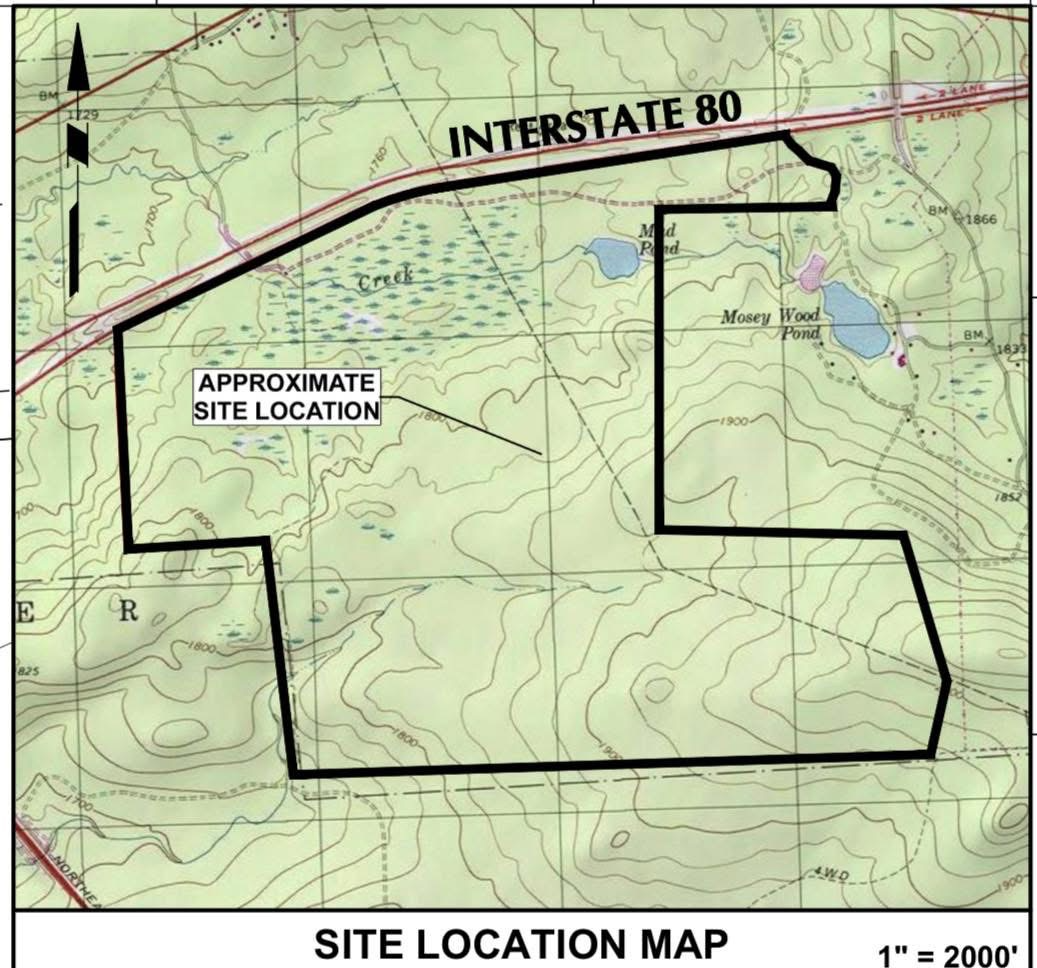
A 60-megawatt solar project that would clear roughly 390 acres of forest in Carbon County's Kidder Township heads to a Pennsylvania Department of Environmental Protection public hearing Tuesday night, where residents, anglers and environmental groups plan to testify against a development they say threatens the headwaters of the Lehigh River.
The Mora Solar project sits about 40 miles north of Allentown, just beyond the Lehigh Valley, in the Carbon County Poconos, but its critics argue the stakes are regional: the wooded site drains into streams that feed the Lehigh River, the waterway that defines the Valley downstream. The DEP hearing, set for Tuesday, June 23, gives the public its formal chance to weigh in before the state decides on a key water permit.
What's Proposed
Mora Solar, LLC, a company based in Durham, North Carolina, is seeking to build a 60-megawatt, utility-scale solar farm on roughly 390 acres off Moseywood Road in Kidder Township. According to the developer's permit materials and state filings, the project would come online around December 2027 if approved.
The site sits in a heavily recreational and residential stretch of the Poconos. Supporters of the land's preservation note it is framed by private homes and lies near Lake Harmony, Jack Frost National Golf Course and Big Boulder Lake, is adjacent to the long-running Girl Scout Camp Moseywood, and is not far from Hickory Run State Park.
The Hearing on Tuesday
The hearing is specifically about an Individual NPDES (National Pollutant Discharge Elimination System) stormwater permit, application No. PAD130054, which governs how a construction site controls erosion, sediment and stormwater runoff. DEP has stressed it can only consider comments related to that permit application, not the merits of solar energy generally.
It will run from 6 to 8 p.m. at Jim Thorpe Area High School, 1 Olympian Way, Jim Thorpe. Representatives from DEP's Waterways & Wetlands Program, the Carbon County Conservation District and Mora Solar are expected to attend.
Residents who want to speak are asked to submit a notice of intent to testify to DEP's community relations coordinator at pamonahan@pa.gov; requests are accepted up to the day of the hearing, and those who preregister get priority. DEP asks speakers to limit testimony to five minutes, and says written and spoken comments carry equal weight. Opponents say they will hand out press packets with site maps and written testimony from 5:30 to 6 p.m. as attendees arrive.
Why the Project Is Contested
The flashpoint is what sits on the land now. The property is a largely forested headwater watershed containing High Quality Cold Water Fisheries streams, Fourth Run, Shingle Mill Run and Black Creek (also known as Hayes Creek), along with Exceptional Value wetlands, the state's most protected wetland classification. Those waters ultimately drain into the Lehigh and Delaware river systems.
Opponents say Black Creek supports an exceptionally productive wild brown trout population that exceeds the standard for Pennsylvania's highest-quality wild trout streams, which they argue underscores how sensitive the watershed is. Citing the project's own permit application, opponents count 97 wetlands on the steeply sloped site and say the forest has been largely undisturbed since 1967.
Critics further point to Pennsylvania's own grid-scale solar siting guidance, which encourages developers to prioritize previously disturbed land and minimize impacts to forests, wetlands and streams. Mora Solar, they contend, does the opposite by proposing roughly 390 acres of disturbance in an intact forested watershed.
The Concerns Being Raised
Environmental groups, watershed advocates and residents have outlined a list of objections they plan to bring to the hearing:
Clearing of approximately 390 acres of forested land
Potential impacts to High Quality streams, wetlands and downstream water resources
The adequacy of erosion and sediment controls during construction
Whether less environmentally sensitive alternatives were adequately evaluated
Cumulative impacts alongside other large development projects in the region
Emergency access and public-safety considerations at the site
“Our organization has never opposed a solar project because we recognize the need for clean, cheap, renewable energy,” said Linda Christman, president of the environmental nonprofit Save Carbon County. “However, we find that we cannot support this project. It is too destructive to the Lehigh River watershed and our streams.”
Phyllis Spencer, a local resident, argues the project would affect three different watersheds and that DEP has a statutory duty to protect the waters of the Commonwealth from degradation. Local residents, anglers and environmental professionals are among those expected to testify.
The Other Side
The dispute lands in the middle of a broader tension: Pennsylvania has actively encouraged renewable energy, and large solar farms like Mora are part of how the state expects to add carbon-free generation. Projects of this scale can power thousands of homes and advance state clean-energy goals.
The fight here is less about solar itself than about where it is built. Mora Solar is pursuing the state and local approvals it needs to proceed, and company representatives are expected at Tuesday's hearing. The NPDES review will ultimately turn on whether the project's stormwater and erosion controls satisfy DEP's standards for protecting the high-value streams and wetlands on the site.
How a Solar Farm Could Affect the Watershed
At the center of the debate is a question of hydrology: what happens when forest is replaced by a solar installation. The effects are neither automatic nor uniform, they depend heavily on the site, the slope and the controls put in place, but the general mechanisms are well understood.
Less forest, faster runoff. A mature forest acts like a sponge, intercepting rainfall and letting it soak into the ground. When trees and undergrowth are cleared, more rain runs off the surface, and runs off faster, particularly during construction, when soil is exposed.
Erosion and sediment. Faster runoff over cleared, sloped ground can carry soil into nearby streams. Sediment is among the most damaging pollutants for High Quality Cold Water Fisheries: it clouds the water and can smother the clean gravel beds that wild trout need to spawn.
Water temperature. Tree canopy shades streams and keeps them cool. Removing vegetation near waterways can let temperatures rise, which stresses cold-water species like trout.
Wetlands and steady flow. Wetlands store floodwater and filter pollutants, and forested ground recharges the groundwater that keeps headwater streams flowing in dry spells. Disturbing them can weaken those natural functions.
There is also a counterpoint specific to solar. Unlike a warehouse or parking lot, a finished solar farm is not a sea of pavement: panels are mounted above ground that is typically kept vegetated, so long-term stormwater can often be managed. For that reason, the most acute risk tends to come during construction, when land is cleared and graded.
That is exactly what the NPDES stormwater permit is meant to address. The permit and its required erosion-and-sediment-control plan are the state's tools for limiting runoff, erosion and sedimentation, and DEP approves the application only if it determines those controls are adequate to protect the receiving waters. The dispute at the hearing, in essence, is whether they are, on a site this steep, this forested and this ecologically sensitive.
Why It Matters in the Lehigh Valley
Although Kidder Township is in Carbon County, roughly a 45-minute drive north of Allentown, the project sits in the Lehigh River's headwaters, meaning decisions made upstream ripple down through the Valley's primary waterway. It is also the latest test of a question increasingly facing the region: how to balance the push for clean energy and new development against the conservation of the forests, streams and open space that define the area.
Mora Solar at a Glance
Project: Mora Solar, LLC, a 60 MW, ~390-acre solar farm off Moseywood Road, Kidder Township, Carbon County
Permit: DEP Individual NPDES stormwater permit, application No. PAD130054
Hearing: Tuesday, June 23, 2026, 6–8 p.m., Jim Thorpe Area High School, 1 Olympian Way
At stake: A forested headwater watershed with High Quality streams (Fourth Run, Shingle Mill Run, Black Creek) and Exceptional Value wetlands draining to the Lehigh River
Opposition: Save Carbon County, watershed advocates, anglers and residents
To comment: Submit notice to testify to pamonahan@pa.gov (5-minute limit; preregister for priority)
If approved: Targeted to come online around December 2027