Since 2022, Bethlehem has quietly been running one of the more ambitious civic experiments in the Lehigh Valley: an online platform that lets residents help decide how the city spends millions of dollars and reshapes its streets. Yet WeBuild Bethlehem remains one of City Hall’s lesser-known efforts, a tool many residents may not realize exists.
Found at webuild.bethlehem-pa.gov, WeBuild is a digital town square where the city posts initiatives, gathers feedback and reports back on what it heard. Residents can browse projects, leave comments, take surveys and sign on to programs, all in English and Spanish. It is built on Decidim, the free, open-source “participatory democracy” platform used by more than 500 governments and organizations worldwide, from Barcelona outward.
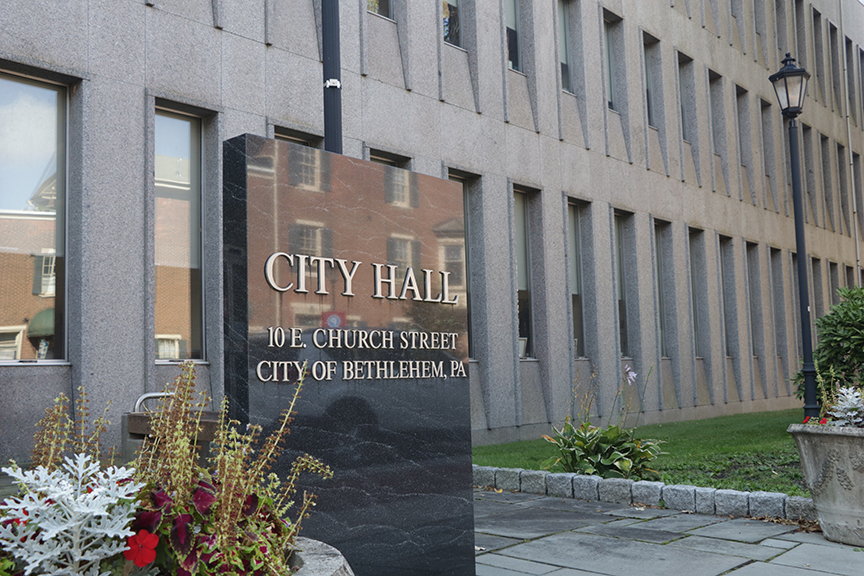
Bethlehem City Hall on East Church Street, home of the administration behind the WeBuild platform.
It Started With $34 Million
The city launched WeBuild in April 2022, early in Mayor J. William Reynolds’s administration, with a high-stakes first question: how should Bethlehem spend the roughly $34.4 million in federal pandemic-recovery money it received through the American Rescue Plan?
To answer it, the city ran the We Build Bethlehem Survey, asking residents to rank their top 10 priorities from a list of 22. The response was modest but real, nearly 600 submissions (285 online and 308 on paper, as of late October 2022). The priorities that rose to the top:
Mental health and counseling services (60.6%)
Food assistance (57%)
Construction of a permanent homeless shelter (56.9%)
Those answers helped shape real spending. The city went on to stand up a Community Recovery Fund, which awarded $759,668 to local nonprofits in 2023, and budgeted millions more for affordable housing and homelessness initiatives.
“It’s not about what you’re doing in (2022) or (2023),” Reynolds said of the approach. “It’s what we are going to be doing for the next five, 10, 15, 20 years.”
From Recovery Funds to a Year-Round Hub
What began as a one-time budgeting exercise has grown into a standing engagement platform. Today WeBuild hosts a rotating set of projects across planning, sustainability, parks and infrastructure, including:
Complete Streets, a citywide plan to make roads safer for pedestrians, cyclists, transit riders and drivers.
Bethlehem Climate Challenge, a sign-on campaign tied to the city’s Climate Action Plan.
Switch Together Bethlehem, a group-buying program for clean-energy upgrades.
South Side Community Center and Parks and Recreation, efforts gathering input on community spaces.
Climate Justice / Justicia Climática, a bilingual call for resident ideas.
Complete Streets: Safer Roads, Block by Block
The Complete Streets plan is one of the platform’s most active efforts, aimed at redesigning roads for everyone who uses them. Concrete pieces are already moving: the conversion of Linden Street to two-way traffic, from Fairview to East Church Street, is expected to wrap in spring 2026, and a redesign of Broad Street is set to begin construction in 2026. The city has gathered input at open houses, including one in November 2025, and held a June 18 community meeting on the draft bicycle network and the Broad Street and Stefko Boulevard plans.
The Climate Challenge and Switch Together
On the sustainability side, the Bethlehem Climate Challenge asks residents to commit to a set of climate-friendly actions; those who sign on are listed as “Climate Champions” and receive a free yard sign. A year into the effort, the city pointed to progress including hiring a sustainability manager, the Bethlehem Area School District’s plan to add ten more electric school buses, and a new energy grant, with future goals like composting at community gardens. A companion program, Switch Together Bethlehem, uses group buying to help residents save on solar panels, home batteries and EV chargers.
A Tool Hiding in Plain Sight
For all its reach, WeBuild has kept a relatively low profile. Its first survey drew only a few hundred responses in a city of roughly 76,000, a sign of how much room its visibility still has to grow, even as it quietly helps steer decisions on streets, budgets and climate policy. City officials, including Community and Economic Development Director Laura Collins and Equity and Inclusion Director Janine Carambot Santoro, have framed it as a way to widen who gets a say in local government.
Participating is low-barrier: anyone can visit the site, read the active projects, comment, answer surveys and sign on to initiatives, and the platform points residents to the in-person meetings tied to each project.
Why It Matters
Tools like WeBuild are part of a wider movement among cities to make local government more transparent and participatory, meeting residents where they are and building a record of public input that officials can point back to. The catch is that a participation platform only works if people use it. For Bethlehem, the bet is that residents who live on a street, take their kids to a park or breathe the city’s air should have a direct hand in what gets built next, if they know the door is open.
WeBuild Bethlehem at a Glance
What: The city’s online community-engagement platform (webuild.bethlehem-pa.gov), built on the open-source Decidim platform
Launched: April 2022, under Mayor J. William Reynolds
Origin: Gathering input on roughly $34.4 million in American Rescue Plan recovery funds
Early turnout: ~600 survey responses; top priorities were mental health, food assistance and a permanent homeless shelter
Languages: English and Spanish
Featured projects: Complete Streets, Climate Challenge, Switch Together, South Side Community Center, Parks and Recreation
How to take part: Browse projects, comment, take surveys, sign on to initiatives and attend tied meetings