Most people never meet the person who made the loan happen. They see the restaurant that opened, the century-old factory that became apartments, the family business that finally bought the building it had been renting for twenty years. Jeff Barber has spent 27 years on the other side of those stories.
Barber founded Lehigh Financial Group in 1999 and still runs it from 122 North Fifth Street in Allentown, a few blocks he has never wanted to leave. The firm is a commercial mortgage brokerage, which means it does not manage retirement accounts or sell investments. It finds the money: for the entrepreneur acquiring an established company, for the investor gutting a mixed-use building on Main Street, for the contractor who has outgrown the shop.
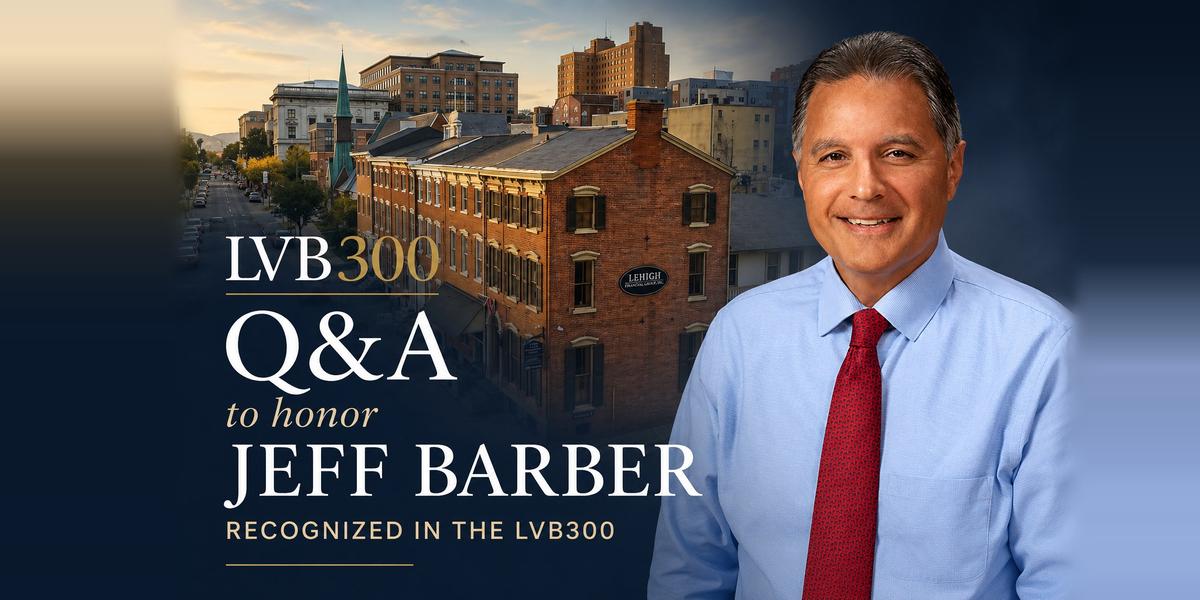
Barber was recently named to the inaugural LVB 300, Lehigh Valley Business’s list of the region’s most influential leaders across every industry. We sent him a set of questions about the work, the market, and what nearly three decades of watching deals close (and fall apart) has taught him. His answers are below, edited lightly for length and clarity.
The Recognition
The LVB 300 spans every industry in the Valley. What does being named to that first list mean to you?
Being named to the inaugural LVB 300 is a tremendous honor, especially because the list represents leaders from every major industry throughout the Lehigh Valley. To be included among so many accomplished business and community leaders is both humbling and rewarding.
I also view this as recognition of the work performed by the entire Lehigh Financial Group team. Commercial financing is a collaborative process involving our employees, lenders, attorneys, accountants, real estate professionals and, most importantly, our clients. After more than 27 years in business, it is gratifying to know that the work we have done to help local businesses, entrepreneurs and real estate investors is being recognized.
At the end of the day, our success is measured by the businesses that open, the properties that are revitalized, the jobs that are created and the people who are able to realize their goals.
How It Started
You founded Lehigh Financial Group. What year, and what made you strike out on your own at that point?
I founded Lehigh Financial Group in 1999.
I saw a gap in the commercial lending market. Many good business owners and real estate investors had viable projects, but they did not always understand how to present their requests to a lender. In other cases, their own bank could not finance the transaction because it did not fit that institution’s particular lending guidelines.
I believed there was a need for an independent commercial financing professional who could understand the borrower’s entire situation, identify the obstacles and match the transaction with the right lender. I wanted to advocate for small business owners and help them navigate a process that can be complicated and intimidating.
Starting the company was a risk, but I believed strongly in the need for the service. More than 27 years later, that basic mission has not changed.
What did commercial lending in the Lehigh Valley look like when you started, and what has changed most since?
When I started, commercial lending was much more locally concentrated. There were more independent community banks, and many lending decisions were made by people who personally knew the borrower, the business and the property.
The process was also much more paper-driven. There were fewer specialized loan programs, fewer non-bank lenders and far less access to private capital. Borrowers generally approached their local bank and accepted whatever answer that bank gave them.
Today, the market offers many more financing options, including conventional banks, credit unions, SBA lenders, non-bank lenders, private bridge lenders and specialized commercial finance companies. Technology has made communication and document collection faster, but underwriting has become more detailed and highly documented.
Bank consolidation has also changed the market. Lending decisions are not always made locally, and every institution has its own credit policies, property preferences and concentration limits. That makes understanding where a transaction fits more important than ever.
The Work
People hear “financial group” and often assume retirement accounts and investments. How do you describe what you actually do, and who is your typical client?
We are a commercial mortgage brokerage and business financing firm. We do not manage retirement accounts, sell investments or provide personal financial planning.
We help small and midsized businesses, entrepreneurs and commercial real estate investors obtain financing. That can include purchasing or refinancing an owner-occupied commercial property, buying an investment property, acquiring an existing business, purchasing equipment, funding renovations or obtaining working capital.
Our typical client may be a business owner purchasing the building they currently lease, an entrepreneur acquiring an established company, a real estate investor renovating a mixed-use property or a growing company that needs a larger facility.
Our job is to understand the complete transaction, determine which financing structure makes the most sense and manage the process from the initial analysis through underwriting and closing.
You work across banks, non-banks, private money investors and SBA lenders. Why does a business owner come to you instead of walking into their own bank?
A business owner should always maintain a good relationship with their bank. However, one bank can offer only the products that fit its own credit policies. If the transaction falls outside those policies, the bank may decline it even though it is fundamentally a good deal.
We look at the entire lending marketplace. We understand which lenders finance particular property types, which institutions prefer owner-occupied real estate, which lenders specialize in SBA transactions and which private lenders can provide short-term bridge financing.
We also know how to structure and present the request. A lender does not evaluate only the property. It evaluates cash flow, collateral, credit, management experience, liquidity, equity and the overall repayment strategy. We identify potential concerns before the request reaches underwriting and address them as part of the loan package.
A client is not coming to us simply for an interest rate. The client is coming to us for strategy, access, experience and someone who will remain involved until the transaction closes.
What do most small business owners misunderstand about SBA loans?
The biggest misconception is that the Small Business Administration directly lends the money. In most cases, the loan is made by a bank or another approved lender, with the SBA providing a government guaranty to that lender.
Another misunderstanding is that SBA financing is only for startups or businesses that are struggling. In reality, SBA loans can be excellent tools for healthy businesses purchasing real estate, acquiring another company, buying equipment, refinancing eligible debt or obtaining working capital.
SBA financing can offer longer repayment terms and may require less equity than a conventional transaction. However, it is not free money, and it is not an automatic approval. The borrower still must demonstrate the ability to repay the loan, provide complete financial information and personally guarantee the debt when required.
The program is powerful because it can combine several components of a project into one financing package. The tradeoff is that borrowers must be prepared for a detailed underwriting and documentation process.
What is the most common reason a deal you believe in gets declined, and how do you get it done anyway?
The most common reason is insufficient documented cash flow. A borrower may own a valuable property or operate a successful business, but the tax returns and financial statements must demonstrate enough cash flow to repay the proposed loan.
When a transaction is declined, we first determine whether the issue can be corrected through a different structure. That may mean reducing the loan amount, increasing the borrower’s equity, obtaining seller financing, extending the amortization, using an SBA program, adding collateral or separating the project into multiple financing components.
In some situations, a short-term bridge loan can allow the borrower to purchase or improve the property and then refinance into permanent financing once the property is stabilized.
Our responsibility is not to force a transaction that does not make financial sense. It is to determine whether there is a responsible structure that protects the borrower and gives the lender a reasonable path to repayment. Sometimes the right answer is to restructure the deal, and sometimes the right answer is to advise the client to wait.
Historic Properties
Your team highlighted helping entrepreneurs acquire and revitalize historic property corridors. Which of those projects are you proudest of?
It is difficult to select only one because every historic property has a story. One project that stands out involved arranging a $1.3 million construction loan for the conversion of a more than 100-year-old former factory at 401 North Second Street in Allentown into apartments.
The property had been in the Hadeed family for three generations. Plans to convert it had existed for many years, but the financing finally allowed the family to move forward. The project preserved a family asset, returned an underused industrial building to productive use and added housing near Allentown’s developing waterfront.
We have also helped finance the acquisition of 546 Main Street in Historic Downtown Bethlehem, a building dating to 1880, as well as the purchase and renovation of other older properties in Bethlehem, Nazareth, Allentown and surrounding communities.
These projects are rewarding because the financing does more than complete a real estate transaction. It helps preserve the character of a neighborhood while creating a new business, new housing or another productive use for the property.
What makes financing an older downtown building harder than a standard purchase, and what has to be true for the numbers to work?
Older downtown buildings often have multiple issues that must be evaluated at the same time. There may be structural concerns, outdated electrical or plumbing systems, environmental conditions, zoning questions, code requirements, limited parking and unexpected renovation costs.
Many are mixed-use properties with commercial space on the first floor and apartments above. That can make the appraisal and cash-flow analysis more complicated because the lender must evaluate several income sources and different types of tenants.
The renovation budget must be realistic and include a contingency for unexpected conditions. The borrower also needs sufficient liquidity to handle cost overruns and delays. Projected rents must be supported by the market, and the completed property must generate enough income to cover the mortgage, taxes, insurance, operating expenses and a reasonable reserve.
The purchase price, renovation cost and stabilized value all have to work together. A beautiful building and a great vision are important, but the project still must make economic sense.
The Market
You have described the Lehigh Valley as the fastest-growing region in Pennsylvania for business and job growth. Do you still see that, and where is the growth coming from now?
Yes, I still see tremendous strength in the Lehigh Valley. The region continues to be recognized as a leading midsized market for economic development. Regional employment has reached record levels, and the Valley’s population has grown considerably faster than Pennsylvania overall.
Our greatest advantage is that the economy is diversified. We continue to see growth in manufacturing, healthcare, life sciences, distribution, professional services, hospitality and locally owned small businesses.
The Lehigh Valley is also geographically positioned between the New York and Philadelphia markets. We have a strong highway network, a skilled workforce, educational institutions and communities where people want to live.
Large economic development projects receive most of the attention, but much of the region’s strength comes from smaller businesses. Every contractor, medical practice, restaurant, manufacturer, repair shop and family-owned company that expands contributes to the overall economy.
You once said demand had tripled your normal volume. How have interest rates since changed what is actually possible for borrowers?
Interest rates have made borrowers and lenders more disciplined. Although rates have moved from their highest levels, the cost of commercial financing remains considerably higher than it was during the ultra-low-rate period.
A property or business that supported a certain loan amount several years ago may not support the same amount today because the monthly debt payment is higher. That means borrowers may need to contribute more equity, negotiate a lower purchase price or demonstrate stronger cash flow.
The market has not stopped, but marginal deals are more difficult. Strong borrowers with good liquidity, realistic expectations and well-performing businesses can still obtain financing. The transactions struggling today are generally those that were dependent on very low interest rates, aggressive valuations or minimal borrower equity.
Which kinds of Valley businesses are getting financed right now, and which are struggling to?
Established businesses with documented cash flow are getting financed. We continue to see activity involving medical and dental practices, automotive businesses, contractors, manufacturers, childcare operations, established restaurants, professional service companies and owner-occupied commercial real estate.
Business acquisitions are also being financed when the existing company has a proven operating history and the buyer has relevant management or industry experience.
The most difficult requests involve startups with limited capital, businesses with inconsistent financial reporting, highly leveraged real estate purchases and properties with substantial vacancies. Restaurants and hospitality businesses can obtain financing, but lenders scrutinize their margins, management experience and working-capital needs very carefully.
The dividing line is not always the industry. It is usually the quality of the borrower’s preparation, cash flow, equity and management plan.
Perspective
What is the single best piece of preparation a business owner can do before asking for financing?
Understand and document the business’s cash flow.
A lender must be able to clearly see how the loan will be repaid. Before requesting financing, a business owner should have accurate business tax returns, current profit-and-loss statements, a balance sheet, a business debt schedule, personal financial information and documentation showing where the required equity will come from.
The numbers should tell a consistent story. When the financial information is accurate and organized, we can identify the best program and present the request effectively. When the information is incomplete or inconsistent, even a good opportunity can become difficult to finance.
Good recordkeeping is not only for obtaining a loan. It gives the owner a better understanding of the health and direction of the business.
Is there a deal that fell apart that taught you more than the ones that closed?
Some of the most valuable lessons have come from transactions that did not close. One of the most instructive involved a transaction that appeared strong initially, but unresolved issues surfaced too late in the process.
It reinforced the importance of asking difficult questions at the beginning and requiring complete disclosure from every party. A problem does not necessarily kill a transaction, but an undisclosed problem that appears just before closing can destroy the lender’s confidence and leave very little time to find a solution.
That experience made our process stronger. We now work hard to identify credit issues, tax obligations, ownership questions, property conditions, available equity and other potential obstacles before significant time and money are invested.
The lesson is simple: bad news does not improve with age. The earlier we know about an issue, the better chance we have of solving it.
You are still downtown on Fifth Street rather than out in an office park. Why has that mattered?
Our office is at 122 North Fifth Street in Allentown, and remaining downtown has always been important to me.
We talk about investing in cities and revitalizing older commercial corridors, so I believe we should also be part of that community. I have personally invested in properties along Fifth Street and have watched the neighborhood and the city evolve.
Being downtown keeps us close to the businesses, investors, attorneys, title professionals and community leaders with whom we work. It also gives us a direct understanding of the opportunities and challenges involved in owning and improving urban properties.
There is an authenticity to operating from downtown. We are not simply financing these communities from a distance. We are here, we are invested and we want to see them succeed.
What is next for Lehigh Financial Group?
The next step is to continue expanding our capabilities without losing the personal service on which the company was built.
We will continue strengthening our team and developing relationships with banks, credit unions, SBA lenders, non-bank lenders and private capital sources. That will allow us to provide more options and solve increasingly complex financing requests.
We also want to continue telling the stories of the entrepreneurs and businesses we help. A commercial loan is not just a financial transaction. Behind every closing is a person taking a risk, creating jobs, preserving a local business or giving an older property a new purpose.
I am not interested in growth simply for the sake of becoming a larger company. I want Lehigh Financial Group to remain a trusted local resource where clients can receive honest advice, understand their options and have an experienced team standing beside them from the first conversation through closing.
Lehigh Financial Group is located at 122 North Fifth Street in Allentown.