
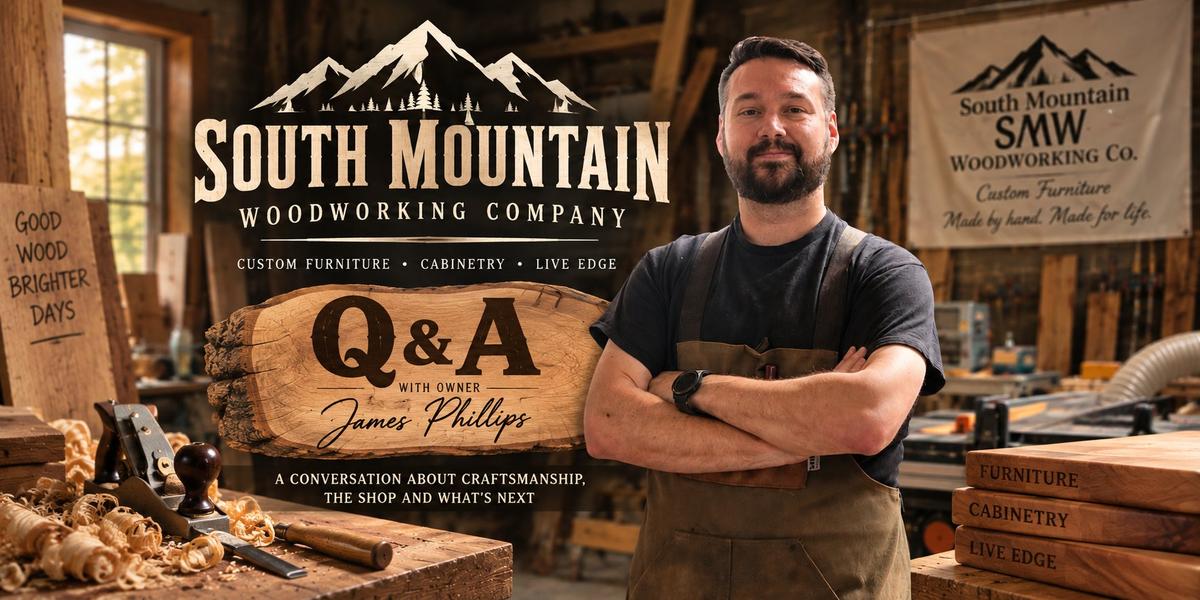
James Phillips has a fifteen-foot commute, and he would like you to know it is killing him.
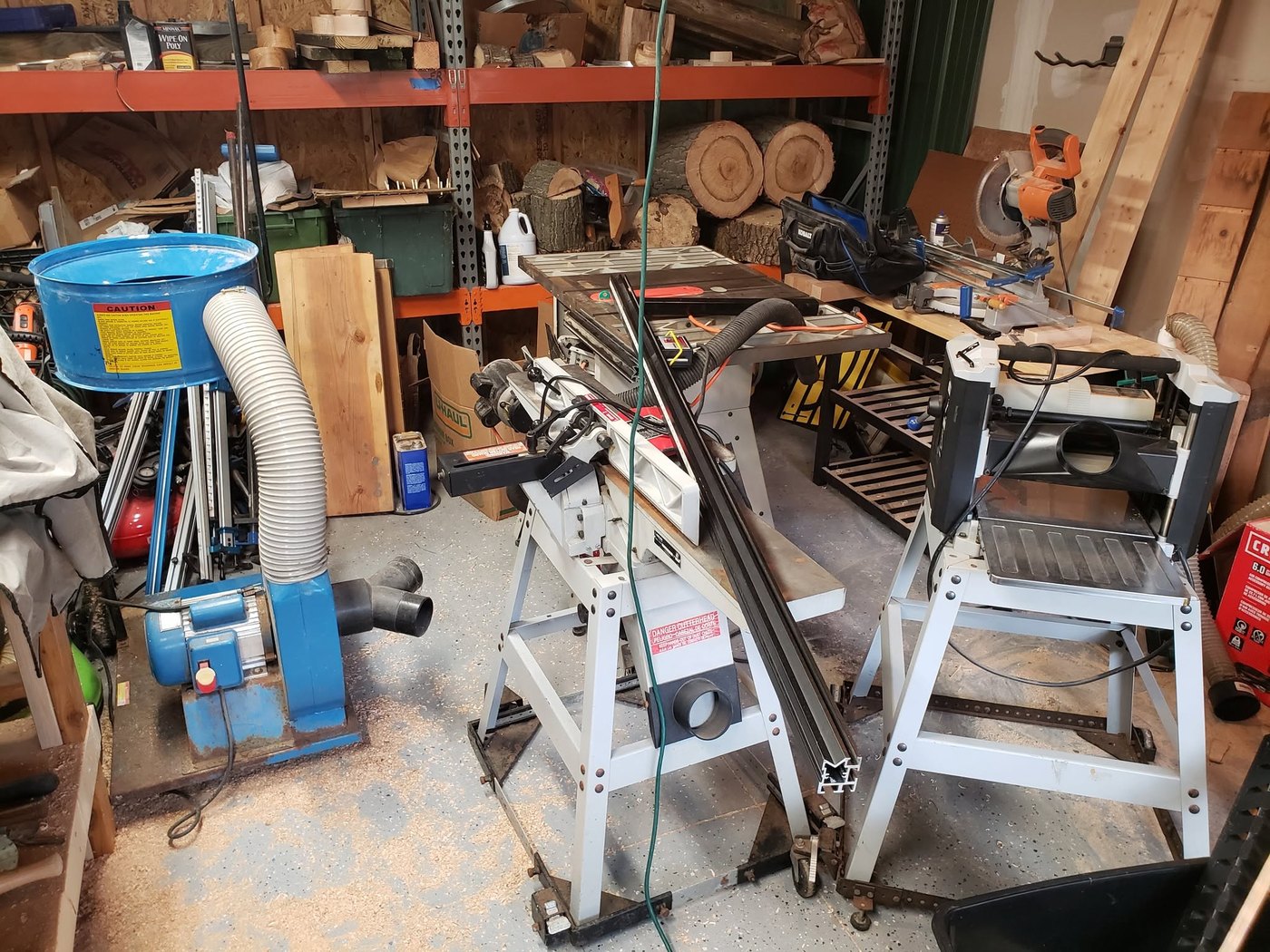
The joke lands every time he walks out his back door in Cementon, crosses a short stretch of yard and lets himself into the 1,500-square-foot garage that is now South Mountain Woodworking Company. When he and his wife moved to the Lehigh Valley, the garage was the point. He always intended it to be a shop.
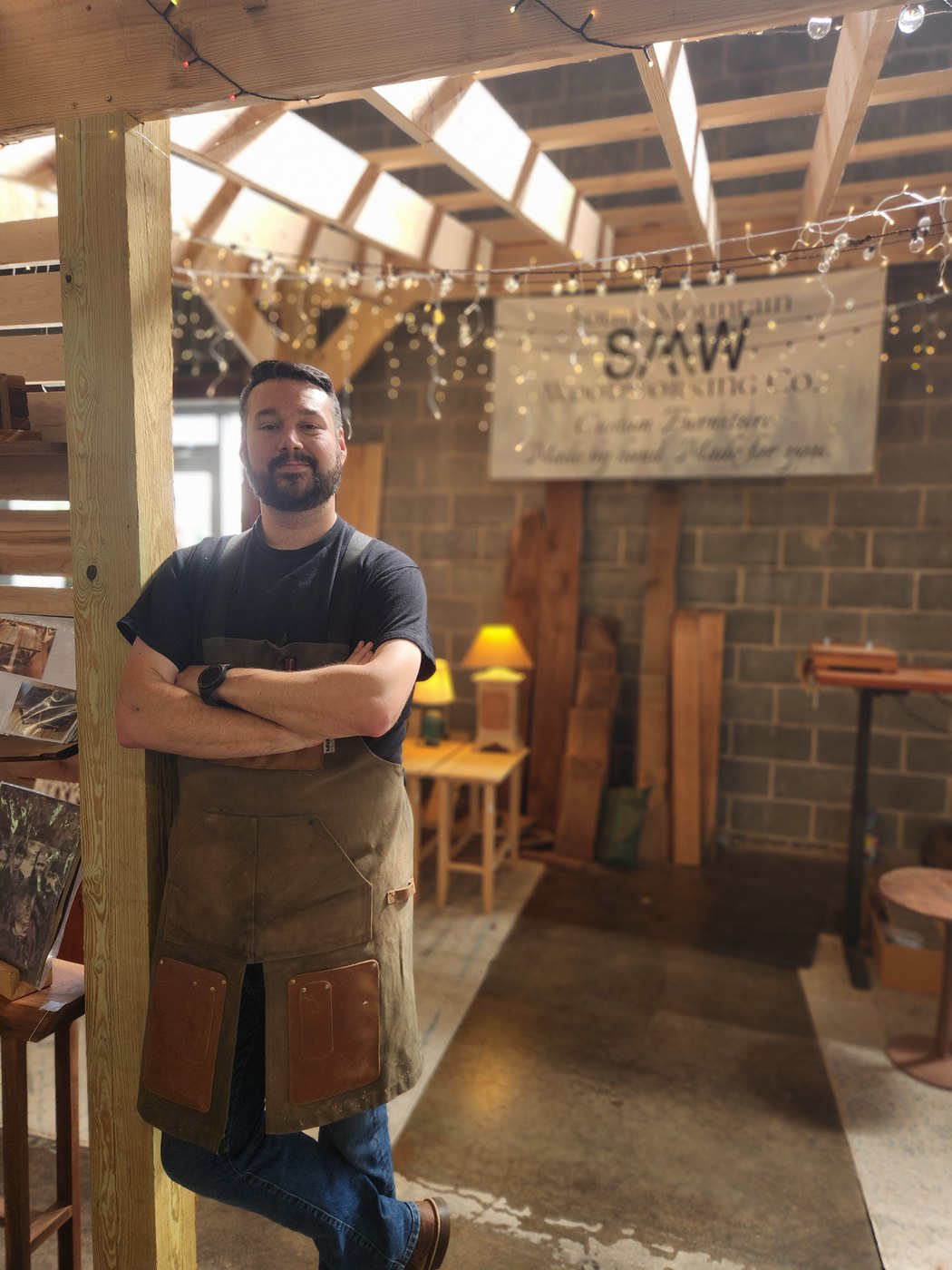
If you want to see the work without standing in his driveway, he keeps a showroom at the Slatington Farmers Market, open Saturdays and Sundays from 11 to 4.
A Covid Hobby That Got Out of Hand
The business started the way a lot of things started in 2020.
“South Mountain Woodworking Company started as a Covid hobby,” Phillips said. “I was looking for a new hobby that allowed me to make something creative and functional and woodworking was an obvious choice. It was also convenient that we had just purchased our first house and we needed new furniture.”
Six years later it is his full-time job.
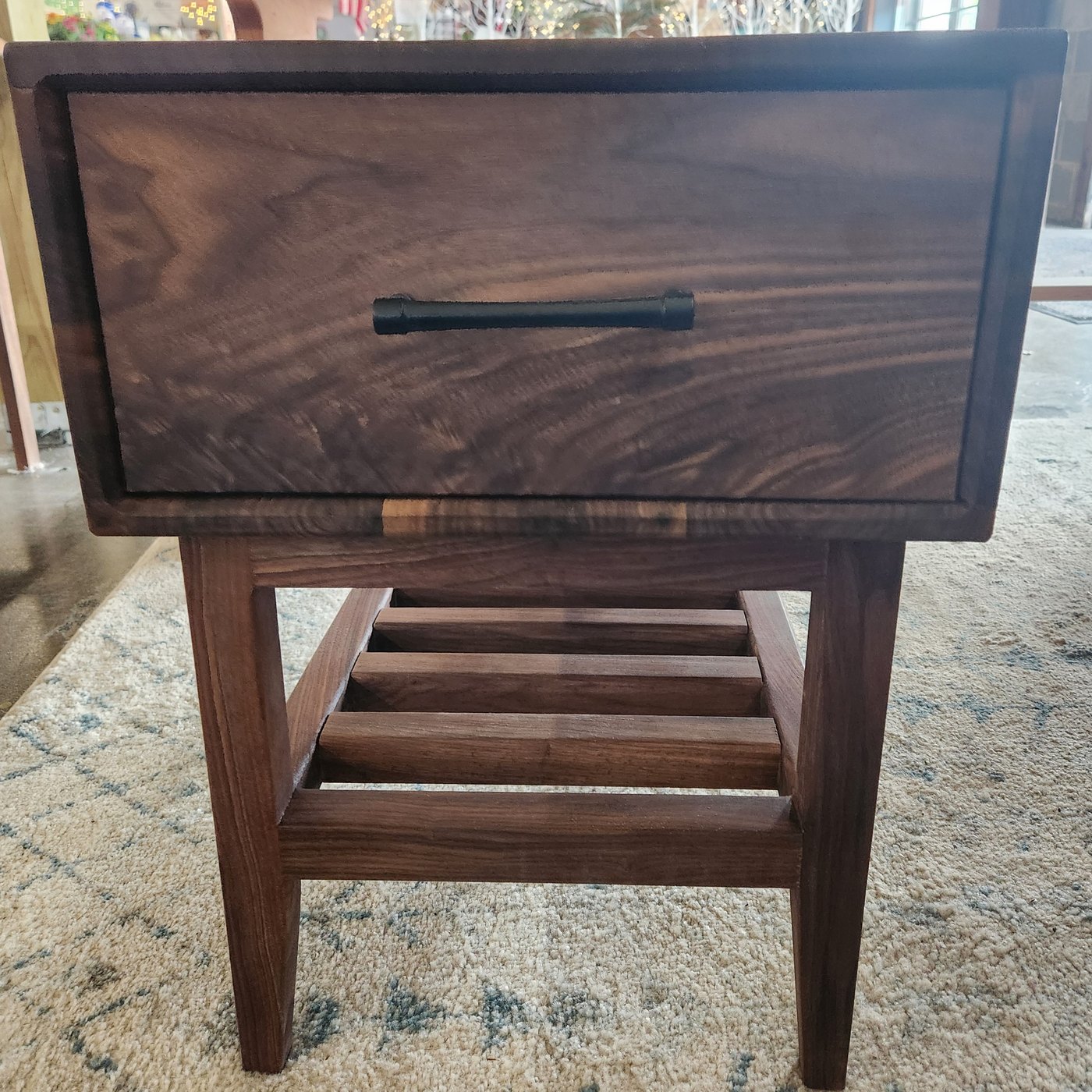
The first thing he ever built was a pair of nightstands, and they came with an idea attached: he put electrical outlets in the tops. Friends and family reacted strongly enough that he still makes small tables with outlets built in. The originals are in his house, demoted to the guest room after he built a better set for the main bedroom.
The first piece anyone paid him for was a hexagonal table built to hold an aquarium. Unsure how much a full tank would weigh, he overbuilt it to the point that he could jump on it without it shifting. It is still under that aquarium at his old neighbor’s house in Michigan.
What Ford Taught Him About Furniture
Before the shop, Phillips spent ten years in application development, designing digital experiences and doing user research, six of those years at the Ford Motor Company.
That sounds like a hard left turn into furniture. He does not think it was.
“My time there taught me the art of listening to people, not just what they say, but digging deeper to find the emotions that drive their behaviors,” he said, “and learning how to build something that helps them complete a job easier, better, faster.”
He learned the woodworking itself the hard way, which is to say mostly alone.
“I mostly learned by trial and error,” he said. “I’m a firm believer that you should make every mistake you can but try to only make it once.”
The rest came from YouTube and from other woodworkers. He goes to the Lehigh Valley Woodworking Guild every month, and his description of those meetings is the best argument for a local guild anyone is likely to make: it is “like suddenly entering a room full of grandparents who have hundreds of years experience combined.”
Why the Joinery Shows
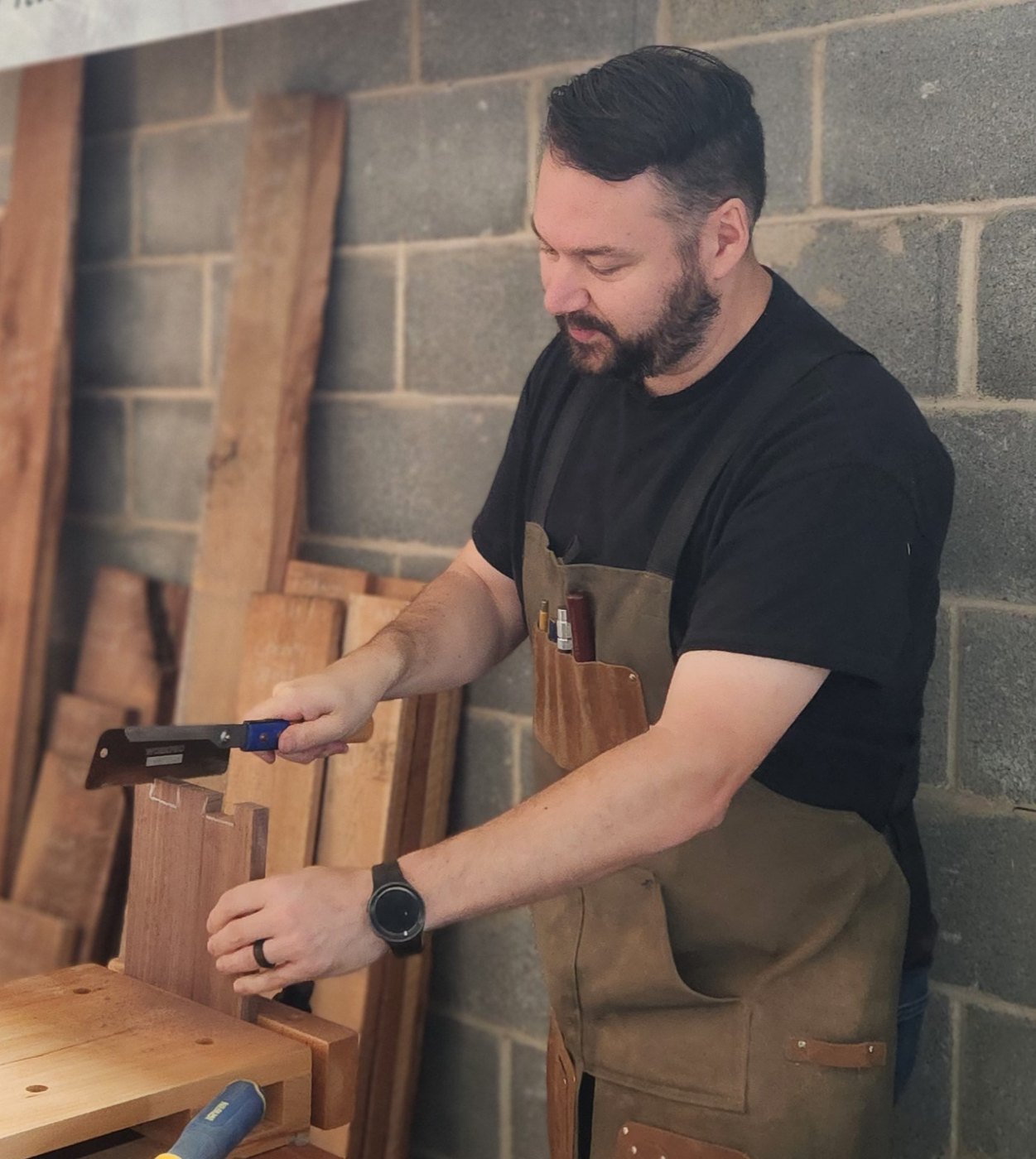
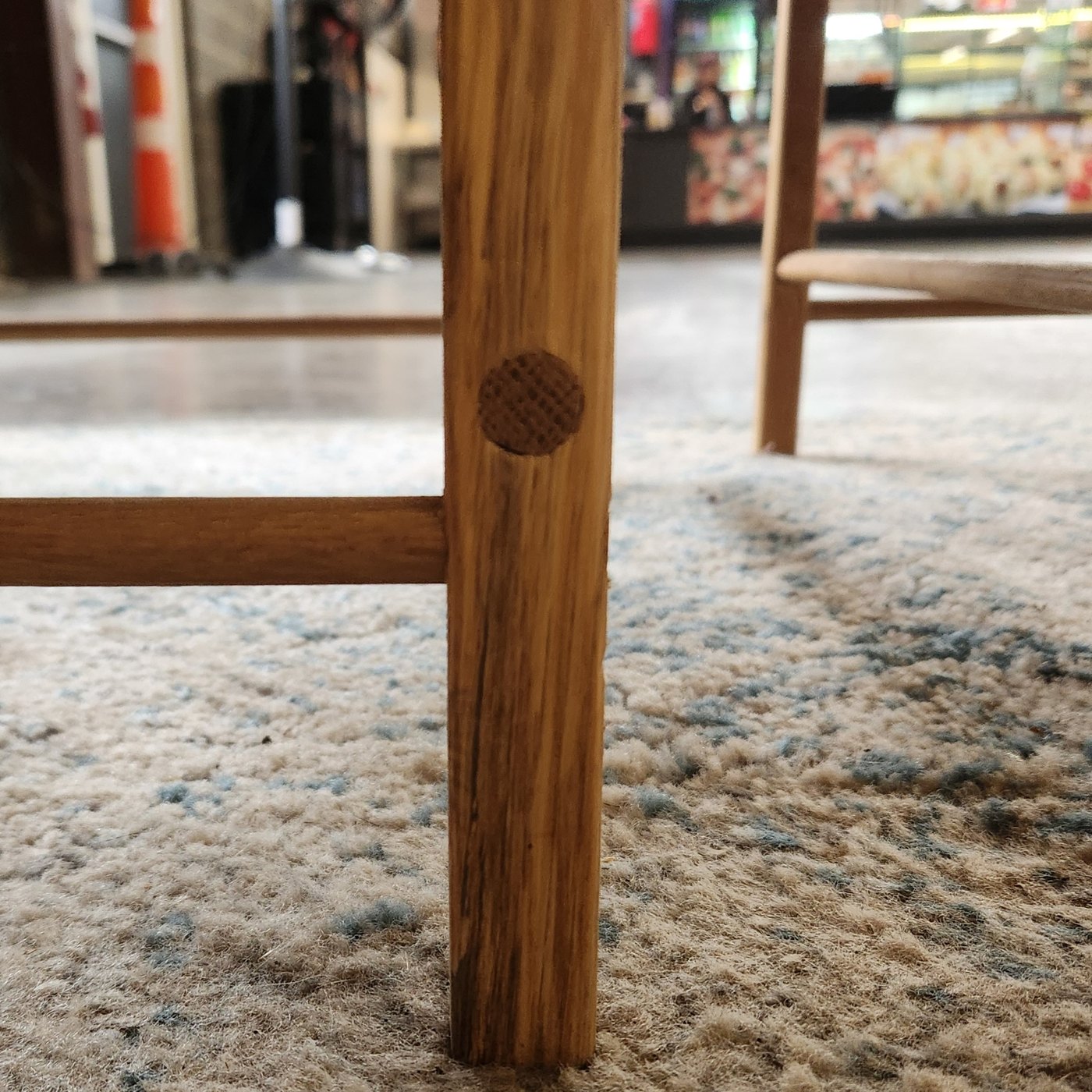
Phillips builds with visible joinery, mortise and tenon and dovetails left where you can see them, in a market where most furniture either hides its construction or has none worth showing.
“Visible joinery is the story of the craftsmanship of the piece,” he said. “There’s nowhere to hide when you peel back the curtain like that. When the joinery is hidden, you can never know the thought process and the decisions made to put those pieces together. With visible joinery, the piece can speak volumes to those who understand the language.”
His website says he obsesses over the parts no one consciously notices, because those are the parts people feel. Asked what that actually means on a finished piece, he had a specific answer: proportion.
“Every piece that is thoughtfully designed has a reference unit that all other elements of the piece adhere to,” he said. “When those proportions are off, you might look at a piece and think it looks unbalanced, or bulky, or somehow wrong. We are surrounded by things that have been designed for humans and we all have a subconscious sense of what looks right. My job as the craftsman is to play with those rules just enough to give you something unique but that looks balanced and cohesive.”
On the old argument about hand tools versus machines, he declines to take a side.
“I think both hand tools and machines have a place in the shop. Each has a task they are suited to and half of woodworking is knowing which tool is the right one for the task,” he said. Purists are welcome to their position. “The beauty of making things is that there are a thousand ways to make something and they’re all valid methods. It’s all in the hands and vision of the craftsman.”
Where the Wood Comes From
Pennsylvania leads the country in hardwood production and is sometimes called the black cherry capital of the world, and Phillips buys accordingly.
“There are so many small independent sawmills within an hour or so from the Lehigh Valley,” he said. “I prefer to buy wood that has been milled in Pennsylvania and the abundance of sawmills makes that easy to do.” His own favorite species is black walnut, for a color and grain pattern he considers unmatched.
The second source is stranger and better. People call him.
“Sometimes it’s because they had a woodworker in their life who has passed and they’re trying to clean out the scrap pile that person collected,” he said.
He does not treat those calls as a supply run.
“When I come across pieces like that, I like to make them something small as a thank you and as a way to honor a fellow woodworker,” he said.
The $400 Table
Every custom furniture maker eventually has to answer for the price. Phillips was asked how he makes the case to someone looking at a $400 table online that will arrive Thursday.
His first move is to concede the point.
“If budget and/or immediacy is their highest priority, I would encourage them to buy that table,” he said. He might add, “good luck passing that table down to anyone,” but if that is not what the buyer wants, it does not matter. “They can buy another $400 table in a few years when this one falls apart.”
The customers he is built for, he says, do not need convincing. “If their priority is to have a table that is the statement piece of the space, is made of high quality, durable material, and has a story that can continue with their children and grandchildren, then I don’t need to make a case to them. They already know why they should have me make their table.”
What he objects to is the comparison itself.
“To me, that $400 table that will be here on Thursday is the equivalent of a double cheeseburger meal from McDonalds. It’s cheap, fast, will fill you up, and is common,” he said. “The table I make is much more like a 5 course chefs tasting menu from a high-end restaurant. It’s unique, done masterfully, and personalized. It’s an experience that delights more than just satiates. They are both technically food, but no one is telling their friends about the double cheeseburger from McDonalds.”
What It Costs and How Long It Takes
Price comes down to size, complexity and material. A small bench, an end table, a nightstand or a dining chair sits at the lower end of his range, which starts between $1,000 and $3,000. Dining tables, china hutches, countertops and anything functionally complex climb from there. “Just like with any luxury or premium good, the floor is set but the ceiling is unlimited,” he said.
A project runs about two months on average, and most of that is not sawdust. Phillips meets the client, learns the space, takes measurements and talks through style, then produces 3D rendered images of the room and the proposed design so the customer can see the thing before it exists. Once a design is settled, the client enters a build queue that runs two to eight weeks. He delivers and installs the finished piece himself.
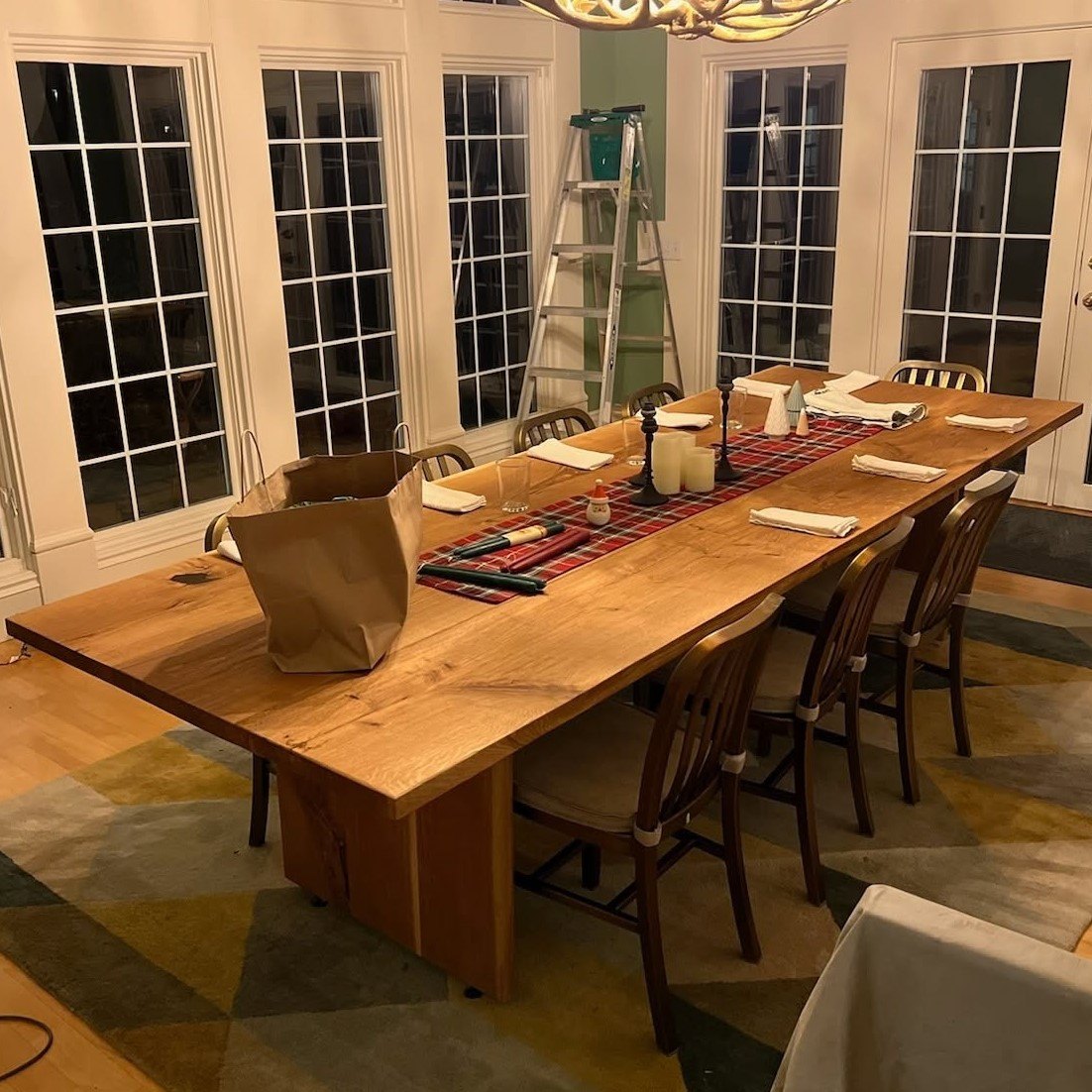
Most of what people ask him for is dining tables, usually with a matching bench or chairs, and he is glad about it.
“It’s a place where family dinners happen, homework is done, board game nights are hosted, and a place people like to gather,” he said. “I’m always honored to be a part of creating those moments for people.”
The commission he is waiting for is more specific. He wants to build a board game table with, in his words, all the bells and whistles: felt-lined top, cupholders, dice trays, space for a dungeon master, possibly a touchscreen display in the center, color-changing lights, integrated speakers. “I just need to find the right person who wants to make it happen.”
The Table That Almost Broke Him
The hardest thing he has built was his first massive slab dining table, and it went wrong in the way ambitious pieces do.
He had never built a top he could not lift by himself, and leaned on a patient neighbor to move it. Worse, he had designed it to be simple.
“The challenge with that is there’s nowhere to hide when everything is simple and I was using expensive material that was not easily replaced,” he said. “Every mistake I made building that piece would instantly be noticeable so I had to be incredibly careful.” The scale meant a constant hunt for cracks and voids, each one tracked down and fixed.
“That table almost broke me but I persevered and now I consider it one of my proudest pieces,” he said. He has built more slab tables since, each one better for what that first one cost him.
Asked whether he has ever made something he did not want to give up, he said no, and the reason is revealing.
“I enjoy the act of creation and mastery but I don’t enjoy the act of owning,” he said. “To me, each piece is a puzzle to solve and once the puzzle is done I’m on to the next puzzle.” What he wants is the reaction. “The thing I enjoy the most is seeing the delight people have when they first see their piece.”
Naming a Business After a Mountain You Just Met
Here is the part that complicates the story in an interesting way. Phillips is not from the Lehigh Valley. He grew up in Michigan and spent most of his life there. He has lived here for about a year.
His family arrived first, in stages. His sister married someone from Emmaus and moved here, and they now have two daughters. His mother retired and followed to be near them. His wife’s family is from the Harrisburg area. Eventually the arithmetic was obvious.
“It just made sense to us to be close to family,” he said. “The only goal was to be close to our family.”
What he did not expect was to fall for the place, particularly its topography.
“We love that we are close to the Lehigh River and can go for a walk near it every day, or that we’ll be driving somewhere, turn a corner, and see the most beautiful view of the mountains,” he said. “There isn’t much elevation in Michigan so seeing distant mountains and miles of valley takes our breath away.”
The move cost him something real. He had built a clientele in Michigan and left it behind, and used the disruption as the moment to go full-time. “The people in the area have been incredibly kind to me and I’m happy that I’m starting to become a member of the community here,” he said.
Which brings it back to the name. He called the business after the ridge that helps form the valley he had just moved into.
“I wanted to name my business after something that roots me to this area,” he said, “and I try to build my pieces in the spirit of the mountain. Nothing rushed, built to last, and natural craftsmanship.”
Asked whether the Valley’s long history of people who made things by hand, the Moravian trades in Bethlehem and the industrial era that followed, meant anything to him or whether that was romanticizing a job, he did not hedge.
“I absolutely feel connected to the lineage of this area,” he said. His commitment to traditional joinery is partly homage, and not only to the Moravians. He named the Shakers, the English and the Japanese too. “These are pieces built by people who used what they had to get things done and I’m proud to be a continuation of that legacy.”
The rule he took from all of them is four words long and applies to more than furniture: “First make it functional and then make it beautiful.”
At a Glance
- Who: James Phillips, owner and maker, South Mountain Woodworking Company
- What: Custom hardwood furniture built with visible traditional joinery
- The shop: A 1,500-square-foot garage at his home in Cementon, near the Lehigh River
- Where to see the work: Showroom at the Slatington Farmers Market, Saturdays and Sundays, 11 a.m. to 4 p.m.
- Before this: Ten years in application development and user research, six of them at the Ford Motor Company
- How he learned: Trial and error, YouTube, and monthly meetings of the Lehigh Valley Woodworking Guild
- Materials: Pennsylvania-milled hardwood from small independent sawmills, plus reclaimed stock from locals clearing out barns. Favorite species is black walnut
- Most requested: Dining tables, usually with a matching bench or chairs
- Budget: Smaller pieces start in the $1,000 to $3,000 range; larger and more complex work runs past $10,000
- Timeline: About two months on average, including design and 3D renderings, with a build queue of two to eight weeks
- Online: southmountainwoodworking.com