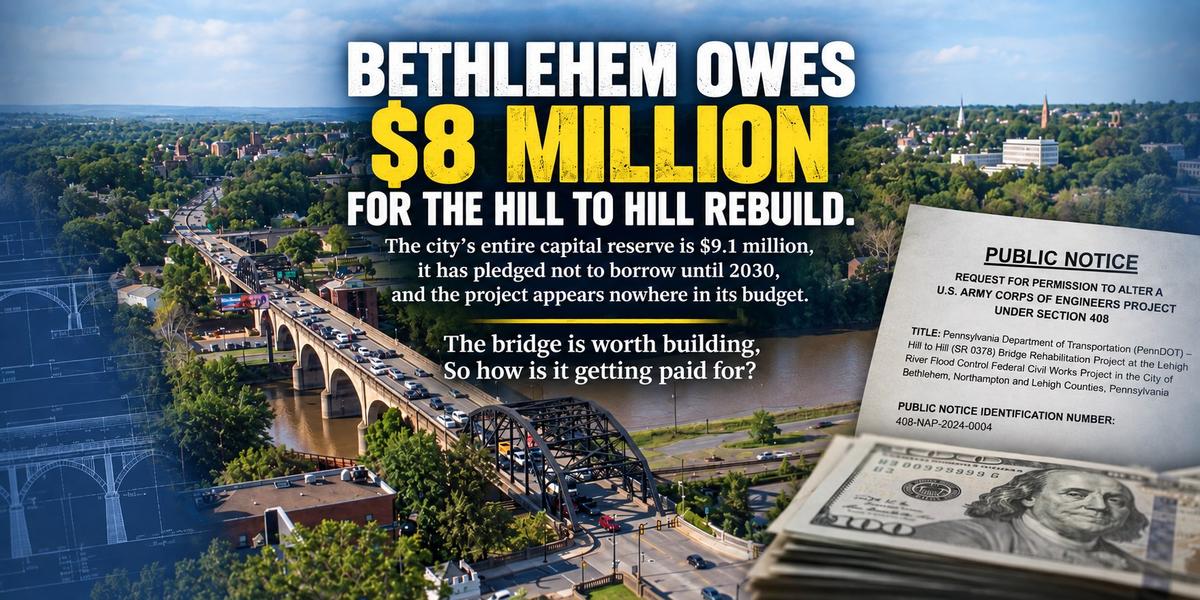
PennDOT starts rebuilding the Hill to Hill Bridge this fall. The work runs to the summer of 2030 and costs roughly $78 million.
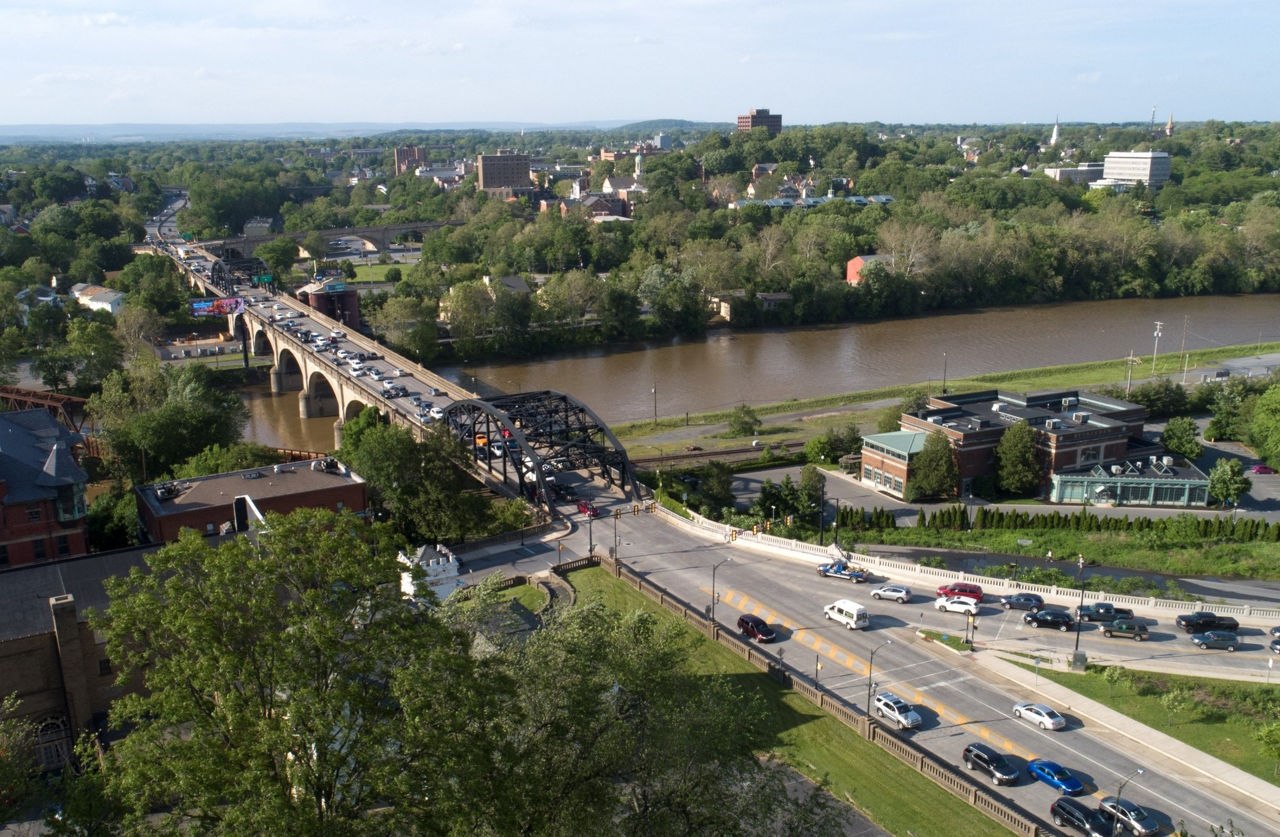
The project itself is good. The Hill to Hill opened in September 1924 and carries Route 378 and about 55,000 vehicles a day over the Lehigh River, and it was built for a city that no longer exists. PennDOT will put a new span alongside the old one at the southern end, move northbound traffic onto it, give the century-old structure over to southbound, add a second southbound left turn lane, realign Third Street and restore direct Second Street access that was torn out in 1989. Both historic trusses stay, including the one-of-a-kind Hudson truss that exists on no other bridge anywhere.
Four construction seasons on the only crossing most people use will be genuinely unpleasant. It is still worth it. A hundred-year-old bridge carrying 55,000 vehicles a day does not get fixed conveniently, and the alternative is deferring it until the repairs are no longer optional.
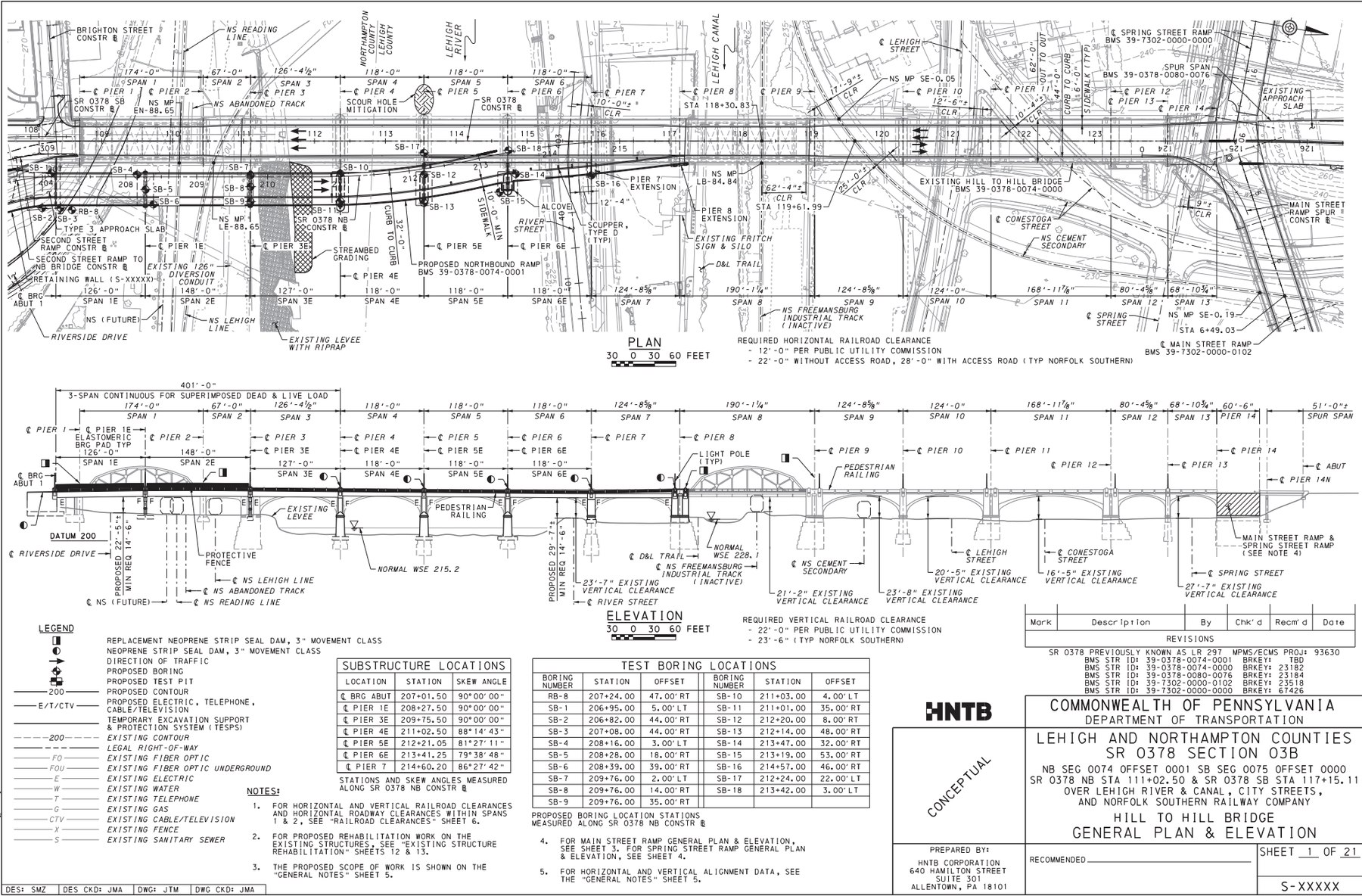
If you want to see it for yourself, the construction plans are public. The blueprints can be found here, filed with the U.S. Army Corps of Engineers, and PennDOT maintains an official page for the project with its scope and schedule.
Take the four years. The question is not whether to do this. The question is how Bethlehem is paying its share, because the city's own budget does not answer it.
The Bridge Bethlehem Spent 130 Years Fighting For
It is worth understanding what is being rebuilt, because almost nothing else in this city carries the same weight.
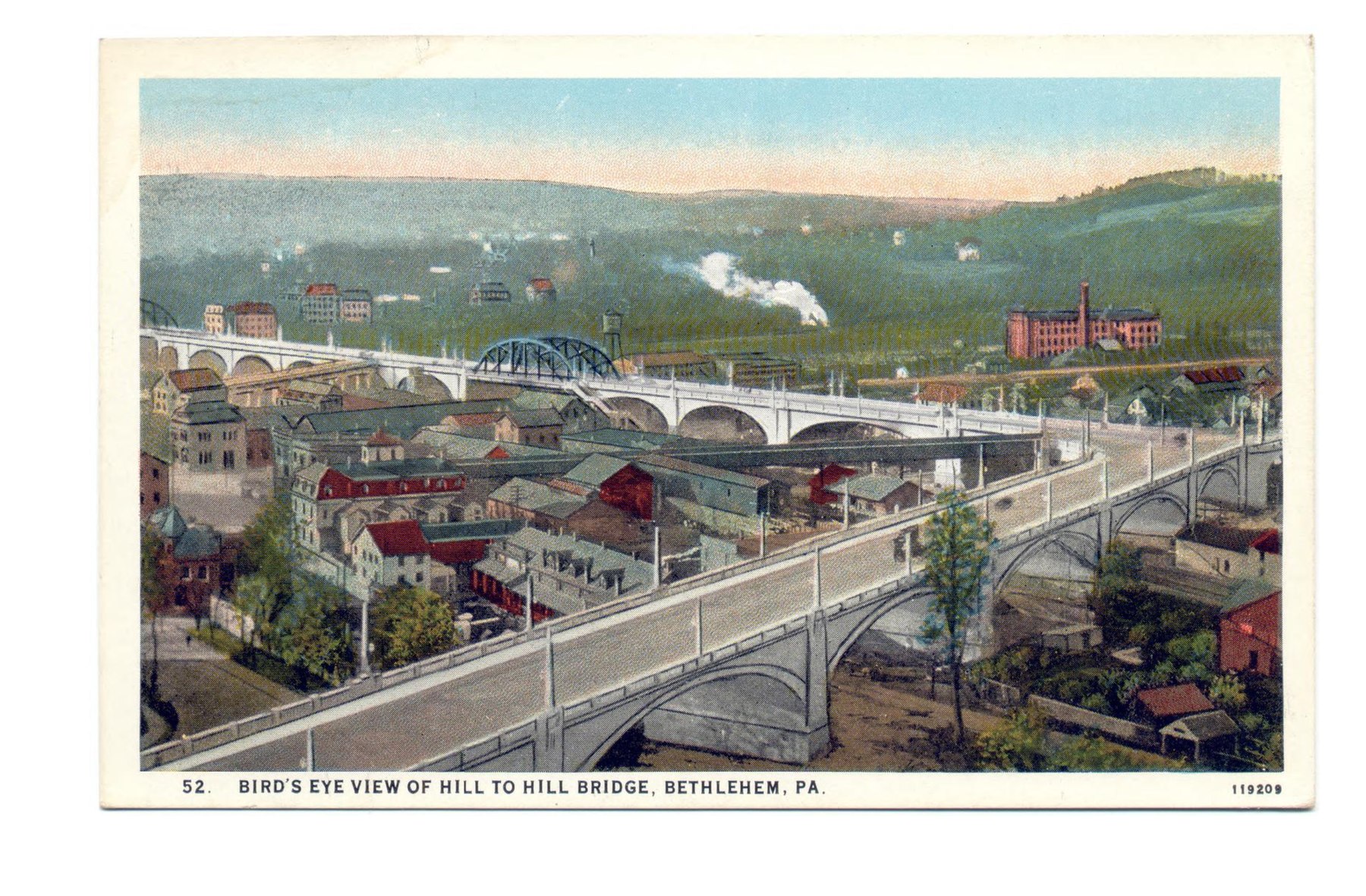
People have been crossing the Lehigh at this spot since a one-lane covered bridge went up on September 27, 1794. An uncovered replacement opened in October 1816. A January flood destroyed that one, and the next bridge, built for $7,258, opened in September 1841. Every version burned, flooded, or rotted.
By the end of the nineteenth century the crossing was a toll bridge run by the Bethlehem Bridge Company, and the tolls were the problem. Archibald Johnston started pushing for a real bridge in 1892, three years after joining Bethlehem Iron Company, and the bridge company fought him because it was collecting money at the gate. County commissioners finally bought the structure outright for $26,000 that same year.
It still took another three decades. Momentum came when Charles M. Schwab took over Bethlehem Steel in 1904 and Johnston became one of his executives. The Bethlehem Joint Bridge Commission formed in 1911. By 1915 the old wooden span had deteriorated so badly that truck drivers crossed it, in the language of the day, at their own risk.
Construction finally began in August 1921. Rodgers and Hagerty, a New York contractor, put 400 men on it at peak. They poured 28,000 cubic yards of concrete and set 3,400,000 pounds of structural steel. The Pennsylvania Cement Company supplied the concrete, Bethlehem Steel the reinforcement, and local vendors the sand, stone and castings. The deepest pier went 51 feet below ground. The roadway sits 48 feet above the water. There are 26 arch spans, the longest reaching 146 feet.
Clarence W. Hudson, Lehigh class of 1889, designed it. To clear the railroads running beneath the structure he worked out a pair of 171-foot steel trusses in a configuration nobody had built before and nobody has built since. They are called Hudson trusses, and the only two in existence are the ones in Bethlehem.
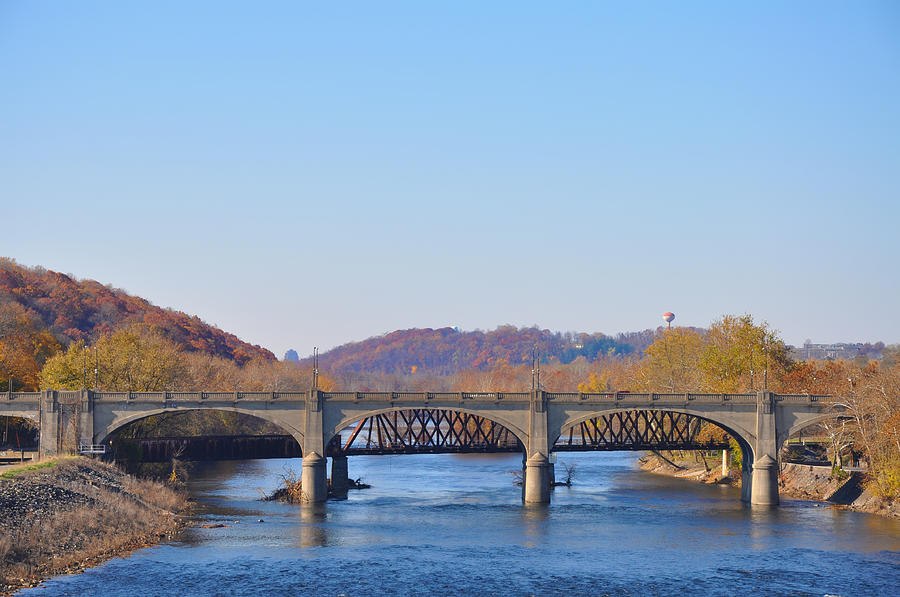
The whole thing cost about $3 million, something near $44 million in today's money, and it did more than carry traffic. It erased the grade crossings of three separate railroads on both banks, which had been killing people. And it stitched together a city that had only just become one, joining Bethlehem to South Bethlehem in physical fact rather than on paper.
It opened on November 1, 1924. At 10:15 that morning former mayor Archibald Johnston, who had been arguing for this bridge for thirty-two years, and sitting mayor James M. Yeakel pulled the ropes blocking the deck. The Bethlehem Globe reported "a continuous parade of automobiles and trucks across the bridge" that day, accompanied by "merry tooting of horns and sirens."
That is the structure PennDOT is about to spend four years working on, and it is why preserving both trusses is not a sentimental detail. The bridge went on the National Register of Historic Places in 1972 and sits inside the Central Bethlehem Historic District.
It Also Touches the Levee
One detail in the federal paperwork deserves more attention than it has received.
The Army Corps filing is not a routine permit. It is a request for permission to alter a United States Army Corps of Engineers project under Section 408, and the project being altered is named in the notice: the Lehigh River Flood Control Federal Civil Works Project, in the City of Bethlehem, Northampton and Lehigh Counties.
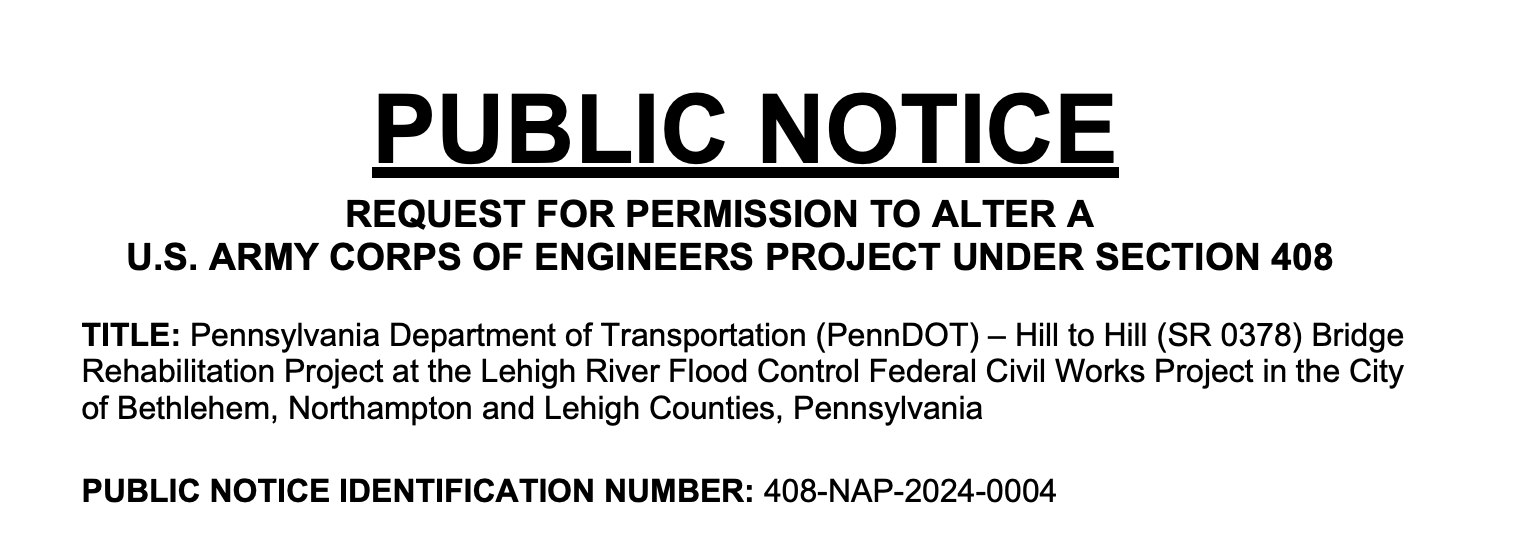
In plain terms, rebuilding this bridge means working on Bethlehem's federal flood control system. The plan sheet shows an existing levee with riprap near the western approach and calls for scour hole mitigation in the riverbed. Anyone who has watched the Lehigh come up understands why that is not a footnote.
The $8 Million
PennDOT has about $69 million secured, most of it federal. The Hill to Hill is a split-ownership structure, so the City of Bethlehem is responsible for roughly $8 million covering the approaches and ramps it owns.
That $8 million does not appear in the City of Bethlehem 2026 Approved Budget. Not in the thirteen pages of non-utility capital improvement project detail, where every capital project the city intends to fund is named with a dollar figure and a funding source. Not in the capital improvement plan table that breaks each project across bond funds, grants, recreation fees and reserves. Not anywhere in 314 pages.
The Hill to Hill appears exactly twice in the entire document. Once in a Public Works overtime note about cleaning the bridge's drains on weekends, which the counties reimburse. Once in the narrative for the Route 378 light pole replacement, a separate and much older project.
What Bethlehem Actually Has
Here is the city's 2026 capital picture, from its own fund analysis.
The total non-utility capital fund is $39,025,323. Most of that is restricted money: federal, state and local grants tied to specific projects, recreation fees, and dedicated local reimbursement funds.
The flexible money is smaller. The 2026 capital reserve is $9,111,138. The 2024 local reimbursement fund holds $4,230,491 and the 2022 fund $626,175. The 2019 bond, the last time the city borrowed for capital, is down to $77,123. That well is dry.
So the city's single largest pool of discretionary capital money, $9.1 million, is being asked to absorb an $8 million obligation on one bridge, on top of everything else it funds. Spread across four or five budget years that is roughly $2 million annually, which is less alarming but not remotely trivial against a reserve that also has to cover fire apparatus, street overlays, building systems and the ten other bridges the city maintains itself on a $330,406 repair line.
The Borrowing Problem
The obvious answer to a large capital bill is to borrow for it. Bethlehem has taken that off the table.
When City Council passed the 2026 budget in December by a 5 to 2 vote, the plan it approved included heavy payments toward existing debt and a commitment to no capital borrowing for the next four years. The Hill to Hill rebuild runs from the fall of 2026 to the summer of 2030. It is the same four years, almost to the month.
This is not an accidental collision. It is the city's stated strategy. Among the finance department's own 2026 objectives, printed in the budget, is this: "Continue to build Capital Reserves in order to avoid the expense of additional debt service." Directly beneath it: "Explore opportunity to restructure existing debt for 2026."
Bethlehem is trying to get out from under debt it already has. The general fund carries $8,240,913 in debt service for 2026, a figure that happens to be almost exactly the size of the bridge obligation. Out of a $112.8 million general fund, roughly one dollar in fourteen goes to servicing what the city already borrowed.
So the city has ruled out new borrowing, is working to restructure old borrowing, is deliberately building reserves to avoid future borrowing, and has an eight-million-dollar bridge bill arriving inside that window.
Why "That Is Just How Capital Budgets Work" Does Not Hold
There is a reasonable objection here, which is that multi-year projects with outside funding do not always show up cleanly in a single year's budget.
Bethlehem's own budget disposes of that.
The West Broad Street Corridor Improvement is in the book at $11,439,191, with $11,339,191 of it identified as federal and state grant money and $100,000 from reserves. It is a large, multi-year, grant-funded road project, and it is fully itemized with its funding source named. So is the Linden and Center Streets two-way conversion at $1,970,216. So is the East Broad Street Active Transportation Plan at $942,750. So is the Monocacy Way Trail at $982,308.
The city even carries projects it has no money for. Unfunded work gets a placeholder of one dollar. The South Bethlehem Greenway extension between South New and West Third is in at $1, with a note that the city "will move to final design and construction when sufficient funding is secured." The Guetter Street improvements at the Transportation Center are in at $1 while the city chases a state grant.
Bethlehem itemizes eleven-million-dollar grant projects. It itemizes projects funded at one dollar. The largest infrastructure undertaking in the city in a generation gets neither.
Three Possibilities
There are only a few ways this resolves, and residents deserve to know which.
The obligation is backloaded, and the city's payments fall in 2027 through 2030 budgets rather than this one. Plausible for a project starting in the fall, but it would still normally appear in a capital plan that explicitly runs its reserve line out to 2029.
It is not really city cash at all, and the $8 million flows through PennDOT as state or federal money against work on city-owned structures. Also plausible, and the simplest explanation, but then the $8 million figure that was presented to regional planners as the city's contribution means something different than it sounded.
Or it comes out of the capital reserve, in which case the reserve the finance department is deliberately building to avoid new debt gets substantially consumed by one bridge, and everything else competing for that money moves down the list.
Each of those has real consequences and none of them are scandalous. What is not acceptable is that a resident cannot tell which one is true by reading the budget their council voted on.
What to Ask
Three questions, all answerable, all owed to the public before construction equipment arrives.
When did City Council vote on Bethlehem's share of the Hill to Hill rebuild, and at which meeting? If there was no separate vote, when was the commitment made and by whom?
Which fund pays it, and in which years? Capital reserve, grant pass-through, or something else.
And if it is coming from the capital reserve, what drops off the list to make room, given that the city has pledged not to borrow until 2030?
The bridge is worth building. That is not in dispute. An eight-million-dollar commitment from a city with a nine-million-dollar reserve and a no-borrowing pledge should not be something the public has to reverse-engineer.
At a Glance
- What: Full rehabilitation of the Hill to Hill Bridge, plus a new parallel span at the southern end
- When: Construction starts fall 2026, finishes summer 2030
- Cost: Roughly $78 million
- Who pays: About $69 million PennDOT, mostly federal. Roughly $8 million from the City of Bethlehem
- The problem: Bethlehem's entire 2026 capital reserve is $9,111,138, the city has pledged no capital borrowing until 2030, and the project has no line item anywhere in its 314-page budget
- Traffic: About 55,000 vehicles a day. PennDOT aims to keep four lanes open at weekday peaks, with restrictions pushed to nights and weekends
- What you get: A second southbound left turn lane, Third Street realigned, direct Second Street access restored, extended sidewalks, both historic trusses preserved
- The bridge: Opened November 1, 1924. On the National Register since 1972. Carries the only two Hudson trusses in existence