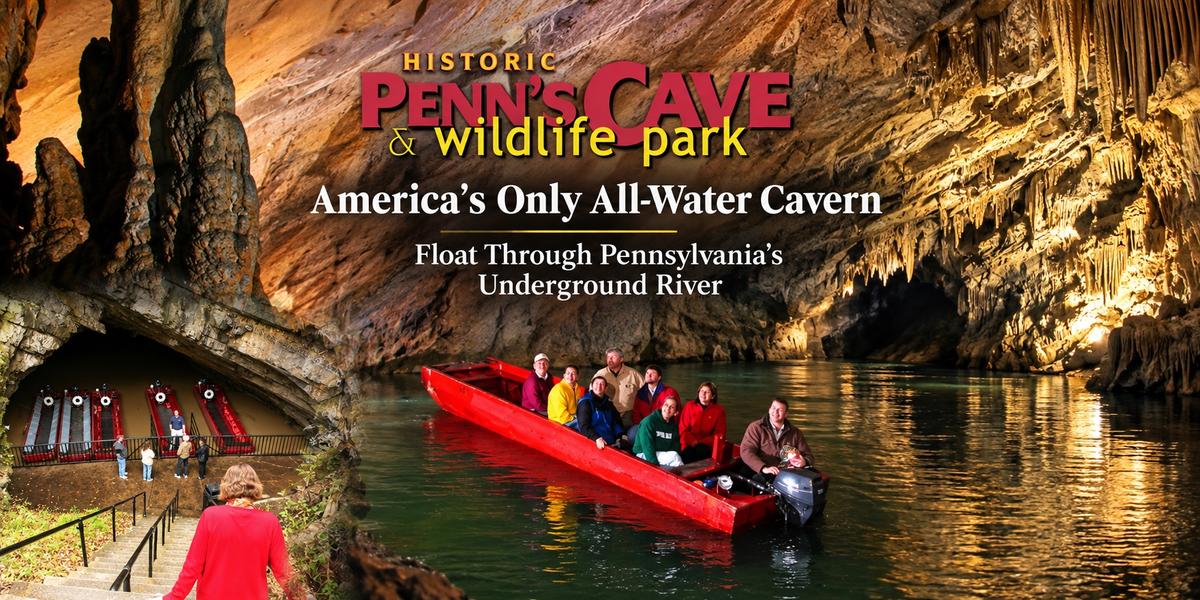
Most caves in Pennsylvania are something you walk through. Penn’s Cave is something you float through. About three hours west of the Lehigh Valley, outside Centre Hall in Centre County, a flat-bottom motorboat carries visitors into a limestone cavern where there is no path, no railing and no dry ground, just a stream and the formations hanging above it. The attraction bills itself as “America’s only all-water cavern,” and it has been showing that water to paying visitors since 1885.
It is also, as of this month, a place with an uncertain future. The family that has owned it for more than a century says it wants Penn’s Cave to become a state park, and says the alternative would be development.
What the Boat Tour Is Like
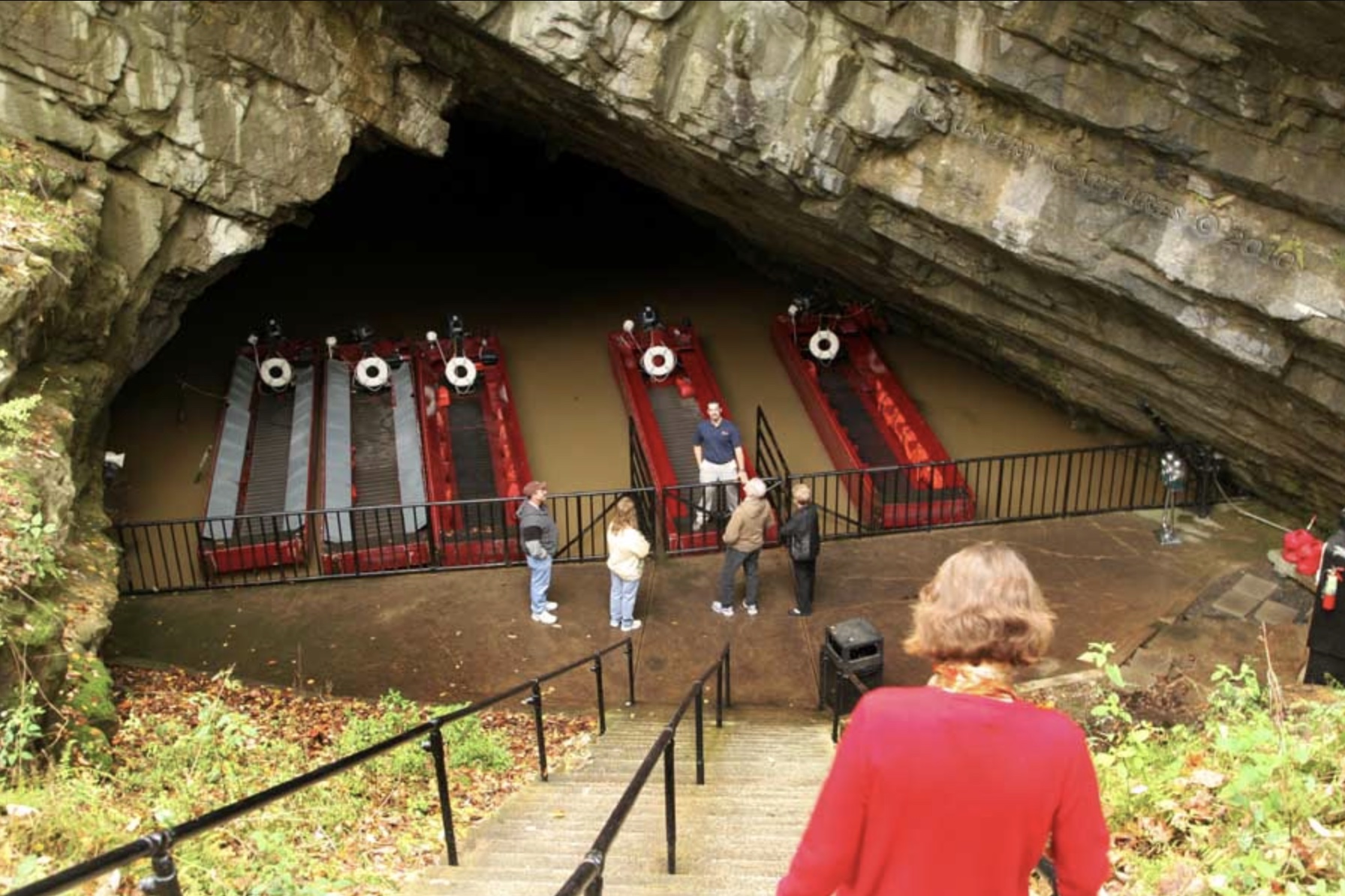
The cavern tour lasts about 45 minutes and is fully guided. Boats hold 20 to 22 people. Before you board, you walk down a 300-foot paved incline and 48 steep concrete steps with handrails to the dock at the cave mouth, which is worth knowing in advance: the tour is not handicapped accessible.
Once inside, the boat glides through a cavern roughly 1,300 feet long. The stream beneath you runs three to five feet deep, and in places the ceiling rises as high as 55 feet above the water. Guides point out stalactites, stalagmites, flowstone, curtains, draperies, pillars and columns, along with named formations like “The Statue of Liberty” and “The Garden of the Gods.” Some of the formations are delicate soda straws, thin hollow tubes of mineral that grow a drop at a time.
The water level is not left to chance. A dam system installed in the 1920s controls it to protect those formations. That dam was originally built to generate hydroelectric power and was one of the first in Central Pennsylvania to do so.
Inside, it is 52 degrees year round. Bring a jacket or sweater even in August, and wear comfortable walking shoes for the steps. Photos are permitted.
The Legend, and the Truth About It
Penn’s Cave comes with a story, and the guides tell it. According to the attraction’s own history, the Seneca found the cave in what was then called the Valley of Karoondinha, now Penns Valley. The legend concerns a young woman named Nita-nee and a French trapper named Malachi Boyer. “Forbidden to marry because of an Indian custom,” the two ran away, were caught, and Malachi “was thrown into Penn’s Cave to die.”
Penn’s Cave also connects Nita-nee’s name to Penn State’s Nittany Lion. That part deserves a footnote. Penn State’s own history traces the mascot to a student, H. D. “Joe” Mason, who invented it in 1904 after a baseball trip to Princeton left him embarrassed that his school had nothing to match the Princeton Tiger. The “Nittany” comes from Mount Nittany, the ridge overlooking campus. And the Nita-nee legends in circulation were largely the work of author and publisher Henry W. Shoemaker, who later admitted the Indian names in them were “purely fictitious.”
None of that makes the story less fun to hear in the dark, with water lapping at the boat. Just know it is folklore.
A Show Cave Since 1885
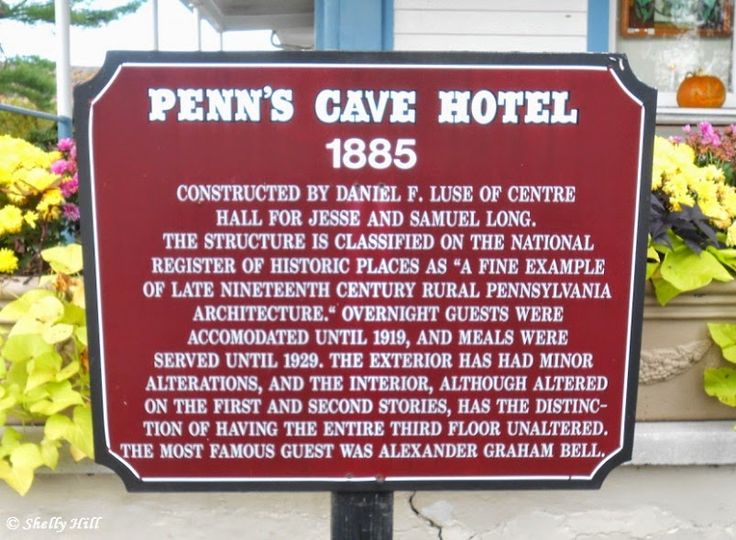
The documented history is interesting enough on its own. Native Americans and early explorers used the cave’s dry chambers for shelter. In 1885 Penn’s Cave opened as a commercial show cavern, and the Penn’s Cave Hotel went up beside it: a three-story frame building with a high mansard roof on a limestone foundation. It was built by Daniel F. Luse of Centre Hall for Jesse and Samuel Long.
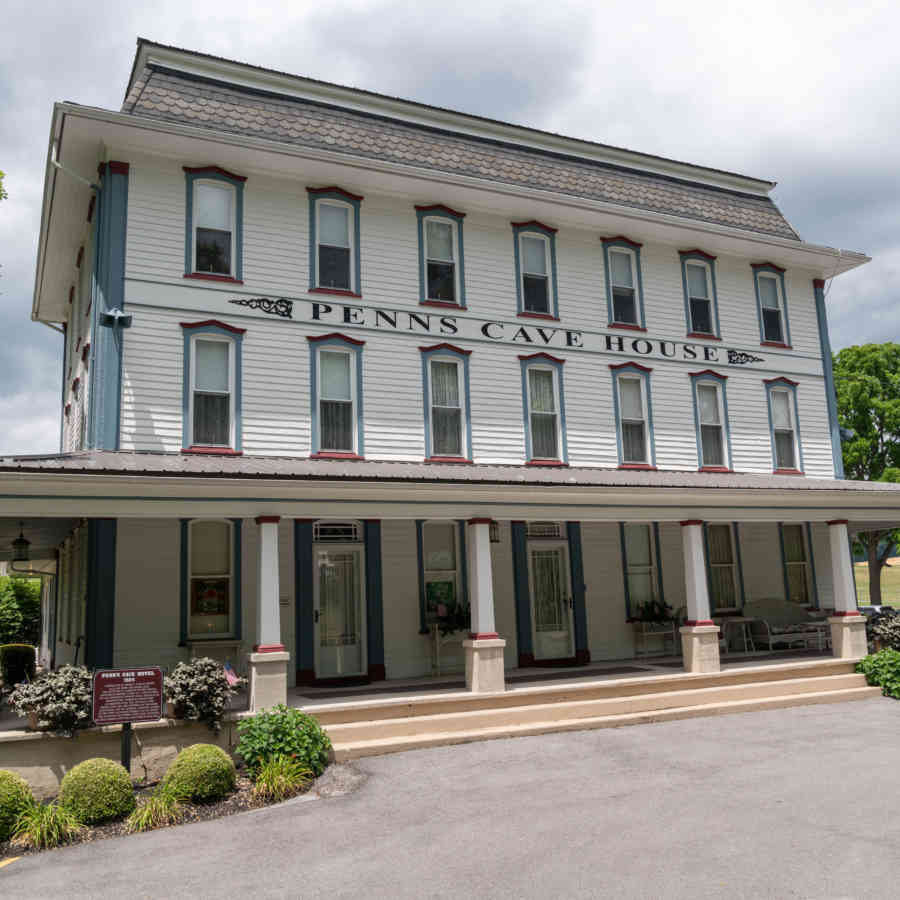
The hotel’s most famous guest, according to the historical marker out front, was Alexander Graham Bell.
In 1908, brothers Henry Clay Campbell and Robert Perly Campbell bought the property from John Herman of Pleasant Gap. Robert, his wife Edith and their children ran the hotel, taking overnight guests until 1919 and serving meals only through 1929. The north wing came down in 1938, and a one-story addition was built in the 1960s.
Penn’s Cave and the Penn’s Cave House are listed on the National Register of Historic Places, which describes the hotel as “a fine example of late nineteenth century rural Pennsylvania architecture.” The first and second floors have been altered inside over the years, but the building still has what the marker calls “the distinction of having the entire third floor unaltered.” It stands today with “Penns Cave House” lettered across its white clapboard front, above a long covered porch.
The same family still owns it, well over a century later.
Above Ground: 1,400 Acres of Farm and Wildlife
The cave is only half the visit. Penn’s Cave sits on roughly 1,500 acres, about 1,400 of them preserved land for its Farm-Nature-Wildlife Park, explored on a guided bus tour of about 90 minutes.
The animals are native North American species, plus some farm stock: bison, elk, whitetail deer, black bears, mountain lions, red and silver foxes, wild burros, Texas longhorn cattle and a wolf pack of gray and arctic wolves. There are also wild horses originally adopted through Bureau of Land Management and state forestry programs. The tour covers the geology and biology of the area and stops at an outdoor butterfly garden.
It is also a working centennial farm, one that grows the crops used to feed the animals. The property even has its own runway for aircraft. “365 days a year, we are feeding the animals and taking care of them because they can’t take care of themselves,” Mark Watson, the park’s executive general director, told WITF.
For something rougher, a separate Mountain Tour runs about an hour and a half in off-road vehicles from June through November and requires an advance reservation. Kids can also work through Prospector Pete’s Miners Maze or try gemstone panning. There is a gift shop and the Cave Café on site.
Why It Might Become a State Park
On September 13, The Philadelphia Inquirer reported that Penn’s Cave’s owners want the property to join Pennsylvania’s state park system.
“We feel that it’s a very important part of not only Centre County, but the Commonwealth of Pennsylvania, and that it should be preserved in perpetuity,” said CEO Russ Schleiden.
His daughter, Jeanine Watson, was blunter about the stakes. “We want it to be preserved and to be taken care of. We’ve always felt we were the stewards of that,” she said. “We would hate to see this go into development and, unfortunately, that would be the alternative.”
The idea has a champion in Harrisburg. State Rep. Kerry Benninghoff, a Bellefonte Republican, pushed for it, though his proposal did not make it into the state budget this July. He intends to try again. “I can’t think of a better time in our country and our county’s history at the Semiquincentennial to make this reality,” he said. “If you want to look at Americana in its best, the park I think exemplifies that.”
The Department of Conservation and Natural Resources sounds open to it. “Penn’s Cave’s natural and cultural resources could make it a strong addition to Pennsylvania’s state park system and provide expanded opportunities for the public to access and enjoy the site,” said DCNR spokesperson Wesley Robinson.
There is recent precedent. Laurel Caverns in Fayette County became Pennsylvania’s 125th state park in April 2026, the state’s first cave park. That property was donated to the state, though. No price, deal terms or timeline for Penn’s Cave have been made public.
For now, nothing changes for visitors. The cave is open, and tickets are sold at the door.
Make a Weekend of It
Penn’s Cave is a long day trip from the Lehigh Valley, so it pairs well with an overnight in State College, about 30 minutes away. Two other show caves sit within reach, and together with Penn’s Cave they make up the Central PA Cave Passport. Pick one up at the Penn’s Cave ticket counter, get it stamped at all three, and you earn a Central PA Cave Explorer sticker.
- Woodward Cave, also in Centre County, has been giving tours since 1926 and holds the largest stalagmite in Pennsylvania. Its tour season is limited to protect its bat population, running from late May to mid-October, so a September trip is your last chance this year.
- Lincoln Caverns & Whisper Rocks offers one-hour interpretive tours of two crystal caverns and hosts underground events through the year.
If you would rather stay closer to home, the Lehigh Valley has its own underground river: Lost River Caverns in Hellertown.
At a Glance
- Where: 222 Penn’s Cave Road, Centre Hall, PA 16828, off Route 192 about five miles east of Centre Hall. Roughly three hours from Allentown.
- Cavern tours: Daily, on the hour, 9 a.m. to 4 p.m. Visitors Center open 9 a.m. to 5 p.m.
- Farm-Nature-Wildlife tours: Weekdays at 11 a.m., 1 p.m. and 3 p.m.; weekends hourly 11 a.m. to 4 p.m. The wildlife park closes December 1 through March 31.
- Closed: Thanksgiving, Christmas and New Year’s Day. The rate schedule lists the cavern as closed January and February 2027.
- 2026 prices: Cavern only, $26.50 adults, $25.50 seniors 65+, $16.50 children 2 to 12. Farm-Nature-Wildlife tour, $29.50, $28.50 and $19.50. Combo (both tours), $43.50, $42.50 and $28.50. Super Combo (adds the Miners Maze), $45.50, $44.50 and $29.50. Military discounts available.
- Tickets: Walk-ins welcome; advance tickets available online. Parking is free.
- Know before you go: 52 degrees inside, 48 steep steps to the dock, not handicapped accessible.
- Info: pennscave.com, (814) 364-1664