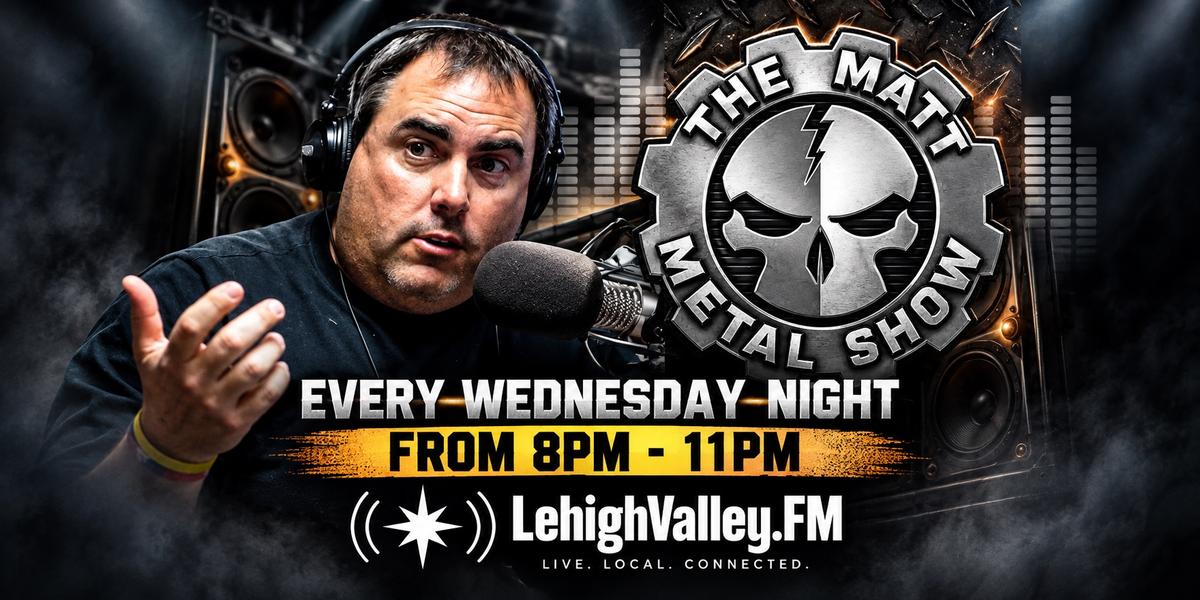
LehighValley.FM adds a fourth show on Wednesday night. Matt Metal, who has been putting Lehigh Valley metal on the radio on and off since Halloween of 1984, brings The Matt Metal Show to the station every Wednesday from 8 to 11 p.m.: three hours of national hard rock and metal from the 80s and 90s, the Valley bands who came up alongside it, and the new ones picking it back up. The first show aired Wednesday, Sept. 23. Listen free at LehighValley.com/radio.
There is a stretch of Lehigh Valley history that exists almost entirely in the memories of the people who lived it. From the early 1980s to the late 1990s, a region of a few hundred thousand people had a metal scene deep enough to fill a 1,500 capacity hall on a weeknight, put original bands on club stages six nights a week, and send a college radio chart to the trade magazines in New York. Almost none of it was written down. The clubs are a carpet store, a machine shop and a banquet hall now.
Matt Metal was the voice of it. Not the only one, but the one who was out in it every night, on the stage between the bands, on the phone with the record companies, and on the air Friday nights on WXLV, the Lehigh Carbon Community College station, for most of that time at 90.3 on the dial. He did it for about 30 years, across three separate runs at the station. He won three consecutive Lehigh Valley Music Awards for noncommercial radio personality and a Morning Call award for his blog. And he did all of it without once using his real name.
“I had no shyness at all,” he said. “I was Matt Metal, had an ego the size of a bus or bigger, mentally thought I was larger than life, so when I would take the mic off the stand and walk around it was easy to do.”
A Room He Thought Was a Closet
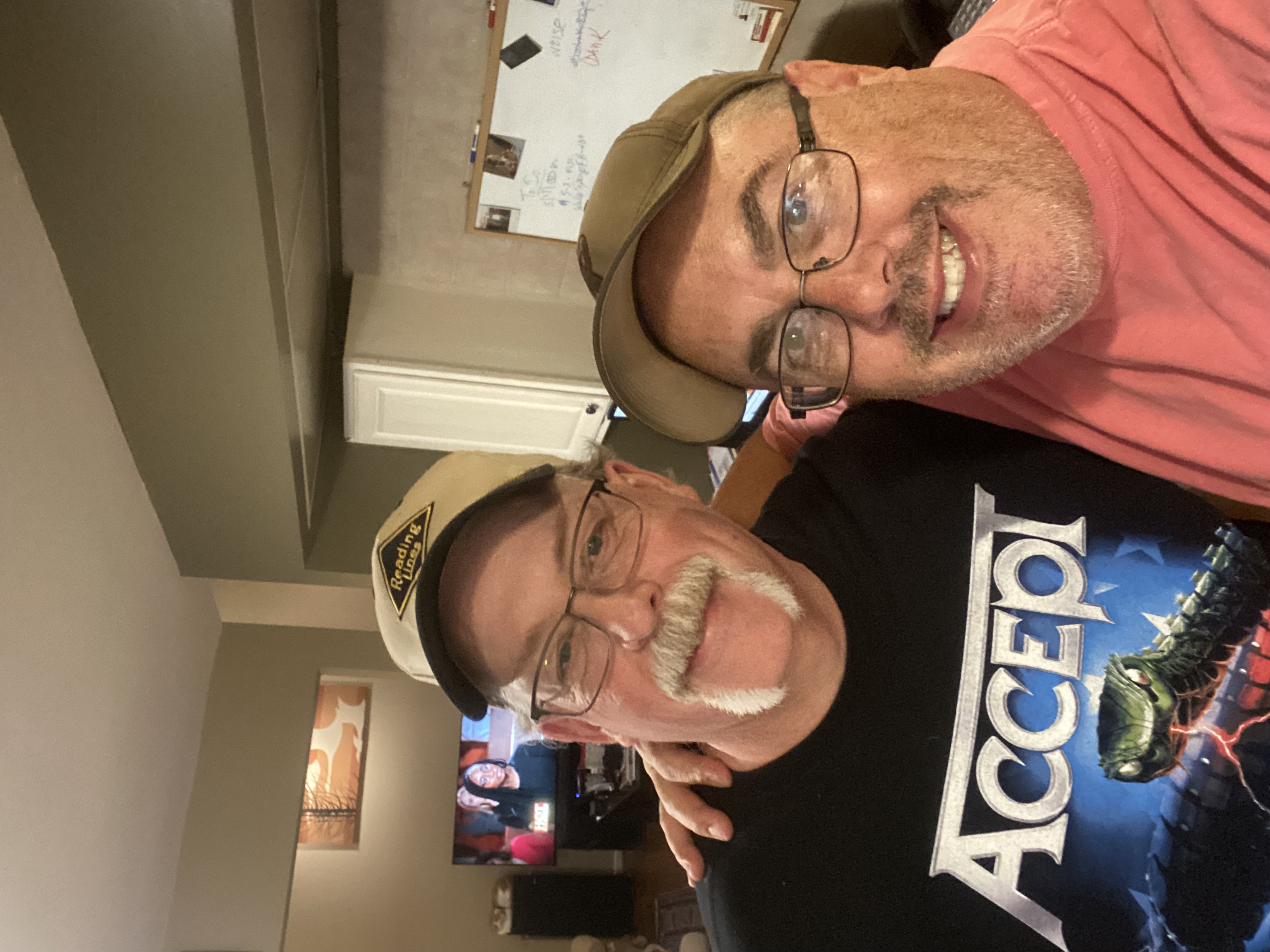
He was 19 and a student at Lehigh Carbon Community College, walking into the school with his girlfriend Karen, when he heard Motley Crue coming through a door he had always taken for a closet.
He asked her what was going on in there. She told him the school had a radio station, and that her friend Craig was the one on the air. She walked him in and introduced them.
They hit it off on the spot. Craig talked him into applying for his FM license, and they have been friends ever since. He started on Halloween of 1984.
The first air shift he ever had was not metal. It was adult contemporary, Monday and Wednesday mornings from 8 to 10. Building a playlist was easy enough, because he just thought about what his grandfather played: Frank Sinatra, Sammy Davis Jr., Tony Bennett. Then what his mother played: Rod Stewart, Neil Diamond.
He thinks he dedicated the first song to his grandfather, who used to tape the shows off the radio and play them for his friends at what the family called the club. “Just a garage made into a man cave where no wives allowed,” he said.
Number of the Beast, Junior Year
He came to metal sideways. He was a punk rock kid first: the Sex Pistols, the Ramones, the Dickies, 999.
He went to Moravian Academy, and in his junior year he spent a week staying in the dorm, hanging out with a kid named Rick Speedie. Speedie listened to the same punk records, and one night he put something else on. It was Iron Maiden, The Number of the Beast.
“When Dickinson hit that long note toward the beginning and then the driving music,” he said, “I was hooked.”
You Need a Metal Name
Craig Weaver was Kamikaze Craig, and nobody has called him anything but Kami in 40 years. His show, the Foundry, ran Friday nights on WXLV and was known across the metal scene. Matt had the slot before him, and Kami started keeping him around to help out and join in. They became close fast.
The name came out of one of those on-air conversations. Nobody at the station used a last name, so Kami told him he needed a metal name and supplied one on the spot.
“Matt Metal,” he said. “I said cool and we just kept going with it.”
Not long after, Kami had to give up the show. He was driving truck, the route got longer, and he could not get back in time to go on the air. He handed the Foundry to Matt and left.
What Matt inherited was a core audience and a book of contacts. Kami already knew most of the local bands and had the listeners. The format was a legal pad and a phone: write down every request, play them all, add something new when there was room.
“You request it, we will play it, within reason,” he said. He kept the local band interviews on Friday nights and started going out to the clubs himself, seven nights a week if he could. “I don’t really think I changed anything. I just added to the story, and did the story ever grow.”
The name grew with it. Friends started calling his mother Mom Metal, and his kids Savannah and Lucas Metal. Plenty of people who have known him for decades have no idea what is on his driver’s license, and that is how he wants it. “Like separation of church and state,” he said.
He and Kami still talk. They were supposed to meet up at a W.A.S.P. show recently before family plans got in the way. People still ask about him.
DJ Bananas, the Zodiac, and Turntables Hanging From Chains
Going out was the job. Club owners learned his name, made introductions, and worked out trades: free air spots on a college station in exchange for a door he never had to pay to walk through again. Then the smaller shows started asking him to emcee, and the clubs started putting his name on the bill with the band.
Four rooms carried most of it.
DJ Bananas was in Whitehall on Fullerton Avenue just past the light at Grape Street, and he believes it is a carpet store now. It was small and not dressed up much, about what you would expect from a Valley rock club, and every band of the era played it. “Place would be packed night in and night out,” he said.
The Zodiac Club, later Starz, is a machine shop today, out by where the IronPigs stadium now sits. Owner Barry Hanna booked real names into it: the Ramones, Winger, the Smithereens, Motorhead, alongside the local bands. There was a big main stage and a second room upstairs for smaller local acts, with windows you could look down through into the main room.
Cafe Le Rock, at Airport Road, is a banquet hall now. Same owner as DJ Bananas, Joe Clark. It was the room for local original artists, and it was nicer inside than most, with a separate lounge where you could sit and talk while the bands played.
The Green Pine Inn was in south Allentown near the cemetery by the Fearless Fire Company. It was a bar with a stage. Local bands played it, and so did Heaven’s Edge, EZO and Skid Row, along with two of his favorite local bands who were not metal at all, Big Fish Little Pond and the Daddy Licks Band. He used to DJ there on WXLV nights, and the Green Pine had one quirk he has never forgotten: the turntables hung from the ceiling on chains so the records would not skip when the room got moving. Which solved one problem and created another. When the platform was swinging, cueing up the next song was a guess.
Sam, Tom and Pat
The first person he started running with was Sam Younes, a local promoter who also managed a band called Washed. Matt befriended the band, then Sam, and the two of them started making the rounds of the clubs together, metal and otherwise.
“He saw the big picture of where I could go before I did I think,” Matt said. When Sam put a show together he would hand Matt the microphone, partly to build the station and partly because it was obvious he could work a crowd. It spread. Bands at places like the Acorn Hotel in Allentown would ask him to introduce them if he happened to be in the building.
“Everybody back then wanted an introduction,” he said. “Now I think this is a lost art, sadly.”
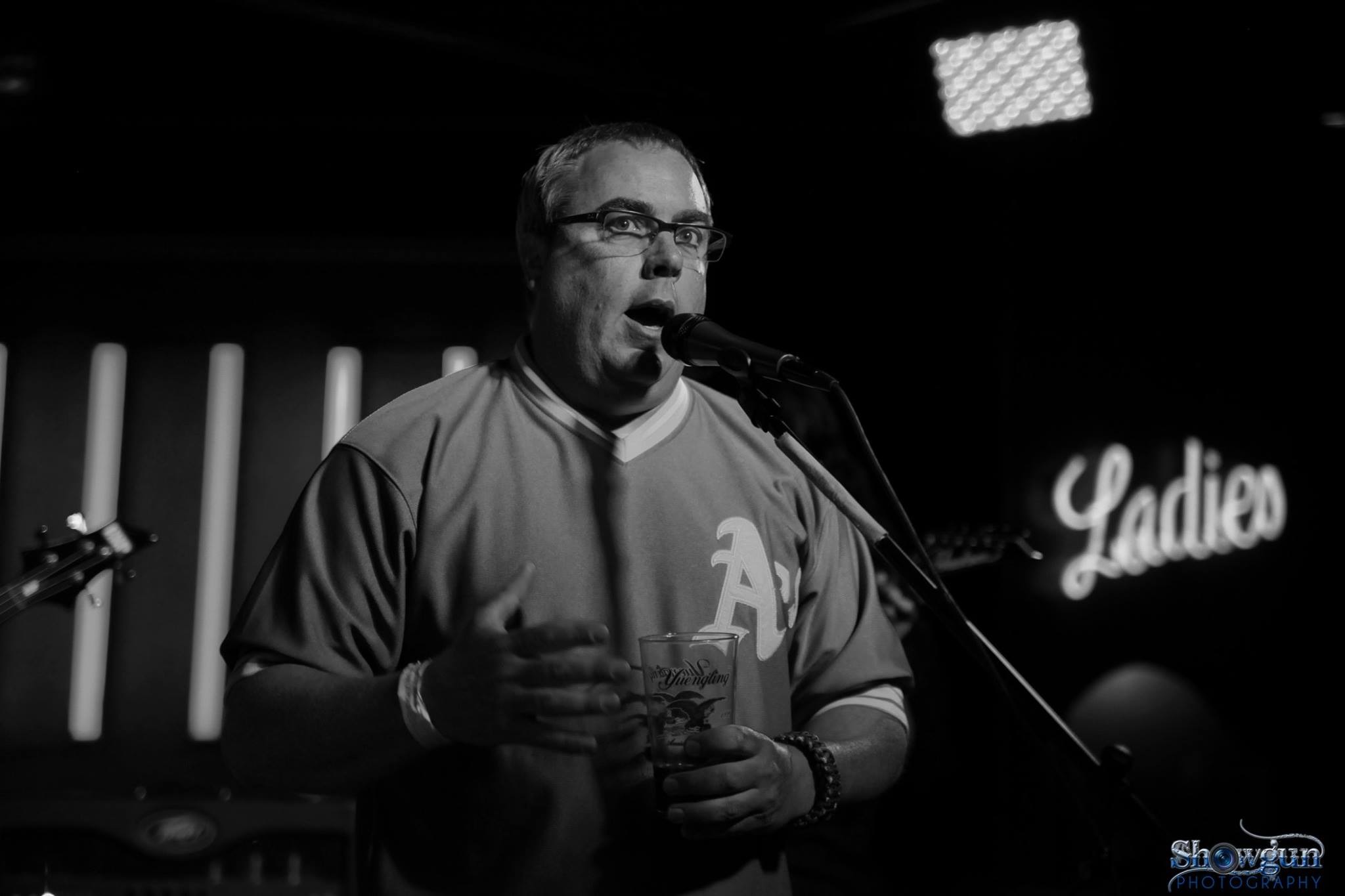
Sam and Matt spent their time at the Airport Music Hall, and that is where he met Pat Lenover and Tom Makoul. Makoul was the promoter in this region for more than 30 years, the man who decided what came through the Lehigh Valley and what did not.
“Just imagine Live Nation back in the day,” Matt said, “but it was him for the Lehigh Valley.”
They put him on the microphone at the Music Hall, capacity around 1,500, and the list of what he introduced there reads like a decade of metal: Pantera, Overkill, Kix, White Lion, Suicidal Tendencies, Flotsam and Jetsam, the Ramones, Faith No More, Heaven’s Edge, TT Quick, Savatage, Exodus, Washed, and a long run of local bands underneath them.
Matt and Makoul built a working relationship that held. Makoul gave him an all access pass plus one for everything, and tickets to give away on the air, because he understood exactly who was listening to the metal show. “Funny how many musicians didn’t like him, but I enjoyed his company,” Matt said, “along with Pat’s and Sam’s. We were all characters in our music scene.”
Once he had cut his teeth at the Music Hall, Makoul walked him up to the bigger rooms: Stabler Arena, the Allentown Fairgrounds, Ag Hall. Cinderella. Tesla. Loudness. The Cult. Dokken. Megadeth. Metallica. Ozzy. Testament. Slayer. Nuclear Assault.
“There will never be another time around here like the early 80’s to the mid to late 90’s,” he said. “There was something to do every night of the week, and if not that, you would hop in your car and go hang down at the circuit on Hamilton Street cruising around.”
Tom Makoul died in February 2009. Pat Lenover went on to Live Nation, where Matt reports he is a big wig now. Sam Younes is still at it, still supporting local music the way he has since the day they met, and Matt runs into him at the Shanty for the Sunday open jam.
The Night Bobby Blitz Fixed His Tie
The biggest crowds were Metallica and Ozzy, upwards of 10,000 people. He cannot really explain what the walk to the microphone feels like, in front of 50 or 500 or ten thousand, except that the job was never about him. It was to plug the next Makoul Productions show, thank the crew working the building, and thank the people who paid to get in, “for without them, none of us would be doing what we all did.”
His favorite night was Overkill at the Airport Music Hall, and it nearly did not happen.
He and his girlfriend at the time, Joyce, were at a wedding that day. He knew he had to work the Hall that night. They got hammered at the wedding and missed part of the show. He turned up in a suit, top button undone and tie pulled halfway down, Joyce in all black with the heels and the big hair.
The band was glad they made it. He collected his show paper from Tom Makoul, and then Overkill’s singer Bobby Blitz walked over, buttoned Matt’s top button, straightened his tie for him, turned him around by the shoulders and told him to go introduce the band.
So he did, in the suit, and the room loved it. “Such a fun night,” he said.
The Wrong Microphone
The one that went sideways was Pantera.
Erv’s, a strip club, sat directly behind the Airport Music Hall. Matt had a wireless microphone that night. So, it turned out, did the emcee running the male revue next door, on the same frequency. He clicked his mic on to introduce Pantera and the Music Hall heard a stranger introducing one of the dancers at Erv’s instead.
Out at the board, the sound man, Schmitty, put both hands on his head. They killed the intro music and Pantera simply walked on.
Matt, mortified and now with nothing to do, went out through the green room and into Erv’s to see what he had been sharing a frequency with. The place was mobbed, and the crowd in there was considerably louder than the one he had just handed the stage to. He stood at the back and laughed.
A Top Ten in CMJ and a Bus to New York
Reporting to the record companies was one thing. Getting his weekly top ten printed in CMJ and Concrete was another. Once the chart ran, the phone did not stop: Megaforce, Metal Blade, Atlantic, Columbia, Elektra, Geffen, plus band managers like Munzy at Skateboard Marketing, every one of them trying to get a record onto the show and into the ten.
“I needed a top 40,” he said.
It opened doors. Promos to give away on the air. Records early, sometimes weeks early. He had Appetite for Destruction three weeks before it came out, with a letter from the label saying he could not play it. Then Guns N’ Roses turned up at the Music Hall, opening act EZO, and Matt walked over to the house DJs, took the microphone and played “Welcome to the Jungle” for a room that had never heard it.
“People loved it,” he said. EZO killed it as the opener, he says, and then Guns wasted no time showing the Valley what they were: “raw, bad ass, and loud.”
Eventually he decided the phone was not enough and got on a bus to New York to meet the people on the other end of it. He thinks it made all the difference. He stopped being a voice and a chart number and became somebody they knew.
“If I asked for something, I cannot remember anyone saying no,” he said. Interviews with every band coming to town, station drops, promotional material, CDs by the box, tickets to shows outside his market, New York to Baltimore to Cleveland, where his father lived.
He never went empty handed. Every trip, he carried tapes of his friends’ bands and handed them across desks.
Nobody bit. The closest he got was one label, whose name he can no longer remember, on a band called Endzone. They liked it. They told him it was ahead of its time. Matt’s read is that grunge was arriving and Endzone was not grunge, which was that simple. He describes them as a harder Chili Peppers welded to Exodus, and says they were killer.
The other thing he learned in those offices is the line that explains the whole era better than anything else in his story. The advice he was given, and passed along to his friends, was to rent a PO Box in Philadelphia or New York and not tell anybody they were from Allentown.
“Kind of stupid I thought,” he said, “but it was what it was.”
The Ones Who Got Out
He is careful about claiming he broke anybody. What he will say is that a lot of people who later turned up on very large records came through his show first, and through these clubs.
He played Howe II, built around brothers Al and Greg Howe. He interviewed Greg at his apartment back then and remembers him as simply cool, a guy with the vibe. Greg Howe went on to play with Michael Jackson and Justin Timberlake.
Kevin Miller, later the drummer in Fuel, played in Shotgun Wedding. Jimmy DeGrasso went on to play drums for Megadeth, Alice Cooper and Ozzy Osbourne. Richie Kotzen was in Anderson’s Museum before the Winery Dogs. Roy Mayorga went to Whitehall High School, Matt’s own hometown, and started a punk band called Youthquake in Allentown in 1985 before going on to Soulfly, Stone Sour, Ministry and Jerry Cantrell’s band.
He watched Live play here before anyone outside York knew the name, and he counts the neighbors too: Poison from an hour and a half west, Breaking Benjamin from up north, and Brian Quinn, formerly of Octane down toward Philadelphia, who ended up with a ten year run in Candlebox.
“Again,” he said, “cool being me with all of this going on.”
The Ones Who Should Have
This is the part he wanted to talk about most.
“Man, did we have some talent here,” he said. “Most of the musicians you see in the older cover bands out there had their own original bands. Mostly all of the music was original back then. Club owners didn’t mind it.”
The one that came closest was Washed. JJ on guitar and lead vocals, with the voice and the look. Danny Brown on guitar beside him, who Matt calls phenomenal and who works at Martin Guitar to this day. John Roebuck on bass. Phil Mahr on drums. They sold out clubs here and well beyond here.
Leviathan was the other one, Joe Stumer’s hard driving thrash band, which Matt thought could have gone up against anybody in the country.
And before his time there were the Dead End Kids, whose shows he used to figure out how to sneak into as a kid. His line on them is the best compliment he has: “Without them, who would have Motley Crue stole their look from.”
Three Runs at WXLV
The first run went from that fall of 1984 until 1998. Then he stepped away.
He went back around 2004 for about two years, and that one did not take. The crew at the station then was not his crew, and it was not fun. He left again.
The third time was different, and it started with a divorce. He needed some stability in his life, and the timing lined up with a call asking him to come up and meet Harry Snodgrass.
They hit it off. Snodgrass laid out his vision for WXLV and the piece that sold it: a real recording studio, and a metal show that could use it. Snodgrass did sound for major motion pictures and needed somewhere to work out of, Los Angeles not being next door, so he built a production studio with a vocal booth at the station. He would come up on Friday nights and work while Matt was on the air. Matt found the work fascinating, down to the night Snodgrass was getting a train to whistle at exactly the right moment as the steam came out of the engine.
For the show, it changed the proposition entirely. It was no longer a band getting a song played. It was a band playing live on The Matt Metal Show. The Damn Dirty Apes came up. So did Sinister Realm and Atomic Age, and he believes Slik Helvetika did too.
“I used the bands to promote me,” he said, “just like I would promote them.”
The signal did not survive the run. Word that Lehigh Carbon Community College might sell 90.3 got out in May 2011, around the time he came back, and the Valley fought it: a Facebook group, rallies, and an online petition that reached 1,261 signatures by that September. The college filed with the FCC anyway, on Dec. 3, 2012, and sold the license to Four Rivers Community Broadcasting of Sellersville for $705,000. By the spring of 2013 the frequency was gone. It carries Word FM today, a Christian format programmed from a studio 32 miles away. Still a nonprofit, still licensed to Schnecksville, and nothing to do with the college.
WXLV kept its call letters, its students and its shows, and moved online. So part of his third run went out over a transmitter, and the rest of it went out over the internet. It is worth noting what that means about the audience he is describing. They followed him anyway.
Kick Ass Friday, and the Station That Said No
By the third run he was not a student anymore, just a man who turned up every Friday to do his show. He reckons that behind the polka show on Tuesday and Thursday afternoons, he was second in audience response at the entire station.
Some of the students came to him with an idea: hard rock and metal all day Friday, 8 a.m. to midnight, with his show as the marquee at the end of it. He took a week to think about it, came back with one guideline, that they were not to play what he would be playing Friday night, and they agreed.
Kick Ass Friday blew up. People still bring it up to him, still tell him where they were working when they listened. If he got out of work early he would listen to the callers himself, and if the business was close enough he would drive over and thank them in person. Plenty of them had no idea what he looked like. All of them knew the name.
The programming had a rule, and the rule was the whole point. If the commercial stations were playing it, Kick Ass Friday did not. No “Enter Sandman.” No “Home Sweet Home.” “If that’s as metal as Z95 could get,” he said, “screw them. We had a plan, and we stuck to it, and it worked.”
There is a piece of that story he has not told often. Before it all, he went to Z95, the Valley’s commercial rock station, and offered to bring his show over. For free. He was not asking them to build anything. He already had the audience, and with his relationship with Makoul the advertising would have taken care of itself.
They said no.
“I got pissed so dug in deeper,” he said, “and beat them at their ratings for my time slot and day.”
By his account a college station in Schnecksville, running a metal show out of a building that also carried a polka program, out-rated the commercial rock station in its own time slot. Thirty years later he is philosophical about it.
“Maybe it was best staying the local guy after all.”
The original Kick Ass Friday lineup, as best he remembers it, was Tom, then someone he cannot place, then Chris Andrew, then Jeff, then Ken, then Kevin, then him to close it out. He is still friends with all of them. Tom has since died, and is not forgotten.
He ran into Kevin at an Iron Maiden show recently, and Kevin introduced his son to him. People standing nearby heard the son say Mr. Metal, and two strangers turned around and asked if he was Matt Metal. He told them of course he was. His friend Bill, who had come with him, asked who he does not know. “I said plenty,” Matt said, “but being at that show I saw lots of people I knew from back in the day.”
Matt Metal, From WLEV
The Lehigh Valley Music Awards came during the third run, and the first nomination arrived with a clerical error attached. Somebody had listed him under WLEV, the adult contemporary station, instead of WXLV.
He was driving home from Florida when the voting opened. His boss at WXLV called him at eight in the morning to ask whether he had left the station. He called the music awards. They told him the ballots were already coming in and they could not change it.
So he ran with it. Every WLEV sign he could find, he had his picture taken in front of. Somebody from WLEV eventually called to ask what exactly he was doing. He told them, they laughed, and they decided it was free press.
He won. He went up to the podium and introduced himself as Matt Metal from WLEV. Everybody got the joke.
Then he won it the next year, and the year after that, three in a row. The award was Outstanding College/Community Radio Station Personality, the Lehigh Valley Music Awards’ prize for noncommercial radio, and what got to him was not the winning. It was who else was on those ballots. AJ Fritz, the Lehigh University radio institution who hosted FritzRocks on WLVR 91.3, owned that category for the better part of a decade. The surviving ballot from 2014 has them on it together, Fritz for WLVR against Matt Metal and Phil Stahl for WXLV, and that year Fritz took it.
“I wasn’t on a commercial station and still out voted him,” Matt said, which is the whole point: two noncommercial guys, a community college and a university, trading an award back and forth while the commercial stations watched.
By year four he decided other people deserved the limelight and pulled his own name off the ballot. The fan nominations carried it anyway. He still turned up to present the award, Fritz won it, and Matt handed it over with a grin and told him he was welcome. Fritz did not find that as funny as Matt did.
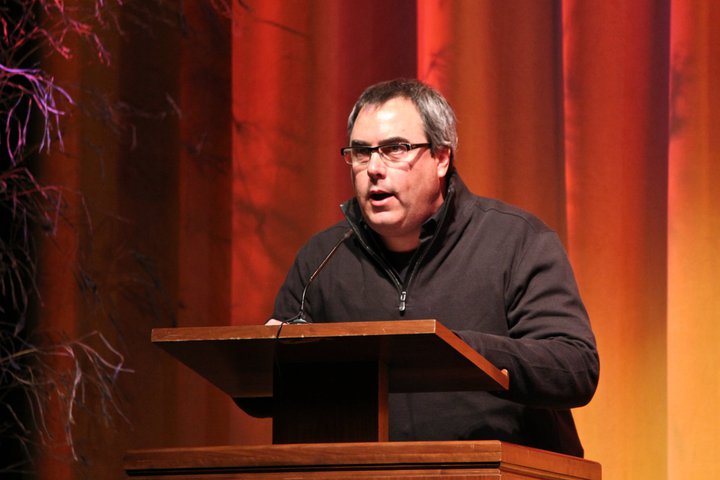
Fritz died on the last day of 2024, at 67, and the Valley radio community has not stopped talking about him since.
Somewhere in the same stretch Matt started writing a blog and won an award for it from the Morning Call, in 2011 and again in 2012. The blog is technically still on the internet, on WordPress, missing a lot of its articles. He has no idea how to log into it anymore.
“Pretty cool for people to think of me that much,” he said, “for all of the work I did along the way.”
The Matt Metal Show
The show runs Wednesday evenings, 8 to 11, and he is building it the way he built the first one.
The spine is the national material from the 80s through the 90s plus the Lehigh Valley bands from those same years, the ones that never left the clubs. Onto that he is layering new music from the bands who are somehow still out there touring after all this time, and new music from local bands who were not born when he started.
He has been paying attention to that last group. Lady White Rat. Project 9. Catatonic Sons.
“Good to see that there is a younger generation picking up the ball so to say,” he said, “for it seemed as if there was a period of nothing or no one wanting to play original music.”
Where he wants to take it is back to the legal pad. The goal is all request radio, the way the Foundry worked in 1986, and then out of the studio entirely: live interviews from events, the show on the road, the thing he spent the 1980s doing with a station van and a stack of promos, rebuilt for a station that streams.
“With the internet the sky is the limit,” he said. “I am super happy to be on the ground floor of this to help this baby grow. I did it once, and I can do it again. It does take a cast of all characters, but I know my part of the puzzle.”
Bands who want airplay can send their music straight to him at Mattmetal28@hotmail.com or to the station. He is not precious about it. That is more or less how the last 30 years started.
“The real prize was this,” he said. “We here in the LV had so much talent here that was missed out on. I was honored to be the vehicle to help push our groups in the forefront.”
The Fourth Show on This Station
When we launched LehighValley.FM in August, the argument was that this region deserves a station programmed by people who actually live here. Al Gilotti brought 50 Odd Years to Monday nights, Tim Neiman brought Straight Lines in September, and Ron the Paisan brought Radio Daze to Tuesday nights.
The Matt Metal Show is the fourth, and it comes with 30 years of institutional memory attached. There is nobody else who can put a Lehigh Valley band from 1989 on the air and tell you which club they sold out, who managed them, and what the record company in New York said about them.
The stream is free, with no app and no account. Open LehighValley.com/radio in any browser, or go to LehighValley.FM, and press play. The player keeps running as you move around the rest of the site, and there is a request form on the radio page if you want to hear something specific while he is on the air. He would prefer that you use it.
At a Glance
The show: The Matt Metal Show
When: Wednesdays, 8 to 11 p.m., live
On the air since: Wednesday, Sept. 23, 2026
The host: Matt Metal, on Lehigh Valley radio on and off since Halloween 1984
Sounds like: hard rock and metal from the 80s and 90s, Lehigh Valley bands past and present, new music from the bands still touring, new local originals
Radio history: WXLV at Lehigh Carbon Community College, three runs, roughly 30 years, beginning with the Foundry on Friday nights. The station was at 90.3 FM until the college sold the license in 2013, and has been online since
Where the name came from: Kamikaze Craig, on the air, sometime around 1986
Awards: three consecutive Lehigh Valley Music Awards for noncommercial radio personality, and a Morning Call award for his blog in 2011 and 2012
Rooms he emceed: the Airport Music Hall, Stabler Arena, the Allentown Fairgrounds, Ag Hall, and most of the clubs in between
Clubs that are gone: DJ Bananas in Whitehall, the Zodiac Club and Starz, Cafe Le Rock on Airport Road, the Green Pine Inn in south Allentown
Valley bands he is still evangelizing: Washed, Leviathan, the Dead End Kids, Howe II, Shotgun Wedding, Youthquake, Endzone
New bands on his radar: Lady White Rat, Project 9, Catatonic Sons
Bands, send music to: Mattmetal28@hotmail.com or the station
Where: LehighValley.FM, streaming free at LehighValley.com/radio
Read next: 1,800 Albums and 1,000 78s: Ron the Paisan Brings Radio Daze to LehighValley.FM