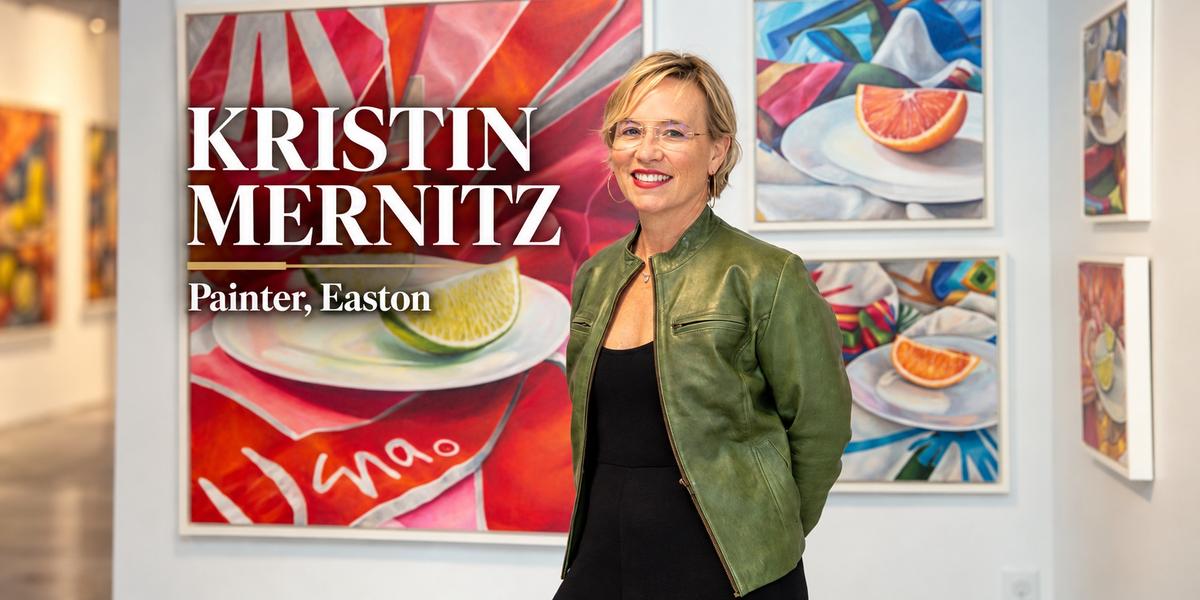
Kristin Mernitz has been making things her whole adult life. Textile prints for children’s wear. Hats, jewelry, handmade books, furniture. Murals, gold leaf and faux finishes on the ceilings of houses belonging to the rich and famous. What she had never done, until she was deep into her fifties, was paint a picture for herself.
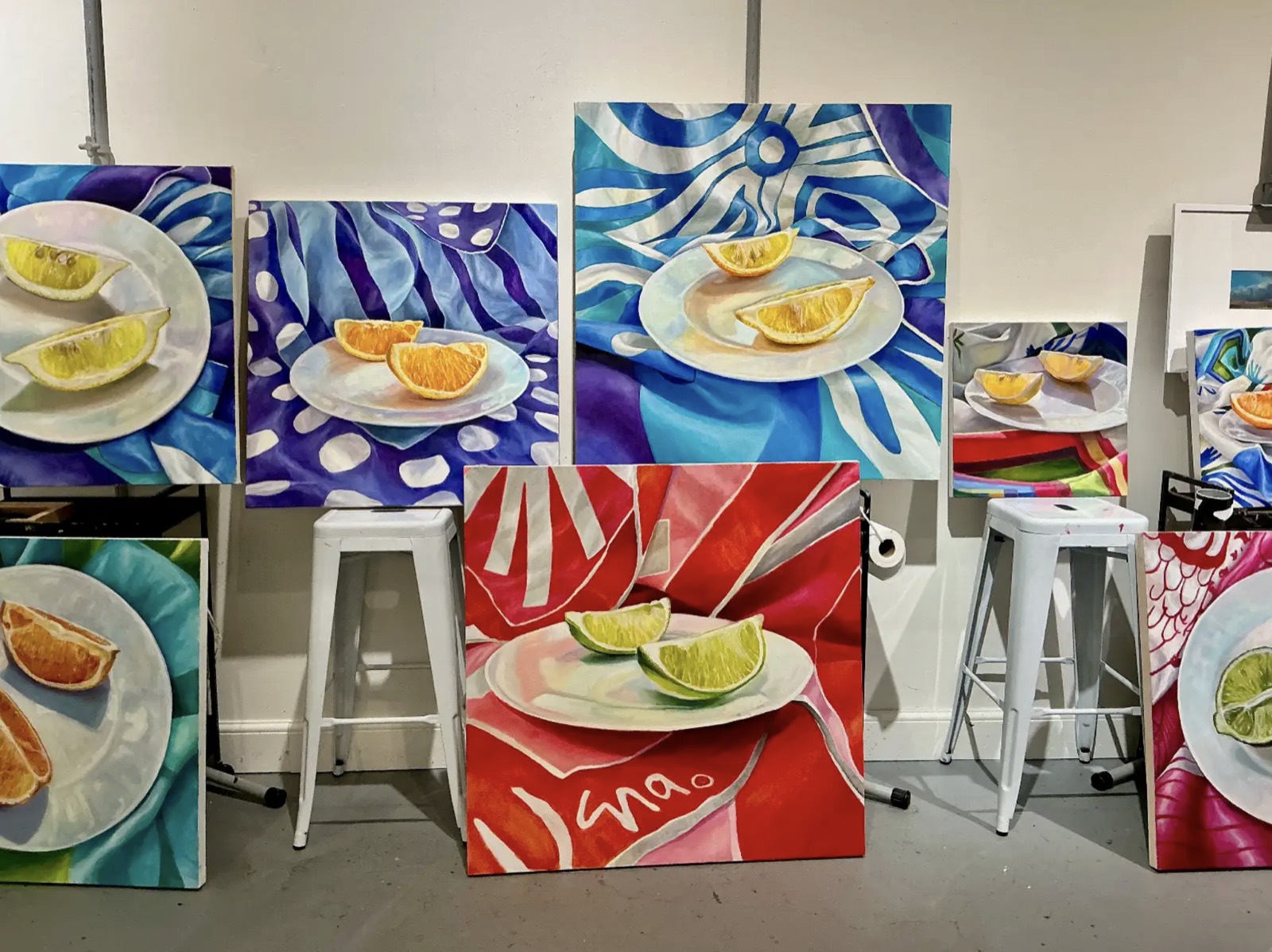
She started in 2015. Her paintings are hanging in the Alpha Building in downtown Easton right now, and almost every one of them has a Vera Neumann scarf in it.
The Basement Silk Screen
Mernitz grew up in Indianapolis, the third of four girls, in a house where somebody was always making something.
“We learned how to be makers by watching our parents create, whether it was food, furniture, or art,” she said.
Her father worked in stained glass and wood. Both parents gardened seriously. Her mother took an art class every week while the girls were at school, silk screened the family Christmas cards in the basement every year, and later built furniture and hand-formed ceramics.
“My mother is a great lover of good design, a passion she passed down to all of us,” Mernitz said. Her three sisters went into careers outside the arts and stayed makers anyway. They paint. They sew elaborate clothing. They build things and they cook like restaurant chefs.
What nobody suggested was art school.
“Coming from Indianapolis, traditional art school just wasn’t on the radar,” she said. “If I had grown up in a different city, or closer to New York or LA, it might have been more of a conversation.”
A Guidance Counselor Who Knew
She went to Colorado College because her high school guidance counselor pushed her there, “who I think knew innately that I needed to leave Indianapolis.” The family had spent childhood summers in Colorado, so the place already felt like hers.
She chose studio art for a reason she states without apology.
“I knew I was never going to have a traditional profession. My brain is not wired that way.”
The women’s studies minor came out of her art history classes, which had put her in front of a great many female artists and a great deal of female imagery.
After graduation came Washington, D.C., and then Chicago, where she took a job as an administrative assistant at an insurance company and ran a second life around it. She did art fairs on the weekends. She dyed textiles in her bathtub. She sewed hats and bags.
“Matching Color Is the Job”
She wanted design work, and she wanted out of the cold, which is how she ended up at Otis Parsons in Los Angeles. She made prints for a women’s wear company by day and went to textile design school at night.
This was before computers touched the trade. Students painted on paper in gouache and learned to build repeats by hand for the printing process. Textile companies either hired freelancers or kept in-house design staffs, and those staffs, Mernitz notes, were almost entirely women.
The children’s wear work came with an unusual assignment. She would be handed a swatch of fabric and an actual garment, usually a shirt.
“I would match the colors and create a pattern or motif from the fabric, painting in gouache directly on the garment,” she said. “The company would then make screens and prints from my design. Matching color is the job, and I became a master at it.”
That sentence turns out to be the hinge of the whole story. Thirty years later, the thing she is doing on a canvas is still matching color.
Ladders, Ceilings and a Dollar Sign
Los Angeles in the 1990s, in her twenties, in a circle of friends who all had unconventional jobs. Mernitz made furniture, hats, jewelry and books, for no better reason than that she liked making things. She was self-employed and had nowhere to report in the morning.
“To me, making things is really just problem solving,” she said. “Sometimes I was very successful at it, and other times not so much.”
She began picking up work from people running large faux finishing, mural and hand-stenciling jobs in the big houses of the rich and famous. Eventually she had enough connections to go out on her own, first with a friend and then alone. In 1994 she launched her own business painting furniture and interiors for high-end restaurants, hotels and private homes.
It was an education, and not mostly an artistic one.
“Running my own business taught me how to put a dollar sign on my work,” she said. “As a result, I learned how to value myself, deal with difficult clients, be honest about my mistakes, and work very hard.”
It was also hard labor. Climbing up and down ladders all day. Straining her neck to paint ceilings. Hauling supplies.
She does not file any of it under lost time.
“Every creative thing I have done, from textile design and furniture making to standing on a ladder faux finishing and painting murals, has brought me to this point,” she said. “All of that experience has given me a perspective I don’t think I would have had otherwise.”
One Scarf at a Santa Monica Flea Market
Mernitz cannot say exactly what set off the collection. She bought her first Vera Neumann scarf at a flea market in Santa Monica, “and it just took off from there.”
Soon she was bidding on whole boxes of them on eBay. They were cheap, and Neumann had produced more than 10,000 designs over her career, which made the hunt close to bottomless. Mernitz has now gathered more than 800 of them, including some of Neumann’s most iconic patterns.
Neumann’s own story is part of the pull. She and her husband started their business in the 1940s printing on surplus parachute silk, and built it out into tableware, clothing and textiles of every kind.
“She was a tremendous creative force and a marketing genius,” Mernitz said. There are two books about her, and a 2019 New York exhibit hung her scarves and her paintings together.
While Mernitz was still in California she began sewing the scarves into pillows and selling them to a furniture store. Some of the collection was never for sale.
“I have many beautiful scarves that I will never part with,” she said. Those are the ones that turn up in the paintings.
Venice to Easton
In the summer of 2002, Mernitz and her husband moved from Venice, California, to Easton. She was pregnant with their first daughter. He had been practicing law in Los Angeles and joined his father’s firm here, in the town where he grew up. Family was close, and life in the Lehigh Valley would be calmer and cheaper than Los Angeles.
She was not part of the art scene for years, because she was raising two girls. Her first art friends in Easton were other mothers with children her daughters’ age. She had arrived expecting very little.
“Coming from LA, I admittedly had very low expectations and no idea what the local art scene was like,” she said. “But the art community here is vibrant and supportive. There are so many creative people in the Lehigh Valley, and I am privileged to be friends with many artists working in all kinds of media.”
Once both daughters were in school full time she opened an Etsy store and went back to the pillows, this time out of the hundreds of Vera napkins she had accumulated. The work was flexible, it kept her hands busy, and it put her own money back in her pocket.
The Decision She Made in 2015
Then she stopped and chose something.
“In 2015, I made a conscious decision to devote my time to painting, something I had always wanted to do.”
She thinks she started taking classes at the Baum School around 2017. She walked into Adriano Farinella’s painting class and has been his student ever since. She also studied with Ken Kewley. Both men live in Easton, and Farinella now runs his own studio and gallery, Studio Work, around the corner from her house. She paints there every Tuesday with a group that has turned into friends.
“Painting is an isolating pursuit, so it’s nice to be part of a group of like-minded, supportive people,” she said. “I encourage anyone who wants to paint to look up these two fine artists.”
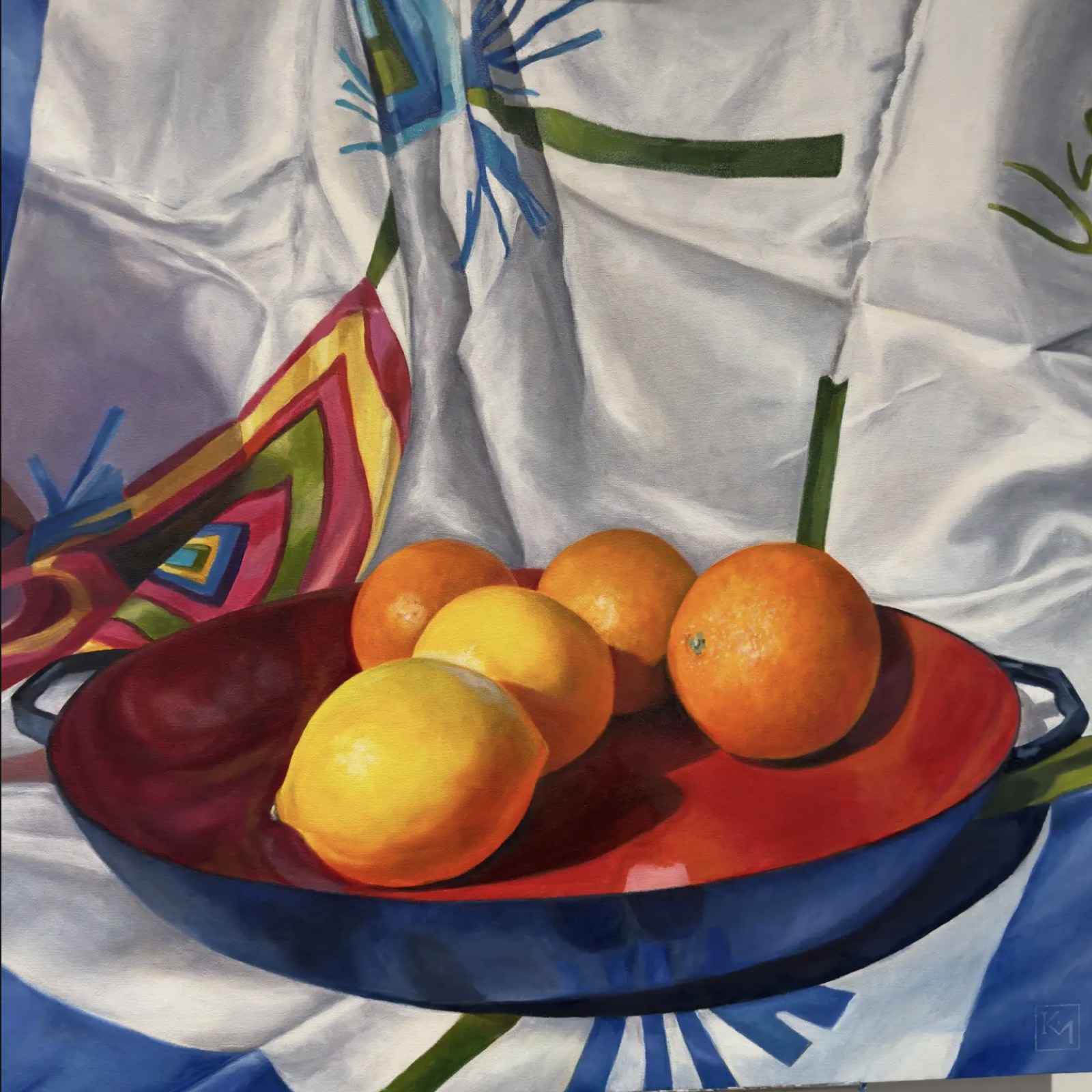
The subject matter was already in the house. Painting the scarves “seemed like a natural fit,” she said. Setting them against citrus fruit and white plates was a design decision, made the way a textile designer makes decisions, and she spent days building the arrangements and shooting hundreds of photographs of them.
“You have to like the subject matter you’re painting, and this made sense to me,” she said. “I love color, light, and vibrancy.”
The Ugly Middle
Mernitz works in oil, on canvas or board, and she begins every piece the same way, by killing the white.
She tones the surface with a wash of yellow ochre or burnt sienna. “It’s difficult for me to paint on a white canvas, and the warm ground suits the colors I use and the light I am trying to catch.” Then she projects one of her photographs onto the canvas and outlines the large shapes with an acrylic paint marker. The block-in follows, setting the general shapes in the mid-tone of each color. After that it is pass after pass until the thing resolves.
The worst of it comes in the middle.
“For me, the hardest part of a painting is the middle, when it’s in an ugly stage, neither fresh nor finished,” she said. The final refinements can be tedious and frustrating too. “But then you get there and the feeling is like a big sigh of happiness.”
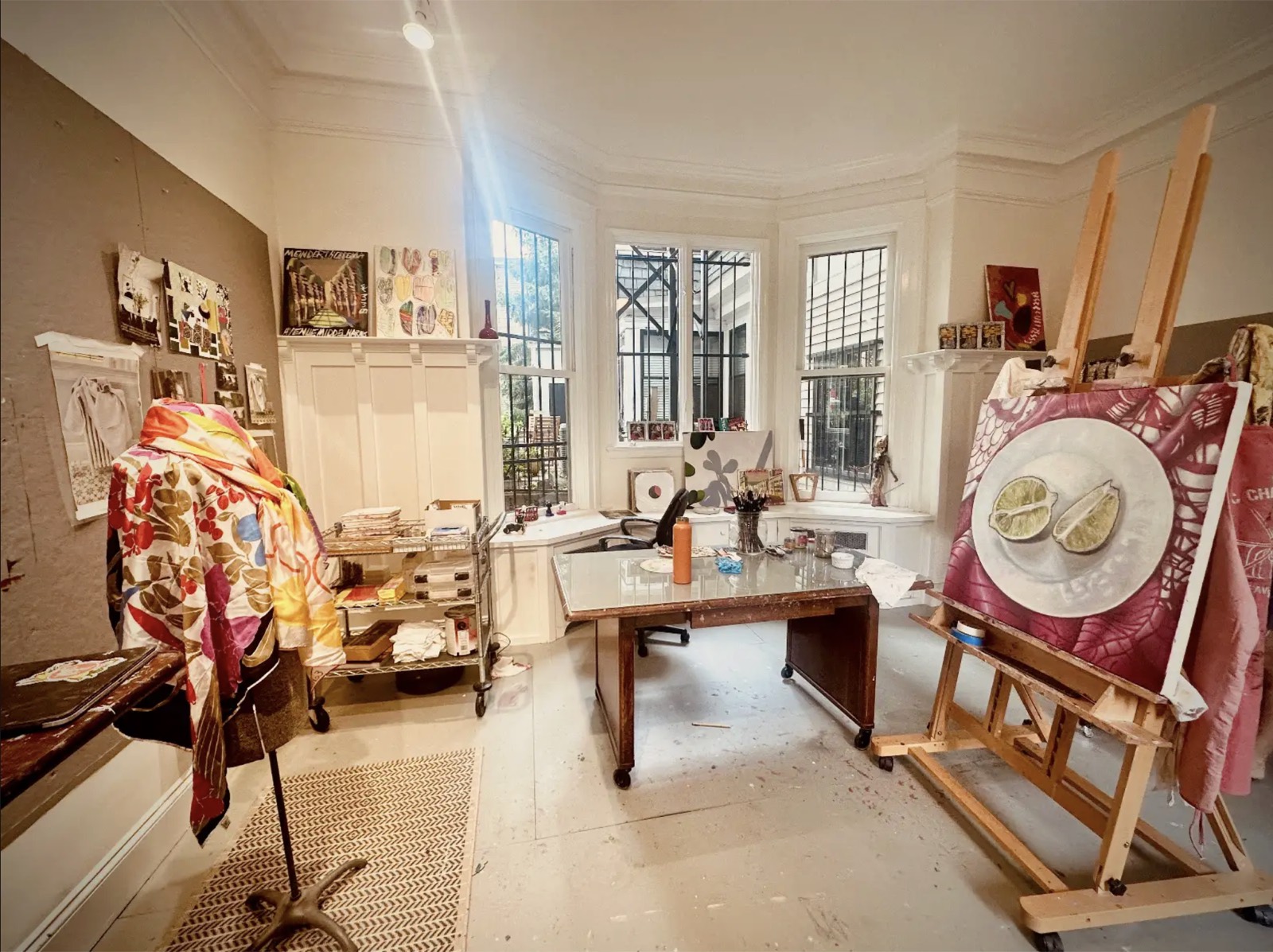
Her sessions run about three hours. “I hit a wall after that time.” At home she might split the day into two shorter sittings on two different paintings. And she pushes back on the idea that painting is the part with a brush in it.
“Every artist I know spends many more hours studying art, deciding upon compositions, thinking about the strategy and structure of painting,” she said. While she works she listens to podcasts, music, and audiobooks, usually historical fiction or biography.
She has tried going other directions. Landscapes. Abstracts. She keeps coming back.
“My paintings are about color, pattern, and light, and my personality is in them,” she said. “I always return to what is most familiar: objects and things I connect with through design. My path to painter seems like a logical conclusion to a life of creativity.”
Asked what she would tell her younger self, she does not pick a technique or a career move.
“Keep creating, and stop listening to other people’s voices and their judgments about a perceived lack of direction.”
What She Is Painting Now
Mernitz is working on a series of interiors, both of the family’s Easton house and of a second home in Palm Desert, California, where she has spent the last several winters. The desert is working on her.
“The desert is magical and beautiful,” she said. “I am working on incorporating my time there into a series, but I haven’t quite settled on the subject matter yet.”
Where to See the Work
Her paintings are hanging in the Alpha Building in downtown Easton. The gallery is not open to the public, but the show can be seen by appointment through Oct. 27. Her work is also at kristinmernitz.com and on Instagram at @kristinmernitzart.
Farinella will show his own work alongside a group show by the painters in his weekly class at Studio Work in downtown Easton. That one opens on Small Business Saturday, Nov. 28, and runs through Jan. 1.
At a Glance
- Who: Kristin Mernitz, painter, Easton
- Medium: Oil on canvas and board
- Subjects: Vera Neumann scarves, citrus, ceramics, white plates, domestic interiors
- Trained: Studio art at Colorado College, minor in women’s studies; textile design at Otis Parsons, Los Angeles
- Earlier work: Children’s wear print design; hats, jewelry, handmade books and furniture; murals, gold leaf and decorative finishes; her own painted furniture and interiors business, launched 1994
- In the Valley since: Summer 2002, from Venice, California
- Teachers: Adriano Farinella and Ken Kewley, both of Easton
- Paints: Tuesdays at Studio Work in downtown Easton, plus sessions at home
- The collection: More than 800 Vera Neumann designs, begun with a single scarf at a Santa Monica flea market
- On view: Alpha Building, downtown Easton, by appointment through Oct. 27; Studio Work group show, Nov. 28 through Jan. 1
- Online: kristinmernitz.com, Instagram @kristinmernitzart